Register or log in at GRIN

Your e-mail-address or password is wrong
Register now
For new authors: free, easy and fast
This will be used as your user name, please specify a valid e-mail address

Lost password

Your e-mail-address or password is wrong

Request a new password
(Universal/University) „ethics“ with Kant, Hume, Hegel, Rousseau et al.? close

Please wait

Please install the Adobe Flash Player if no e-book is displayed.

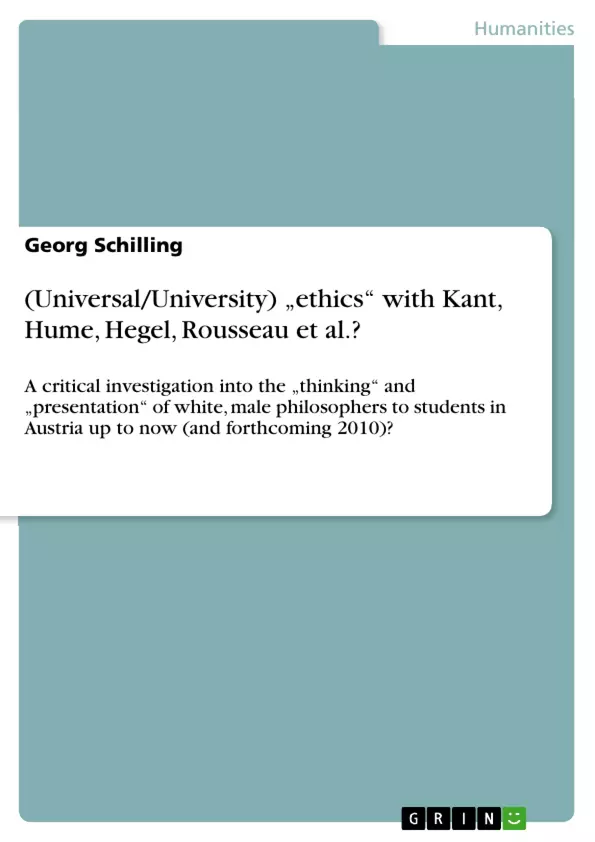
(Universal/University) „ethics“ with Kant, Hume, Hegel, Rousseau et al.?

Subtitle: A critical investigation into the „thinking“ and „presentation“ of white, male philosophers to students in Austria up to now (and forthcoming 2010)?

Textbook, 2009, 86 Pages
Author: Mag. Georg Schilling
Subject: Women Studies / Gender Studies

Details

Event: "Ich kenne Kant ..."? - "Quality" Management and Business "Ethics" with KANT et al?
Institution/College: University of Vienna (Ludwig Boltzmann Institut für Menschenrechte)
Category: Textbook
Year: 2009
Pages: 86
Language: English
Archive No.: V137703
ISBN (E-book): 978-3-640-44898-2
ISBN (Book): 978-3-640-44903-3
Notes :
Why are we basically and regularly often only informed about the positive aspects of KANT? What about his opinion towards women? What about his scientific contemporary Prof Dr Anton Wilhelm AMO? What did KANT, HUME, et al, think of Afro-americans? What was KANT's, HEGEL's, or ROUSSEAU's opinion towards the Jewish minority? Why are students of law, e.g. in Vienna, be it at the University of Vienna, be it at the Vienna university of Economics and Business Adminstration, still often only "informed" about positive sides, not any shadows of KANT, often called the "master of critical (!) thinking"?


Abstract

Why are we basically and regularly often only informed about the positive aspects of KANT? What about his opinion towards women? What about his scientific contemporary Prof Dr Anton Wilhelm AMO? What did KANT, HUME, et al, think of Afro-americans? What was KANT's, HEGEL's, or ROUSSEAU's opinion towards the Jewish minority? Why are students of law, e.g. in Vienna, be it at the University of Vienna, be it at the Vienna university of Economics and Business Adminstration, still often only "informed" about positive sides, not any shadows of KANT, often called the "master of critical (!) thinking"?


Excerpt (computer-generated)

(Universal/University) ,,ethics" with KANT,

HUME, HEGEL, ROUSSEAU et al.?

A critical investigation into the ,,thinking" and ,,presentation" of white, male

philosophers to students in Austria up to now (and forthcoming 2010)?

Aim of this work: serious, fact-bound, critical, and scientific analysis of the question

Vienna, 05.10.2009


G. Schilling ,,Ich kenne Kant..."?­,,Quality" Management & Business ,,Ethics" with KANT et al.?

Table of Contents

1 Introduction 6

2 ,,Cultural" studies, ,,ethics", and KANT!? 7

2.1 Introduction with BERNHARD, KEHLMANN, LEVINAS et al? 7

2.2 Frank STERN, ,,PINK", ,,Advanced Chemistry"? 12

2.3 Prof Dr Frank STERN, KANT, and Orhan Küçükyilmaz? 13

2.4 ,,Tenor(s)" of the study 14

3 (,,Holy"?) Bartolomé DE LAS CASAS 17

3.1 Who was DE LAS CASAS? 17

3.2 DE LAS CASAS and human rights ,,development"!? 17

4 Juan LATINO (Juan DE SESA) 18

4.1 Who was Juan LATINO ? 18

4.2 LATINO: unknown to KANT?! 18

5 Anton Wilhelm AMO 19

5.1 Who was Anton Wilhelm AMO? 19

5.2 What to learn from Anton Wilhelm AMO? 19

5.3 Anton Wilhelm AMO and ,,universities" today? 20

5.4 Anton Wilhelm AMO and his emigration? 20

5.5 AMO and the ,,Ding an sich" (noumenon)? 21

5.6 NTEP on AMO and implications? 22

5.7 AMO: unknown to KANT!? 23

6 David HUME 24

6.1 ,,Enlightening" David HUME at ,,WU WIEN"? 24

6.2 Gilles DELEUZE on HUME? 24

6.3 HAYEK and ,,unser weiser Führer" David HUME? 24

2


G. Schilling ,,Ich kenne Kant..."?­,,Quality" Management & Business ,,Ethics" with KANT et al.?

6.4 DAIRE and MOLINARI on HUME? 25

6.5 Gerhard STREMINGER on HUME? 25

6.6 DER NEUE BROCKHAUS (1959) on HUME? 26

7 Race/"Rasse"; ,,Rassengesetze"; Racism/"Rassismus" 27

7.1 Definition of ,,Rasse" with BROCKHAUS? 27

7.2 Definition of ,,Races of men" by SHAPIRO/PARSONS? 27

7.3 Definition of ,,Rasse" with BROCKHAUS? 27

7.4 Definition of ,,Rassismus" with BROCKHAUS? 28

8 KANT on ,,ethics", ,,aesthetics", and ,,race" 29

8.1 KANT on Africo-American people anno 1764 (1766)? 29

8.2 KANT on ,,Frauenzimmer" (women) anno 1766 (1764)? 31

8.3 Again: KANT on Afro-americans anno 1766 (1764)? 32

8.4 KLEIN on KANT′s ,,scharfe Beobachtungsgabe"? 32

8.5 Wolbert G. C. SMIDT on KANTs ,,Erhabenes"? 34

8.6 Patrick FRIERSON on KANTs ,,Erhabenes"? 35

8.7 Monika FIRLA on KANT and ,Zeitgeist`-fiction? 36

8.8 GRABNER-HAIDER/WEINKE on KANT? 37

8.9 VOLPI/NIDA-RÜMELIN on KANT? 38

8.10

PONGS (1976) on KANT? 39

8.11

KLOPFER (2008) on KANT and ,,Pietismus"!? 40

8.12

KANT, Afro-americans and ,,phlogiston" anno 1785? 41

8.13

(Sir) Isaiah BERLIN on KANT? 42

8.14

BERLIN on KANT`s ,,scharfer und äußerst klarer Verstand"? 43

8.15

KANT: ,,Meister der Architektonik der Vernunft"(GADAMER)? 44

8.16

WIMMER on KANT and Wilhelm Anton AMO? 44

8.17

Helmut FUCHS on KANT? 45

3


G. Schilling ,,Ich kenne Kant..."?­,,Quality" Management & Business ,,Ethics" with KANT et al.?

8.18

Christof MÜLLER on KANT? 46

8.19

Nikolaus FRANKE on KANT? 46

8.20

Anna GAMPER on KANT ? 47

8.21

Fritz SCHEBECK on KANT? 48

8.22

PERTHOLD/SPITZER/WALLNER on KANT? 49

8.23

Thomas OLECHOWSKI on KANT? 51

8.24

Gerhard LUF on KANT? 51

8.25

Again: Gerhard LUF on KANT? 54

8.26

Alexander SOMEK on KANT, HEGEL and ROUSSEAU? 54

8.27

RÜPING/JEROUSCHEK on KANT? 55

8.28

Fritz SCHEBECK on KANT? 58

8.29

PERTHOLD/SPITZER/WALLNER on KANT? 59

8.30

Thomas OLECHOWSKI on KANT? 61

8.31

Alexander SOMEK on KANT, HEGEL and ROUSSEAU? 61

8.32

RÜPING/JEROUSCHEK on KANT? 62

9 KANT on ,,Frauenzimmer" (women) 66

9.1 In the wake of a ,,mir san mir"-mentality? 66

9.2 Therese Frey STEFFEN on KANT? 66

9.3 Again: KANT on ,,Frauenzimmer" (women) anno 1766 ? 66

9.4 Again: Therese Frey STEFFEN on KANT? 68

10

HEGEL 70

10.1

RÜPING/JEROUSCHEK on HEGEL? 70

10.2

COOTER/ULEN on HEGEL? 70

10.3

Franz Martin WIMMER on HEGEL? 71

11

Karl LARENZ and the NS-regime 72

11.1

Karl LARENZ on KANT? 72

4


G. Schilling ,,Ich kenne Kant..."?­,,Quality" Management & Business ,,Ethics" with KANT et al.?

11.2

RÜPING/JEROUSCHEK on LARENZ? 73

11.3

Thomas OLECHOWSKI on LARENZ? 74

11.4

Thomas HOEREN on ,,Ur-Vater" LARENZ? 74

11.5

,,High quality" ? - FAZ, HOEREN, and ,,Ur-Vater" LARENZ? 76

12

Conclusion and ,,Outlook"? 78

13

Bibliography 79

5


G. Schilling ,,Ich kenne Kant..."?­,,Quality" Management & Business ,,Ethics" with KANT et al.?

1 Introduction

At universities, students are often presented (almost) ,,

semi-divine

" personalities, be it

KANT, be it HEGEL, be it HUME, be it other important, influencial thinkers, especially in

the field of so called ,,

ethics

". Some of these students are simply one thing: fed up with the

way of in fact almost ,,gloryfying" these people. It remains the job of at least some people to

at least partially critically (re-)thinking what and how things are presented to students.

The ,,laws" of exclusion do work; and they do work quite perfectly here in Vienna; Vienna,

a city of critically thinking men and women? Vienna, a city, in which e.g. Immanuel KANT is

(also!)

presented in a (more) critical manner

, e.g. with respect to KANT′s ,,views" e.g. on

women

, on

Afro-americans

, on

Jews

? Vienna, a city, in which also a so called ,,faculty of

law" exists in which (some!) legal philosophers ­ nothwithstanding the fact, that many of

them would in fact wish to change some ways and words of presenting e.g. KANT, HEGEL,

or ROUSSEAU to students ­ simply, contrary to a sometimes ,,

I-am-willing-to-change-

something

" ,,

rhetorics

"- do not change anything in the direction e.g. of also informing

students at least about the existence of Prof Dr Anton Wilhelm AMO, a contemporary of e.g.

Immanuel KANT, a man who had to suffer so many prejudices, who tought at universities,

nothwithstanding

racial

, (partially) hatred-filled, boastful, texts, spoken and unspoken words.

Why not mention e.g. him for instance in the Viennese ,,

Einführungsskripten

" (introductory

scripts to law) , also e.g. the script of the corresponding member of the AUSTRIAN

ACADEMY OF SCIENCES (,,ÖAW"), Univ-Prof Dr Gerhard LUF, a man also educated and

gifted in arts, a man of tremendous knowledge also in literature, a man also known about his

opinion on the former ,,Auwald-Besetzung" in the KREISKY-era, the conflicts of those days,

a personality also known for his favour of football, and: the development of (universal?)

human rights? Is there not any time to write at least one word in e.g. a script, thus not

directing (in fact, on a large scale) into a (quite) positive thinking of e.g. Immanuel KANT

stood for? Why not? Are ­ in fact: rather simply/clearly presented answers always ,,good"

answers? Cui bono? Is it probably ,,bad" for e.g.

forthcoming lawyers, civil rights activists,

journalists, public prosecutors, tax managers

(etc) not to know at least one (clear!) word

about the uncritical texts of KANT, his ,,thoughts" on women, or of MONTESQUIEU′s

opinion in ,,L′esprit de la Loi" with respect to slavery [sic!] ? Why not?

6


G. Schilling ,,Ich kenne Kant..."?­,,Quality" Management & Business ,,Ethics" with KANT et al.?

2

,,Cultural" studies, ,,ethics", and KANT!?

2.1

Introduction with BERNHARD, KEHLMANN, LEVINAS et al?

Who does not know the (even though that philosophers are often deemed to be mainly

,,

theoretists

", nonetheless mainly positively1 associated [and presented2]?) name of

,,(Immanuel) KANT", often adressed as ,,einer der größten deutschen Denker"3 [sic!]?4 Who

has not heard of (or read5) the name of ,,HEGEL"6 (, probably also in combination7 with the

(sometimes called ,,Vordenker einer idealistischen Philosophie"8) FICHTE9 and/or ­ probably

- SCHELLING10)?11 Who has never heard e.g. of NEWTON12, of ROUSSEAU13, or

1 E.g. with (KANT′s concept) of the so called ,,Kategorischer Imperativ" (categorial imperative).

2 See, for instance, REDER 2006: 54, where KANT is ­

de facto

­ presented only in a positive manner, with not

any information about sad, negative, shameful aspects; furthermore see, for instance, also KLEIN 2000: 173f.

3 See e.g. DER NEUE BROCKHAUS 1959: 63.

4 For instance in the context of KRAWIETZ (1978: 235) with respect to he so called ,,Neukantianismus"; or in a

book e.g. by Prof Dr (Leo) GABRIEL 1961: 160); or in an interesting (art and philosophy) lecture held by Prof

Dr Konrad Paul LIESSMANN, held on the basis of one of his books (LIESSMANN 1998: 47), or ­ in a

managerial context ­ e.g. in the (highly interesting) book of NEUBERGER (2002: 1f), e.g. with respect to the ­

so called

­ ,,

Führungsethik

", or in a (nonetheless: often highly interesting) book by PERNTHALER 1996: 74

and 249, or ­ with respect to e.g. HEIDEGGER ­ in a book e.g. by SAFRANSKI (1994: 219), with respect to

the so called ,,Neukantianismus" of CASSIRER; for KANT being mentioned in a novel (about HUMBOLDT et

al.) see e.g. KEHLMANN 2005: 22; or 78.

5 For instance in a book by HÖFFE (1990: 25).

6 For instance in a lecture held by Prof Dr Konrad Paul LIESSMANN with respect to one of his books

(LIESSMANN 1998: 47); or e.g. in a book by Prof Dr (Leo) GABRIEL 1961: 159; or e.g. in a book of ­ as they

call them ­ ,,Meisterdenker" (masters of thinking) by GRABNER-HAIDER/WEINKE 2004: 106-107, e.g. with

respect to a so called ,,Weltgeist" (GRABNER-HAIDER/WEINKE 2004: 106).

7 See e.g, GADAMER 1992: 289 with respect to the phrase ,,der ganzen Entwicklung des spekulativen

Idealismus von Fichte bis Hegel".

8 See e.g. GRABNER-HAIDER/WEINKE 2004: 104.

9 Interestingly, GADAMER 1992: 289 also mentions FICHTE ­ in fact ­ (basically) only with positive words

when stating about FICHTE: ,,[...] Es war vor allem Fichte, der das praktische Freiheitsbewusstsein, die

Autonomie der Vernunft, auch für den Aufbau der theoretischen Erkenntnis, der sogenannten

Wissenschaftslehre, in Anspruch nahm"; FICHTE is ­ in fact ­ also only positively presented in a book e.g. by

GRABNER-HAIDER/WEINKE 2004: 104-105.

10 With respect to SCHELLING see e.g. GRABNER-HAIDER/WEINKE 2004: 108-110, calling SCHELLING

an ,,idealistischer Denker".

11 Whereas I would cast doubt inhowfar many students or pupils have ever heard of MOSES MENDELSOHN, a

person about e.g. GRABNER-HAIDER/WEINKE 2004: 181 concede: ,,[...] Er lebte in der jüdischen

Glaubensüberzeugung und trat für Milde, Geduld, Sanftmut und Toleranz in der Ethik ein." [sic!]

12 With respect to NEWTON, KANT in KIRCHMANN 1873: 329 (also) wrote: ,,[...] N e w t o n sah zu allererst

Ordnung und Regelmässigkeit mit grosser Einfachheit verbunden, wo vor ihm Unordnung und schlimm gepaarte

Mannichfaltigkeit anzutreffen waren, uns seitdem laufen Kometen in geometrischen Bahnen."

13 With respect to ROUSSEAU, KANT in KIRCHMANN 1873: 329 (also) stated: ,,[...] R o u s s e a u

entedeckte zu allererst unter der Mannichfaltigkeit der menschlichen angenommenen Gestalten die tief

verborgene Natur des Menschen und das versteckte Gesetz nach welchem die Vorsehung durch seine

Beobachtungen gerechtfertigt wird. Vordem galt noch der Einwurf des A l p h o n s u s und M a n e s. Nach N e

w t o n und R o u s s e a u ist Gott gerechtfertigt, und nunmehr ist P o p e `s Lehrsatz wahr."

7


G. Schilling ,,Ich kenne Kant..."?­,,Quality" Management & Business ,,Ethics" with KANT et al.?

VOLTAIRE14? Who has not heard about the ­ so called ([time] period of the) ­ ,,

Deutscher15

Idealismus

"16 (, a context in which KANT (,,der große Philosoph des dt Idealismus"17) is also

mentioned)18? Who does not associate KANT19 with ,,the" ­ so called ([time] period20 of the)

­ (German21) ,,

Aufklärung

"22 (the - so called ­ ,,

Age of Enlightenment

"23), (furthermore) the

14 But: why is there not any mentioning of sad aspects (especially anti-semitic) aspects in the ­ if one could say

so ­ ,,academic" ,,philosophical" ,,narratives" ? Furthermore: why is there ­ e.g. ­ not a single footnote e.g. of

anti-semitic aspects e.g. of VOLTAIRE, when one (such as ­ e.g. ­ LINDENBERG 1992:1f) uses works of

VOLTAIRE? Why not?

15 With respect to aspects of anti-semitism of German men (e.g. see texts of the late Martin LUTHER [sic!]) see

also e.g. the HP of Professor Steven SALZMAN who also quotes some (important) pages of Lucy S.

DAWIDOWICZ` book ,,The war against the Jews 1933-1945" on his (interesting) HP

(http://members.surfbest.net/shsaltzman/Dawidowicz.html , ,,Return to syllabus", date of retrieval 27.9.2009),

whereby it may be stated that at least some aspects of DAWIDOWICZ` statements could be casted (some) doubt

on, e.g. that DAWIDOWICZ ­ at least on the quotations of the pages SALZMAN gives his readers on his HP ­

the readers are not informed, e.g. that e.g. a) the/a ,,concept" of race [sic!] (probably better: several ,,concepts" of

- so called - ,,race"?) ­ at least from the word-origin? ­ stems from the French [sic!] ,,

la race

" or e.g. b) the

,,philosopher" MONTESQUIEU (not rarely mentioned with respect to the age of Enlightenment,

DAWIDOWICZ also refers to, and, furthermore, the development of human rights) was ­ in his work (e.g.?)

,,

L′Esprit de La Loi

" in favour (!) of slavery, and e.g. c) the (Scotish) ,,philosopher" HUME was in favour of

slavery, too, at least some ­ only marginal (?) ­ aspects to be mentioned with respect to a certain ,,neo-colonial"-

approach probably also to be found in other areas of the world, not only limited to German thinkers ? [sic!] And:

is it serious and scientific to generalize, e.g. when DAWIDOWICZ is quoted with e.g. the following sentence:

,,His [sc. Christian Wilhelm von DOHM′s] work

On the Civic Betterment of the Jews

, Berlin, 1781, presented

the case for granting Jews political equality. Its basic argument was .the extraordinary notion that "the Jew is a

human being even before he is a Jew." But the idea was too radical for the [sic!] Germans.": is this generalisation

correct?

16 See e.g. LUF in HOLZLEITHNER/SOMEK 2008: 249: ,,[...] Die zeitgenössischen Diskussionen um die

Würde des Menschen bewegen sich im Wesentlichen [sic!] innerhalb [sic!] des ,,vernunftrechtlichen [sic!]

Paradigmas der Kantischen [sic!] Tradition", with a footnote (footnote 1) on HONNETH (2001: 7).

17 See e.g. PONGS 1976: 1010.

18 See e.g. PONGS 1976: 1010: ,,

Kant

, Immanuel (1724-1804): Der große Philosoph des dt. Idealismus [sic!],

der den Hochmut [sic!] der Aufklärung überwindet [sic!] und mit der Klärung der Grenzen der Erkenntnis die

Ehrfurcht vor dem Sein zurückgewinnt."

19 Might one not also associate KANT ­ to a certain extent? ­ with Konrad LORENZ, who also supported the

NS-regime? Insofar, might one not ask, why ­ e.g. ­ KREUZER (1984: 250), at least when giving a short

biographical information about Konrad LORENZ (and others) ­ does not also inform readers (especially?) about

LORENZ` NS-regime,,activities"? (With respect to a comparison between LORENZ and FICHTE see e.g. SENZ

2004: 1f).

20 It is worth to be mentioned, what e.g. SPANN 2006: 62 stated about the ,,Zeitalter der Aufklärung": ,,Das

Zeitalter der Aufklärung bekämpfte trotz des Toleranzgedankens den Fremdenhass nicht, weil für eine

weitergehende und gesellschaftliche Wahrnehmung des Fremden kein Raum bestand"[sic!]. Furthermore,

SPANN 2006: 62 writes: ,,Das Selbstbild einer vermeintlich homogenen Gemeinschaft sieht keinen Platz für die

Fremden vor". [sic!] Furthermore, could one not ask what exactly, e.g. in (the HABSBURG′s) ,,own" (?) Austria

,,Toleranz" ­ actually (!) ­ ment (or better: not meant? [sic!] e.g. for Jews, e.g. for protestants, furthermore, e.g.

for atheists? [sic!]

21 When e.g. LUF in HOLZLEITHNER/SOMEK 2008: 239 writes (also) writes the following sentence ,,[...] Die

deutsche Entwicklung, die in der politischen Philosophie Immanuel Kants und Johann Gottlieb Fichtes

wesentliche Klärungen der philosophischen Fundamente [sic!] der [sic!] Menschenrechte hervorbrachte, ist

durch eine erst allmählich sich vollziehende Umwandlung der ständischen Ordnung in eine bürgerliche

Gesellschaft mit grundrechtlichen Sicherungen charakterisiert. [...]", should one not ask a) inhowfar KANT also

thought

diametrically opposed

to what he wrote (during his life as writer (and also teacher at university, e.g. ?

[sic!]) and b) inhowfar KANT did also incorporate Afro-americans and others, such as other enslaved people, as

being granted ­ so called ­ ,,

universal

" (?) ­ human rights? What did KANT think e.g. of

Afro-americans

?

Furthermore: did KANT and FICHTE truly give ,,wesentliche [sic!] Klärungen" ,,der" ,,philosophischen

8


G. Schilling ,,Ich kenne Kant..."?­,,Quality" Management & Business ,,Ethics" with KANT et al.?

roots of the history of ideas of

human rights

(,,geistesgeschichtliche Wurzeln der

Menschenrechte"24) or probably with the Austrian writer Thomas BERNHARD25?26

But are these ­

de facto

, (,,

bei lebensnaher Betrachtung

"/according to ,,realistic reflection") -

all (almost) ,,saints" [sic!], (almost) ,,holy",

de facto

(quite) ,,

undisputable

" (!) people,

lacking27 of (harsh)

faults

, (heavy) mistakes,28 of (

strongly

) negative29, aspects to be

Fundamente"? [sic!] And, again: why does LUF not write any word about the following (unimportant?)

question: inhowfar can one ­ with respect e.g. to KANT and FICHTE ­ write about ,,die Menschenrechte" ([the]

human rights)? Were human rights universal for KANT, FICHTE (and others)? [sic!]

22 E.g. Prof Dr. OLECHOWSKI (2008: 183) writes about the philosophy of the ­ so called ­ ,,Aufklärung":

,,"Die Philosophie der Aufklärung stellte eine Absage an religiöse Weltbilder dar und nahm die Vernunft [sic!]

des [sic!] Menschen zum Ausgangspunkt." Should one not politely and critically ask: what does OLECHOWSKI

mean by ,,des Menschen"? All [sic!] human beings? Also slaves ? Were

enslaved

people, e.g. (often)

Afro-
americans

, also regarded as human beings (with open access to ­ so called (?) ­ ,,

universal

" human rights ?

[sic!]). Is the presentation of OLECHOWSKI correct and true? Is it, to a certain extent, too (probably even

,,dangerously") generalising (, in the sense that it helps to ,,

mystify

" to a certain extent the - so called ­ (Era of)

,,Enlightenment"? [sic!] And: should OLECHOWKSKI not make a (clear) distinction between ,,Aufklärung" a)

in the narrow sense of the word and b) the broader (wider) sense of the word (, as e.g. WILPERT 1969: 51 - on

the research field of literature - does)?

23 DAWIDOWICZ, quoted from her book ,,The war against the Jews 1933-1945" on the interesting HP of Prof.

Steven SALZMAN, wrote, (also) with respect tot he ­ so called ­ (age of) Enlightenment: ,,[...] Progress and

enlightenment were associated not only with the French and English, but also with Jews. Invoking the

universality of these concepts, Jews asked for emancipation, political equality."

(http://members.surfbest.net/shsaltzman/Dawidowicz.html, date of retrieval, 27.9.2009): in that, of course, no

doubt, the hope(s) with respect to this aspect of the Enlightenment, are clearly worth to be mentioned as positive,

worth to be supported, worth to be mentioned as highly, not to say, extremely, probably better: tremendously

important; especially the aspect that the - so called - ,,

Toleranz

"-,,understanding" e.g. of the ,,Austrian" Emperor

Joseph II (of [the family of] HABSBURG) did in fact restrict [sic!] the aspects supported by thoughts voiced

during the age of the Enlightenment by many Jews draws also our attention to the aspect that not everyone is told

what ­ so called - ,,

Toleranz

" did not mean (even though ­ rather strongly? ­ associated [sic!] with the

(Austrian) aspects of the Enlightenment), e.g. for Jews (or Protestants): how often are we informed about these

(sad) aspects? [sic!] (One has to go e.g. to the

Jewish Museum in Vienna

, to be informed about this aspects, if

there is an exhibition in this field (of research) as there was a few years ago.)

24 With respect to these roots whereby KANT (at least) is mentioned in the subindex of those pages of a work

where the author refers - according to the heading

,,§ 77. Die geistesgeschichtlichen Wurzeln der
Menschenrechte

") ­ to KANT, thus ­ in fact ­ (strongly?) suggesting that KANT be worth ­ after all ­ to be

mentioned in this context, see (the author) Em Prof Dr Peter PERNTHALER (1996: 261-262). (PERNTHALER

is not the only scientist who mentions KANT in this context without pointing out that KANT hat ­ in fact ­

strong and insulting words about e.g. Afro-american/African-american men and women.)

25 With respect to BERNHARD′s play ,,Immanuel Kant" and Thomas BERNHARD see e.g. MEYERHOFER

1985: 71-74.

26 With respect to the so called ,,

verzögerte Aufklärung

" (Enlightenment with a ,,time lag") in Austria, one

could refer to e.g. PRIGLINGER in BENEDIKT (1992: 31-92), although, again, there is not any word to be

found about the (harsh, strong) racist aspects of some of KANT′s writings, unfortunately.

27 In fact, when reading e.g. PONGS (1989: 78) with respect to the (key) word ,,Aufklärung" one only reads ­ in

fact ­ positive aspects e.g. about VOLTAIRE (in this context) - : ,,Voltaire wird eine Art Weltgeist der

Aufklärung (1778)", the same thing being true with e.g. HARENBERG (1997: 1050) with respect to

VOLTAIRE.

28 For instance, one will not read any (!) negative sentence about KANT′s racist texts in a book so interesting as

the one written bei SCHÖNRICH (1994: 1f); furthermore, SATTIG (1985: 11), when referring to KANT (and

also ROUSSEAU or HUME) will not voice any criticsm about KANT′s racist texts; it is also to be mentioned,

that, unfortunately, such important (and influencial) historical people such as DE LAS CASAS or LUTHER

voiced ­ de facto ­ racist thoughts during their lifetime, a fact, which is not mentioned ,,all too often". [sic!] (To

9


Comments

No comments yet

Add Comment
Your comment is reviewed before being published

Other users also were interested in the following titles:

Erstellen einer schriftlichen Hausarbeit

Author: Claudia Nickel
Presentations, Models, Tutorials, Instructions, 2006 Download as PDF-file for 4,99 EUR

Grundtechniken wissenschaftlichen Arbeitens

Author: Maik Philipp
Presentations, Models, Tutorials, Instructions, 2004 Download as PDF-file for 5,99 EUR

This text can be quoted and accessed from this url:

http://www.grin.com/e-book/137703/universal-university-ethics-with-kant-hume-hegel-rousseau-et-al
please wait Please wait