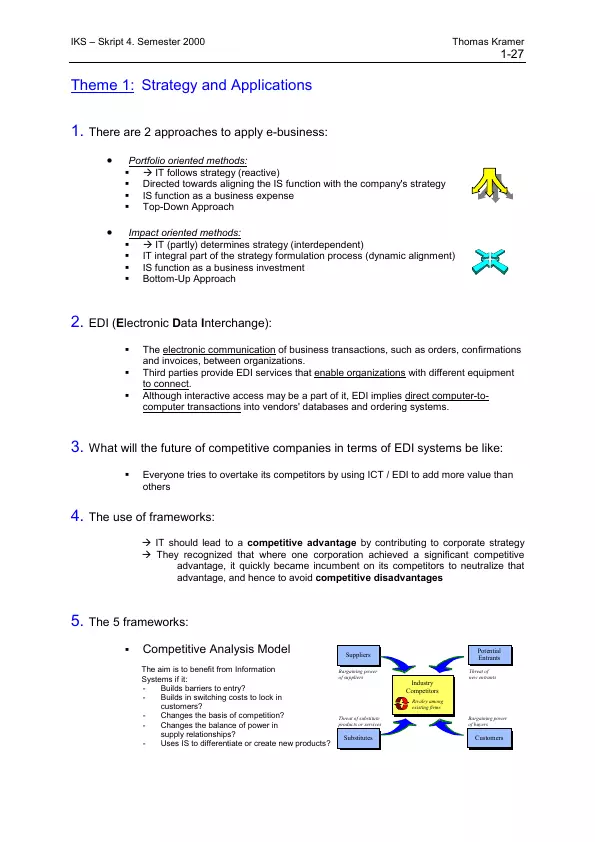
Theme 1: Strategy and Applications
1. There are 2 approaches to apply e-business:
• Portfolio oriented methods:
--> IT follows strategy (reactive)
- Directed towards aligning the IS function with the company's strategy
- IS function as a business expense
- Top-Down Approach
• Impact oriented methods:
--> IT (partly) determines strategy (interdependent)
- IT integral part of the strategy formulation process (dynamic alignment)
- IS function as a business investment
- Bottom-Up Approach
[...]
Table of Contents
Theme 1: Strategy and Applications
1. There are 2 approaches to apply e-business:
2. EDI (Electronic Data Interchange):
3. What will the future of competitive companies in terms of EDI systems be like:
4. The use of frameworks:
5. The 5 frameworks:
6. The IT advantage?
7. Critics on the frameworks
Theme 2: Business Models
8. Examples for e-commerce relationships:
9. Type of business models:
Theme 3: ICT Architecture
10. Signaling and Transmission modes:
11. Components & Networks:
12. Components & Networks:
Theme 4: Security and Authentication
Theme 5: Internet Payment Systems
Theme 6: E-Procurement
Theme 7: Supply Chain Management
Theme 8: Customer Relationship Management
Theme 9: CASE: E-Business in the Automotive Industry
Purpose and Core Topics
The primary objective of this course script is to provide a strategic and technical overview of E-Business, covering essential frameworks, architectures, security protocols, and operational models required to gain competitive advantages in modern digital environments.
- Strategic frameworks for Information Systems (IS) and competitive advantage.
- Business models including E-Commerce, E-Procurement, and Supply Chain Management.
- Technical foundations of ICT architecture, network protocols, and the OSI model.
- Security and authentication requirements, including cryptography and digital signatures.
- Payment systems and customer relationship management (CRM) strategies.
Excerpt from the Book
Value Chain Analysis (Example: Cisco Systems)
By co-ordinating linked activities, an enterprise should be able to reduce transaction costs, gather better information for control purposes, and substitute less costly operations in one activity for more costly ones elsewhere. Co-ordinating linked activities is also an important way to reduce the combined time required to perform them. Hence co-ordination is increasingly important to competitive advantage.
Porter's enterprise's value chain can be used as a framework for identifying opportunities for competitive advantage.
Competitive advantage in either cost or differentiation is a function of this chain. IT is spreading through the value chain, transforming the way value activities are performed and the nature of the linkages among them. It enables an enterprise to better coordinate its activities and thus gives it greater flexibility in deciding its breadth of activities.
Summary of Chapters
Theme 1: Strategy and Applications: This chapter introduces e-business approaches and strategic frameworks like Porter’s Five Forces, focusing on how IT enables competitive advantage.
Theme 2: Business Models: This chapter categorizes e-commerce relationships (B2B, B2C, etc.) and examines various business models such as aggregators and information products.
Theme 3: ICT Architecture: This chapter details the technical infrastructure of communication, including signal transmission modes, network components, and LAN protocols.
Theme 4: Security and Authentication: This chapter explores security requirements and cryptographic techniques, covering asymmetric and symmetric encryption as well as digital signatures.
Theme 5: Internet Payment Systems: This chapter reviews various electronic payment methods, including electronic cash, credit card standards like SET, and digital currency concepts.
Theme 6: E-Procurement: This chapter analyzes the success potentials of electronic procurement, emphasizing process improvement, time-saving, and cost-reduction.
Theme 7: Supply Chain Management: This chapter discusses SCM as a critical business issue, focusing on integrating flows of goods, information, and funds through ERP and SCM systems.
Theme 8: Customer Relationship Management: This chapter defines CRM as a combination of processes and technology to build deeper, more profitable customer relationships across the life cycle.
Theme 9: CASE: E-Business in the Automotive Industry: This chapter provides a practical case study of Autobytel.com to illustrate the transformation of industry patterns and middleman roles.
Keywords
E-Business, Strategic Management, Porter's Five Forces, EDI, Value Chain Analysis, ICT Architecture, OSI Model, Cryptography, Digital Signature, E-Procurement, Supply Chain Management, SCM, CRM, Business Models, Virtual Communities.
Frequently Asked Questions
What is the fundamental focus of this work?
This work provides an overview of how Information and Communication Technology (ICT) influences business strategy, operational processes, and the resulting competitive advantages for modern enterprises.
What are the central thematic fields covered?
The core themes include e-business strategies, e-commerce business models, network architectures, IT security, payment systems, procurement, supply chain management, and customer relationship management.
What is the primary goal of the presented frameworks?
The goal is to provide analytical tools for enterprises to leverage Information Systems (IS) effectively, enabling them to improve their cost structures, product differentiation, and industry positioning.
Which scientific methods are primarily utilized?
The text employs structural and analytical frameworks, such as Porter's Value Chain and Five Forces, combined with process modeling (EPC) and architectural analysis of ICT systems.
What topics are addressed in the main part?
The main part covers the strategic use of IT, the transition of industry business models, technical communication standards, security protocols, and operational improvements in procurement and supply chains.
Which keywords characterize the work?
Key terms include E-Business, ICT Architecture, SCM, CRM, Cryptography, and Competitive Advantage, reflecting the focus on digital transformation.
What role does the "3% Rule" play in E-Procurement?
The rule highlights that only 3% of a process's cycle time typically represents value-added activity, serving as a justification for process redesign and BPR (Business Process Reengineering).
How does the AutoByTel case study illustrate changes in the automotive industry?
The case study shows how intermediaries (like dealers) must adapt to online-enabled customer-supplier connections, demonstrating the shift from traditional physical interactions to integrated, information-driven service models.
- Quote paper
- Thomas Kramer (Author), 2000, eBusiness: Strategies, Frameworks, Business Models, Networking, Security, ePayment, eProcurement, SCM, ERP, CRM, Case Study: Channel Conflicts, Munich, GRIN Verlag, https://www.grin.com/document/1922