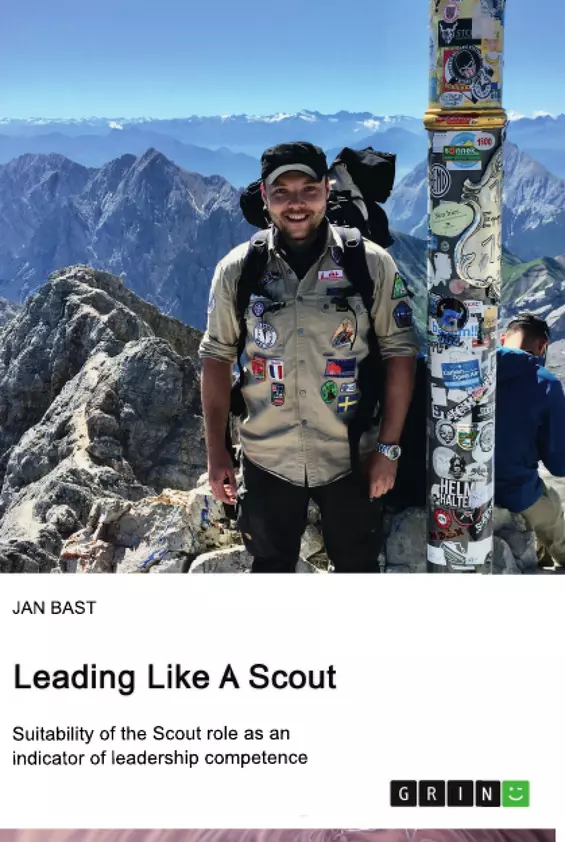
In the context of this work it is to be examined whether the role of the Scout is suitable as an indicator for guidance authority. This is considered to be confirmed if it can be shown that Scouting has a significant influence on the development of leadership competence, or rather imparts relevant competencies that enable Scouts to lead successfully. Therefore, the primary research question is derived from this: "Does Scouting influence personal leadership competence?"
As early as 2006, Handelsblatt wrote about "the managers from the campfire" and quoted the Swedish King Carl Gustaf as saying "Scouts teach leadership skills." A few years later, in April 2019, WirtschaftsWoche published a detailed article on the subject of soft skills entitled "Why scouts make good bosses." The author justifies this with a number of soft skills that a Scout acquires at a young age and during his training. These include decision-making skills, conversational skills, project management, group leadership, teamwork and leadership, and generally taking responsibility. These are all competencies that companies often impart to their employees through expensive training courses.
If this causality can be confirmed, it would be of great importance, especially for aptitude diagnostics, as it would provide a new indicator for leadership competence. While professional competence can still be demonstrated by relevant work experience in a resume, it becomes much more difficult in the area of personal, social and methodological competence.
It should also be taken into account that the demands placed on managers are constantly growing. The megatrends of globalization and digitization are increasingly changing these demands. Intercultural teams working together in different locations around the world are the norm rather than the exception these days. Changes are also taking place at ever shorter intervals due to increasing competition and growing complexity.
Through eleven expert interviews with experienced leaders and a retired federal president - who also have Scouting experience - and a qualitative content analysis, this study examines whether Scouting has an influence on personal leadership competence, which leadership competencies are influenced, and which Scouting elements have the greatest influence on leadership competence.
Table of Contents
1 Introduction
1.1 Relevance of the topic
1.2 Objective
1.3 Delimitation
1.4 Structure of the work
1.5 Note by the author
2 Theoretical part
2.1 Leadership
2.1.1 Leadership versus management
2.1.2 Leadership success
2.2 Traditional leadership theories
2.2.1 Property theories
2.2.2 Behavioural theories
2.2.3 Situational leadership theories
2.3 Modern leadership theories
2.3.1 Emotional leadership
2.3.2 Transactional leadership
2.3.3 Transformational leadership
2.3.4 Leadership approaches
2.4 Leadership competence
2.4.1 Competence models
2.4.2 Elements of leadership competence
2.5 Scouts
2.5.1 Origin and basic elements of the Scout Movement
2.5.2 Scouts today - Vision and mission
2.5.3 Principles of Scouting Education in the DPSG
2.5.4 The age groups in the DPSG
2.5.5 Understanding of leadership and training in the DPSG
2.5.6 Influence of Scout education on leadership skills
3 Applied methodology
3.1 Expert interview
3.2 Structure Tree and Interview Guide
3.3 Pre-test and practical implementation
3.4 Selection criteria of the interview partners
3.5 Definition of the categories
4 Evaluation of the findings
4.1 Influence of Scouting on leadership competence
4.1.1 Influence of Scouting on Personal Competence
4.1.2 Influence of Scouting on Social Competence
4.1.3 Influence of Scouting on Methodological Competence
4.1.4 Influence of Scouting on Professional Competence
4.2 Scouting factors influencing leadership competence
4.2.1 Scouting methodology as an influencing factor
4.2.2 Characteristics of Scouting as an Influencing Factor
4.2.3 Woodbadge training as an influencing factor
4.3 Other influences due to Scouting
4.3.1 Influence of Scouting on career entry
4.3.2 Transfer of Scouting to the corporate world
5 Discussion
5.1 Interpretation of the results
5.2 Critical reflection on one's own approach
5.3 Discussion of the quality criteria
5.3.1 Reliability
5.3.2 Validity
5.3.3 Objectivity
5.4 Overall summary of content
5.5 Outlook and further procedure
5.5.1 Implication for practice
5.5.2 Implication for further research
6 Bibliography
Research Objective and Key Themes
This Master's thesis investigates whether the role of a Scout serves as a reliable indicator of leadership competence. The core research addresses whether Scouting influences personal leadership skills and which specific elements within the Scouting framework foster these capabilities, with the aim of determining if such experiences could benefit aptitude diagnostic procedures in professional recruitment.
- The theoretical development of leadership and leadership competence models.
- An in-depth analysis of the history, mission, and pedagogical methodology of the Scout movement (specifically the DPSG).
- Qualitative expert interviews with leaders possessing Scouting backgrounds to establish empirical correlations.
- An evaluation of Scouting elements (such as "learning by doing" and Woodbadge training) as drivers for personal and social competence.
- Implications for personnel management and the transferability of Scouting experiences to corporate leadership requirements.
Excerpt from the Book
1.1 Relevance of the topic
As early as 2006, the Handelsblatt wrote about "the managers from the campfire" and quoted the Swedish King Carl Gustaf with the words "Scouts teach leadership skills". A few years later, in April 2019, WirtschaftsWoche published a detailed article on the topic of soft skills with the title "Why scouts become good bosses". In this article, the author describes in detail why, in his opinion, scouts are suitable candidates for leadership positions. He justifies this with a series of soft skills that a scout acquires at a young age and during his training. These include decision-making skills, conversation skills, project management, group leadership, teamwork and leadership, or generally taking responsibility. These are all skills that companies often teach their employees through expensive training.
"Anyone who has been in the Scouts long enough is a trained leader”, postulates former Scout Joschko Ruppersberg in this article. This success is justified by the early assumption of responsibility and the opportunity to try out many aspects in a safe environment. That this is no coincidence becomes clear with the formulation of the mission of the World Organization of the Scout Movement (WOSM). "The mission of Scouting is to contribute to the education of young people through a system of values based on the Scout Promise and the Scout Law, in order to build a better world in which people realize themselves as individuals and play a constructive role in society."
According to WOSM, Scouting offers young people the opportunity to participate in programmes, events, activities and projects that contribute to their personal development. Through these initiatives, young people are expected to become agents of positive change and inspire others to take action. By 2023, WOSM promises to become the world's largest educational youth movement, reaching over 100 million young adults.
Summary of Chapters
1 Introduction: Introduces the relevance of Scouting for leadership development and outlines the thesis objectives, research questions, and scope.
2 Theoretical part: Provides a comprehensive overview of traditional and modern leadership theories, defines leadership competence, and details the history and pedagogy of the Scout movement.
3 Applied methodology: Describes the use of expert interviews as a qualitative research method, including the structure tree and selection criteria for the interviewees.
4 Evaluation of the findings: Presents the analysis of empirical data gathered from expert interviews, categorized by their influence on personal, social, methodological, and professional competences.
5 Discussion: Interprets the research results, reflects on the methodological approach, discusses quality criteria, and offers implications for both practice and further academic research.
6 Bibliography: Lists all academic sources, literature, and online references used for the thesis.
Key Keywords
Scouting, Leadership Competence, Personnel Management, Soft Skills, Woodbadge Training, Personal Development, Social Competence, Leadership Theories, Qualitative Research, Expert Interviews, Action Competence, Teamwork, Self-Leadership, Corporate Management, Scouting Methodology
Frequently Asked Questions
What is the fundamental focus of this research?
This thesis examines the influence of Scouting experiences on an individual's leadership competence, specifically exploring whether a background in Scouting can serve as an indicator for professional leadership suitability.
What are the primary thematic fields covered in this work?
The work connects leadership theory and competence models with the practical pedagogical framework of the Scout movement, focusing on how these environments shape individual personality and skills.
What is the central research question?
The primary question asks: "Does Scouting influence personal leadership competence?" A secondary question focuses on which specific Scouting elements contribute to the development of these skills.
Which scientific methods were applied?
The research utilizes a qualitative approach, primarily relying on guided expert interviews with eleven leaders who have a background in Scouting, complemented by qualitative content analysis based on Mayring's methodology.
What does the main body of the work address?
It covers theoretical leadership foundations, an detailed historical and pedagogical review of the DPSG, the systematic evaluation of expert interviews concerning specific leadership competences, and a critical discussion of the study's quality.
Which keywords characterize this thesis?
Key terms include Leadership Competence, Scouting, Personal Development, Social Competence, Woodbadge Training, and Personnel Recruitment.
How does the "Woodbadge" training relate to leadership?
The Woodbadge course is identified as a critical factor in the development of leaders, providing a systematic approach to personality development, self-awareness, and group-dynamic leadership skills.
What practical conclusion does the author reach regarding recruitment?
The author suggests that recruiters should view Scouting experience as a positive indicator of an applicant's strong personality, social intelligence, and methodological skills, potentially serving as a competitive advantage in modern corporate environments.
- Arbeit zitieren
- Jan Bast (Autor:in), 2021, Leading like a scout. Suitability of the Scout role as an indicator of leadership competence, München, GRIN Verlag, https://www.grin.com/document/1031007