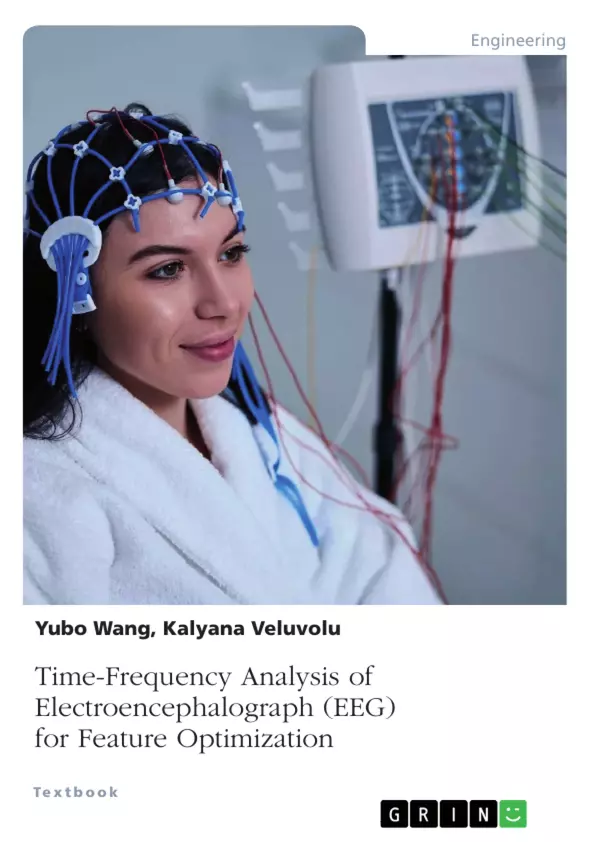
Electroencephalograph (EEG) has been widely used for BCI applications due to its non-invasiveness, ease of implementation, and cost-efficiency. The collected EEG signal is non-stationary and has task-related information buried in the frequency and temporal domains. In this book, we focused on developing time-frequency decomposition methods for improving the feature extraction module in BCI systems. The obtained features are then optimized by identifying subject-specific reactive band and employing evolutionary algorithm-based methods for optimizing the obtained features, improving the BCI systems' performance.
A signal model named as band-limited multiple Fourier linear combiner (BMFLC) is employed to model the non-stationarity in the EEG signal for feature extraction. The non-stationary amplitude oscillation is presented as adaptive weights in the model and estimated with various adaptive filters such as least-mean square (LMS), Kalman filter (KF), or Kalman Smoother (KS). The estimated coefficients serve as features for classification. Our results suggest that the BMFLC-LMS, BMFLC-KF, and BMFLC-KS are all sufficient in modeling EEG signal in the band with average estimation accuracies of 93%, 99%, and 98%, respectively. We modelled motion-induced EEG signal in frequency domain. We found that most subjects present a subject- specific reactive band during motion tasks. We then constructed features for a classifier that used only the frequency information in the subject-specific reactive band. As a result, the classification accuracy of the BCI system is improved compared to the system which uses the complete band information. Features obtained from multiple EEG channels need to be optimized to enhance the performance of the BCI systems. Essentially, two problems need to be resolved: 1) volume conduction; 2) dimensionality. The volume conduction can be mitigated if spatial filter is employed, and the dimension of the feature vector can be reduced if a feature selection procedure is adopted. An evolutionary algorithm (EA) based approach was developed to estimate spatial filter and reduce feature dimension simultaneously. We show that the BMFLC-KF combined with the evolutionary al- algorithm has the highest classification accuracy compared to other BMFLC-KF based approaches and is superior to the traditionally employed band-power methods.
Table of Contents
1 Introduction
1.1 Background
1.1.1 EEG-based Brain-computer Interface
1.2 Motivations
1.3 Contribution of the Thesis
1.4 Organization of the Thesis
2 Literature Review
2.1 EEG for BCI
2.1.1 Origin of EEG
2.1.2 Rhythmic Pattern in EEG
2.1.3 Event-related De-synchronization and Synchronization
2.2 ERD/ERS-based BCI Systems
2.3 Feature Extraction of the ERD in EEG
2.3.1 Band Power based Methods
2.3.2 Time-frequency Decomposition based Methods
2.4 Feature Optimization for BCI
3 Subject-specific Reactive Band Identification with BMFLC-LMS
3.1 Overview
3.2 Methods
3.2.1 Band-limited Multiple Fourier Combiner with Least Mean Square
3.2.2 Time-frequency Decomposition
3.2.3 Subject-specific Reactive Band Identification
3.2.4 Normalized Power Between Events
3.3 Experiment Design
3.4 Results
3.5 Discussions
3.6 Summary
4 Single Trial ERD Detection with Multiple BMFLC-LMS
4.1 Overview
4.2 Methods
4.2.1 Time-delayed Multiple BMLFC-LMS
4.2.2 Time-frequency Decomposition of Multiple BMFLCs
4.2.3 Reactive Band Identification for Single Trial EEG
4.2.4 ERD Detection in Single Trial EEG
4.2.5 Data Set
4.3 Results
4.4 Discussions
4.5 Summary
5 Time-frequency Decomposition of EEG Signal with BMFLC Kalman Filter/Smoother
5.1 Overview
5.2 Methods
5.2.1 Uncertainty Principle of Time-frequency Methods
5.2.2 State-space Model of BMFLC
5.2.3 BMFLC with Kalman Filter/Smoother
5.2.4 Data Sets
5.3 Results
5.3.1 Parameter Selection
5.3.2 Estimation Accuracy
5.3.3 Temporal and Spectral Resolution: Comparison of All Five Methods
5.3.4 Computational Complexity
5.3.5 ERD Detection
5.3.6 Performance of BMFLC-KF under Noise Condition
5.4 Discussions
5.5 Summary
6 EA-based Feature Optimization for Multi-channel EEG Classification
6.1 Overview
6.2 Methods
6.2.1 Proposed BCI Architecture
6.2.2 EA-based Spatial Filter and Feature Selection Optimization
6.3 Results
6.3.1 Experiment Settings
6.3.2 Performance of GLGA and CMA-ES-based Feature Optimization
6.3.3 Performance of the Final Classifier for All Configurations
6.4 Discussions
6.5 Summary
7 Conclusions and Future Work
7.1 Conclusions
7.2 Future Work
Objectives and Topics
This thesis aims to enhance the performance of Brain-Computer Interface (BCI) systems by developing advanced algorithms for feature extraction and feature optimization. The research specifically focuses on addressing the non-stationarity of EEG signals by implementing time-frequency decomposition methods and utilizing evolutionary algorithms to optimize feature vectors for improved classification accuracy.
- Development of Band-limited Multiple Fourier Combiner (BMFLC) methods.
- Identification of subject-specific reactive frequency bands for EEG signals.
- Implementation of adaptive filtering techniques (LMS, Kalman Filter, Kalman Smoother) for real-time BCI.
- Evolutionary algorithm-based feature optimization and spatial filtering.
- Performance comparison against traditional band-power and time-frequency analysis methods.
Excerpt from the Book
1.1 Background
Brain-computer interface (BCI) or brain-machine interface (BMI) is a collection of hardware and software systems which serves the purpose of translating measured brain activities into control commands. The output of BCI is then utilized for controlling an external device or software application [3].
Since the first brain electric activity was measured in laboratory by Hans Berger in 1938, researchers immediately started to look for methods that can utilize this brain generated signal [4]. Hans’ new finding had immense implications in gaining insight into brain functions [5] and developing new therapeutic methods for treating neurological disorders [6]. One of the most profound applications of brain electric activity measurement was the development of BCI systems in which an direct link could be established between the brain and the external world [7].
The BCI research in its earlier days focused primarily on confirming the possibility of employing ongoing brain activity to decipher thoughts or intents of humans [7–10]. Among the earlier attempts, the Brain-Computer Interface project initiated by Vadal confirmed the possibility of using human brainwave to generate meaningful control signal and also coined the term brain-computer interface that has been widely accepted by the research community [11, 12].
Summary of Chapters
Chapter 1 Introduction: Provides an overview of BCI systems, the research motivations, and the primary contributions of this thesis.
Chapter 2 Literature Review: Reviews the neuroscientific foundations of EEG and existing methodologies for feature extraction and optimization in BCI systems.
Chapter 3 Subject-specific Reactive Band Identification with BMFLC-LMS: Introduces a procedure for identifying subject-specific reactive frequency bands using the BMFLC-LMS algorithm to improve feature extraction.
Chapter 4 Single Trial ERD Detection with Multiple BMFLC-LMS: Extends the BMFLC-LMS method to real-time single-trial EEG analysis using a time-delayed scheme.
Chapter 5 Time-frequency Decomposition of EEG Signal with BMFLC Kalman Filter/Smoother: Develops Kalman filter and smoother-based BMFLC models to enhance real-time spectral estimation and ERD detection accuracy.
Chapter 6 EA-based Feature Optimization for Multi-channel EEG Classification: Presents evolutionary algorithm-based techniques to perform simultaneous spatial filtering and feature selection for improved classification performance.
Chapter 7 Conclusions and Future Work: Summarizes the key research findings and outlines potential future research directions for BCI technology.
Keywords
Brain-Computer Interface, BCI, EEG, Feature Extraction, Feature Optimization, Time-Frequency Analysis, BMFLC, Kalman Filter, Evolutionary Algorithms, CMA-ES, ERD/ERS, Signal Processing, Spatial Filtering, Classification Accuracy.
Frequently Asked Questions
What is the core purpose of this research?
The core purpose is to improve the performance of EEG-based BCI systems by developing more accurate time-frequency decomposition methods and optimizing feature extraction/selection through evolutionary algorithms.
What are the primary challenges addressed by this work?
The research addresses the non-stationarity of EEG signals, the need for improved feature dimensionality reduction, and the requirement for real-time computational efficiency in BCI feature processing.
What is the central research question?
The central question involves how to accurately identify subject-specific reactive frequency bands and optimize feature vectors to maximize classification accuracy in BCI systems.
Which specific scientific methodologies are utilized?
The work utilizes the Band-limited Multiple Fourier Combiner (BMFLC) model combined with adaptive filters (LMS, Kalman Filter/Smoother) and metaheuristic optimization strategies like Evolutionary Algorithms (CMA-ES and GLGA).
What does the main body of the thesis cover?
The main body focuses on developing BMFLC-based feature extraction for both motion execution and imagery, identifying subject-specific reactive bands, and implementing EA-based optimization to refine feature sets for classification.
Which keywords define this research?
Key terms include Brain-Computer Interface (BCI), EEG signal processing, time-frequency decomposition, BMFLC, evolutionary optimization, and classification accuracy.
How does BMFLC differ from traditional band-power methods?
BMFLC provides a parametric model capable of tracking time-varying frequency components with better spectral resolution and adaptive capability compared to fixed band-pass filtering.
Why are Kalman filters applied to the BMFLC model?
Kalman filters are implemented to improve state-space estimation accuracy, reduce transient adaptation time, and provide more robust spectral tracking for real-time BCI applications.
- Quote paper
- Kalyana Veluvolu (Author), Yubo Wang (Author), 2017, Time-Frequency Analysis of Electroencephalograph (EEG) for Feature Optimization, Munich, GRIN Verlag, https://www.grin.com/document/1168520