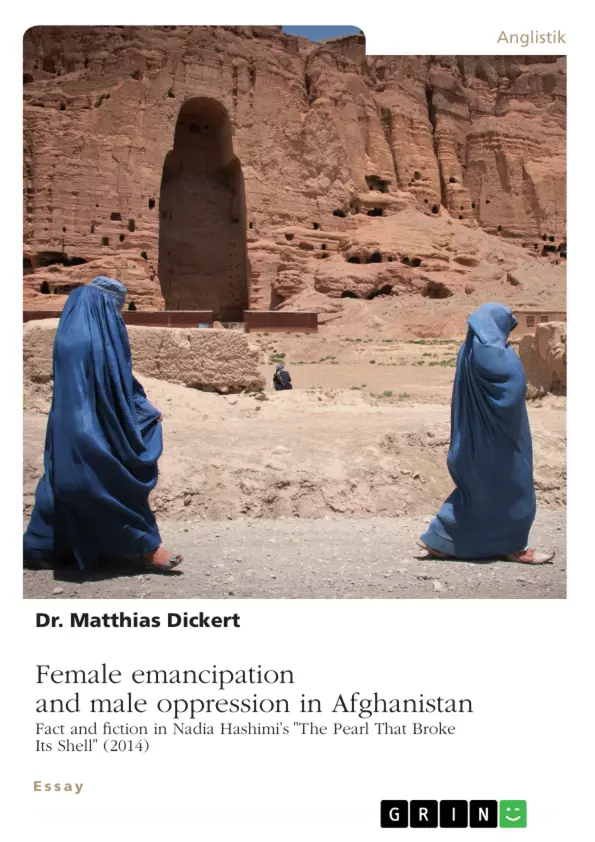
The manifold reflections of loss of home or migration are complex in the displacement histories and narratives because they contain difficult, untraceable journeys and experiences of immigrants and refugees involved. At present, this also concerns the largest religious community linked to massive migration movements worldwide – Muslims. Most Muslim immigrants coming to Europe, Canada or the United States carry their national, cultural, religious and above all their personal past which taken together create an ideal basis for narrating their stories.
Things are worse in their own way when people at present cannot leave Afghanistan after the Taliban came back into power in 2021. Most Afghan people trying to escape from their mother country carry classical colonial or postcolonial topics such as matters of loss, expulsion, displacement, border crossing, exile, diaspora and home. These are – as in the case with female characters – often linked to intolerance, gender injustice or the inferior role of women in the Muslim world, which at present can be seen in the ongoing protests against the Mullah regime in Iran as well.
Nadia Hashimi's novel "The Pearl That Broke Its Shell" (2014) is set against a different background, reflecting the necessity to stay in Afghanistan against a Sharia background. The narration centers around (among other women) two female characters named Shekiba and Rahima. Both are family members of different time periods whose female role and struggle is set against Afghanistan's historic, cultural and religious background. The novel in parts can be seen as a literay addition to Khaled Hossein's "The Kite Runner" (2003) or Nadeem Aslam's "The Wasted Vigil" (2008) since both novelists also place their characters into an Afghan background.
Table of Contents
1. Introductionary notes
2. A short survery of the historical background of Afghanistan as one key to understand
3. The position of women in radical Islam and the practice of `Bacha Posh`
4. Female Muslim writing – a survey
5. A Feminist Interpretation
6. Conclusion
7. References
Objectives & Core Themes
This essay explores the complex intersection of gender, culture, and power in Afghanistan as portrayed in Nadia Hashimi's novel "The Pearl That Broke Its Shell" (2014), analyzing how the protagonist's struggle against patriarchal structures reflects the broader historical and psychological pressures faced by women in Afghan society.
- The practice of "Bacha Posh" as a mechanism for both female empowerment and systemic objectification.
- The role of patriarchal interpretations of Islam in institutionalizing female subordination.
- Comparison of female existence and resistance across different historical periods in Afghanistan.
- The function of literature as a tool for political and social advocacy in migrant and post-colonial contexts.
- The interplay between personal identity-making and the traumatic history of a nation defined by migration and war.
Excerpt from the Book
The position of women in radical Islam and the practice of `Bacha Posh`
To better runderstand Hashimi`s presentation of women in her main characters it seems necessary to reflect the traditional concept of women in Islam and its radical interpretation of the Sharia which the Taliban represent. The Taliban interpretation of the Sharia must be regarded as a fundamental concept of Islam which can be related to the term puritan since they regard their concept of Islam as basic and original just as the mullahs in Iran. In both countries religious leaders regard women as inferior to man an old fashioned notion of male and female which is opposed to emancipation and an equal status of both sexes.
Basically speaking this religious intolerance is opposed to the classical role of women as part of the religious community the ummah. In fact religious fundamentalists criticise and fight all religious arguments aiming at honouring women and their role in Islam as parts of Western influence and decadence. Male dominance hereby follows as a logical consequence, religiously, socially and politically.
Thus the negative treatment of women is in fact practised from these sides and is glued together by the West as the main enemy.
In Islam there is one term which sums up the above mentioned puritan attitude toward women: fitna. Fitna itself is a vast term that contains many connotations, all of which are decidedly negative. Fitna means sexual enticement, a source of danger, civic and social discord, a sense of instability and impending evil. Although radicals and puritans often praise and celebrate the role of women as mothers, in every other role women are portrayed as deficient and subservant. Therefore, as a wife she is completely under the tutelage of her husband; as a daughter, she is under the tutelage of her father; as a member of society, she is under the tutelage of all men. She is never an independent and autonomous person who shares in equal measure the obligation of fulfilling the Divine covenant with Allah.
Summary of Chapters
1. Introductionary notes: This chapter highlights the historical and geopolitical turmoil of Afghanistan and introduces the role of migrant fiction in reflecting personal and national trauma.
2. A short survery of the historical background of Afghanistan as one key to understand: This section details the country's ethnic, linguistic, and religious divisions and the subsequent rise of radical fundamentalism and its impact on women.
3. The position of women in radical Islam and the practice of `Bacha Posh`: This chapter examines the ideological origins of female subordination in Sharia law and analyzes the traditional practice of disguising young girls as boys.
4. Female Muslim writing – a survey: This part situates the novel within the landscape of contemporary Muslim women's literature and discusses how these writers leverage their work to challenge patriarchal paradigms.
5. A Feminist Interpretation: This chapter provides a critical reading of the main characters' struggle for survival, interpreting their challenges as both personal journeys and reflections of systemic, patriarchal exploitation.
6. Conclusion: This summary synthesizes the novel's feminist undertones, emphasizing that despite the trauma of displacement and oppression, the characters embody a push toward self-realization.
7. References: This list provides the scholarly sources and secondary literature used to construct the essay's arguments.
Keywords
Afghanistan, Bacha Posh, Female Emancipation, Patriarchal Exploitation, Islamic Fundamentalism, Gender Intersectionality, Migration, Transnational Literature, Sharia, Identity, Power Dynamics, Subaltern, Domestic Violence, Hybridity, Nadia Hashimi.
Frequently Asked Questions
What is the primary focus of this academic essay?
The essay critically analyzes Nadia Hashimi's 2014 novel "The Pearl That Broke Its Shell" to explore the intersection of gender oppression, traditional customs like "Bacha Posh," and the persistent struggle for female identity within the patriarchal framework of Afghanistan.
What are the core thematic pillars addressed in the text?
The key themes include the socio-religious impact of radical Islam on women, the role of physical and psychological violence as tools of control, the power of literature to bypass censorship, and the juxtaposition of ancient tradition with modern struggles for rights.
What is the central research question guiding the analysis?
The essay explores how Hashimi’s female characters navigate and resist a male-dominated society, specifically examining how their personal efforts to break free symbolize a broader movement toward emancipation.
Which scientific or analytical framework does the author apply?
The author uses a literary-sociological approach, drawing on post-colonial studies, feminist critique, and migration theory to evaluate the text's representation of Afghan societal structures.
How is the novel's main section structured?
The core analysis revolves around the lived experiences of the two female protagonists across different time periods, contrasting their individual struggles with the historical and political backdrop of Afghanistan.
Which keywords best characterize the discourse of this work?
The discourse is characterized by terms such as "patriarchy," "Bacha Posh," "subalternity," "Islamic fundamentalism," and "female emancipation."
How does the author interpret the significance of the "Bacha Posh" tradition?
The author argues that "Bacha Posh" is a dual-edged sword: it offers a temporary, survival-driven escape from systemic limitation, but also risks causing deep psychological trauma and eventual reintegration into a submissive female role.
How does the novel portray the relationship between "nation" and "female bodies"?
The essay explains that the novel draws a direct parallel between the war-torn, victimized state of Afghanistan and the subjugated experiences of its women; both are subjected to control by external and internal patriarchal forces.
- Quote paper
- Dr. Matthias Dickert (Author), 2023, Female emancipation and male oppression in Afghanistan. Fact and fiction in Nadia Hashimi's "The Pearl That Broke Its Shell" (2014), Munich, GRIN Verlag, https://www.grin.com/document/1351677