
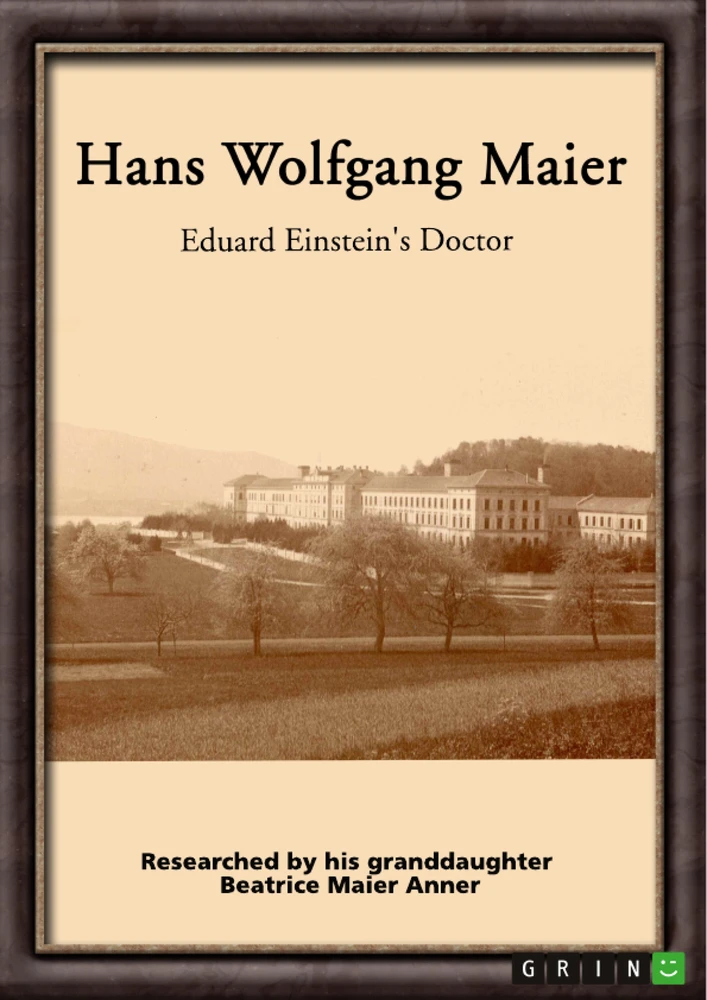
Hans Wolfgang Maier was born in Frankfurt in 1882 as the youngest of three sons of Gustav and Regina Maier-Friedlaender. In 1892, the family moved to Switzerland, mainly to escape the professional barriers erected for Jews in Germany, who were not allowed to work in public service. There, Gustav Maier declared Judaism a family secret and joined the liberal reformed Zwingli church with his family; he retired from banking and became a writer, ethicist, and pacifist. In fall 1895, the 16-year-old Albert Einstein was a guest at the Maier home in Zurich and Gustav assisted the gifted young man to be accepted at the Federal Polytechnical School, ETH to study physics (see the book Gustav Maier. Sponsor of the young Albert Einstein, published by the same author). Hence, since 1895 Hans was acquainted with Albert Einstein; 38 years later, Albert's son Eduard, a brilliant medical student, started having mental problems and became the patient of Hans, who had become director of the Psychiatric University Clinic at Zurich, the "Burghölzli". This book illustrates the life of the psychiatrist Hans Wolfgang Maier and his family with documents and images from a private Maier family archive.
More information about the history of the Maier, Meierhofer and Anner families can be found on this website: https://www.themaierannerfiles.ch/
Table of Contents
1 GOETHEPLATZ IN FRANKFURT AM MAIN
2 ERMATINGEN ON LAKE CONSTANCE
3 HANS WOLFGANG MEETS ALBERT EINSTEIN
4 AT HOME IN THE BURGHÖLZLI
5 HW MAIER PROTECTS EDUARD EINSTEIN
6 KRISTALLNACHT 1938
7 FAREWELL
Objectives and Topics
This book investigates the life and professional career of Hans Wolfgang Maier, a psychiatrist and long-term director of the Burghölzli clinic, while contextualizing his biography within his family history and his involvement with prominent figures like Albert Einstein and his son Eduard Einstein.
- Family history of the Maier-Friedlaender lineage
- Hans Wolfgang Maier's psychiatric career and leadership at Burghölzli
- Biographical connections between the Maier and Einstein families
- The impact of political persecution and the "Maier Affair" scandal
- Resistance activities and the rescue of relatives from Nazi-controlled regions
Excerpt from the Book
CLEMENTINE MARX'S INTRIGUE TO LURE HER NEPHEW RUDOLF MOOS, A BANK APPRENTICE TO GUSTAV MAIER, BACK TO ULM.
The Koch, Einstein, Moos, Marx, Maier, and others of the Jewish community of Ulm around 1870 were also friends outside the synagogue, mostly kept in touch for life, and supported each other in typical Jewish family solidarity. So it is no coincidence that the young Rudolf Moos (1866-1951), the son of Heinrich Moos and his wife, née Karoline Einstein, completed a banking apprenticeship with Gustav Maier, director of the Deutsche Handelsgesellschaft Frankfurt, from 1881.
The autobiography of Rudolf Moos was published in English by his son Rudolf Hugo Moos21. From page 97 we can read how Gustav Maier, a Jew from Ulm, came to work in a bank in Frankfurt: In the summer of 1881, there were extensive family discussions about what Rudolf Moos should do after he had completed his military service. Then, suddenly, there was a new development. The head of the Reichsbank branch in Ulm, Gustav Maier, was transferred to Frankfurt for better reasons. The large stock exchange company there, Deutsche Handelsgesellschaft, had run into financial difficulties because of the director's misplaced speculation. A new director was sought and Gustav Maier was asked to take over the position and offered the young Rudolf Moos to take him with him as his apprentice.
So it was decided that Rudolf Moos would move to Frankfurt at the beginning of October 1881 and begin his commercial training as a bank apprentice. Father Moos traveled with his son to Frankfurt and took him with him to Goetheplatz, where the Deutsche Handelsgesellschaft had its rather pompous building. The bank itself was located on the first floor and Director Maier lived on the second floor. They were both warmly welcomed by Maier. He showed Father Moos all the offices, introduced him to all the employees and proudly pointed out the many departments in the large company.
Summary of Chapters
1 GOETHEPLATZ IN FRANKFURT AM MAIN: This chapter covers the relocation of Gustav Maier to Frankfurt to direct the Deutsche Handelsgesellschaft and details the early family environment.
2 ERMATINGEN ON LAKE CONSTANCE: Describes the family's acquisition of Villa Breitenstein and the ancestral history of the Friedlaender family.
3 HANS WOLFGANG MEETS ALBERT EINSTEIN: Details the arrival of the young Albert Einstein in Zurich and the support he received from the Maier family.
4 AT HOME IN THE BURGHÖLZLI: Focuses on the life of the Maier family within the Psychiatrische Universitätsklinik Burghölzli during Hans Wolfgang Maier's tenure.
5 HW MAIER PROTECTS EDUARD EINSTEIN: Examines the clinical relationship and professional care provided by HW Maier to Einstein's son, Eduard.
6 KRISTALLNACHT 1938: Documents the persecution of the family, particularly the rescue of Max Friedlaender during the surge of Nazi anti-Semitism.
7 FAREWELL: Concludes with the circumstances surrounding HW Maier's resignation and the staff's reactions to his departure.
Keywords
Hans Wolfgang Maier, Gustav Maier, Burghölzli, Albert Einstein, Eduard Einstein, Psychiatry, Jewish History, Villa Breitenstein, Anti-Semitism, Nazi Persecution, Exile, Resistance, Cocainism, Family Archive, Zurich
Frequently Asked Questions
What is the core focus of this work?
The book provides a biographical account of Hans Wolfgang Maier, highlighting his medical career at Burghölzli and his deep-seated connections to the Einstein family and his own family's history.
What are the primary thematic fields?
The themes include the professional medical life of a 20th-century psychiatrist, the personal and political tragedies affected by Nazi persecution, and the documentation of family resilience and Jewish history.
What is the primary objective of the author?
Beatrice Maier Anner aims to restore the historical reputation of her grandfather, Hans Wolfgang Maier, and document his life against the backdrop of the "Maier Affair" and Nazi-era pressures.
Which scientific methodology is primarily applied?
The author uses a historical-biographical approach, relying on private family archives, personal letters, certificates, and historical documents to corroborate the events described.
What does the main body analyze?
The body analyzes the development of the Maier family, Hans W. Maier's professional achievements in psychiatry, and his role in supporting individuals like Albert and Eduard Einstein, as well as relatives fleeing Nazi Germany.
What are the key terms associated with this study?
Key terms include psychiatric medicine, historical biography, anti-semitic persecution, familial legacy, and the Einstein-Maier relationship.
How did the political situation influence Hans W. Maier's career?
Political pressure and anti-Semitic sentiment in Switzerland during the Nazi era led to a smear campaign against Maier, ultimately forcing his resignation from the directorship of the Burghölzli in 1941.
What was the nature of the "Maier Affair"?
It was a media-driven scandal involving allegations of sexual misconduct meant to damage Maier's reputation, which research now views as a form of vigilante justice during a period of rising Nazi influence.
- Quote paper
- Beatrice Maier Anner (Author), 2023, Hans Wolfgang Maier. Eduard Einstein's Doctor, Munich, GRIN Verlag, https://www.grin.com/document/1418675

