The following term paper deals with Leech’s Politeness Principle and the Maxims of Politeness, especially with its appliance on children’s books.
I think it is a quite interesting theme to analyse children’s books according to politeness.
At a first step I would like to show the coherence between the Politeness Principle and Gricean’s Cooperative Principle, and to show problems with the CP.
Next I want to give a short overview about positive and negative politeness and about the Politeness Principle itself. After that I would like to point out the six main maxims: Tact Maxim, Generosity Maxim, Approbation Maxim, Modesty Maxim, Agreement Maxim, and Sympathy Maxim. Further I also want to give a short overview about the Miscellaneous Principles: Consideration, Irony and Banter.
After explaining the maxims I would like to find examples, where these maxims are broken. The resource for these examples is Lewis Carroll’s book Alice’s Adventures in Wonderland.
In a last step I want to give a short summary about how analysing the book functioned and whether Leech’s Maxims can be adapt to children’s books.
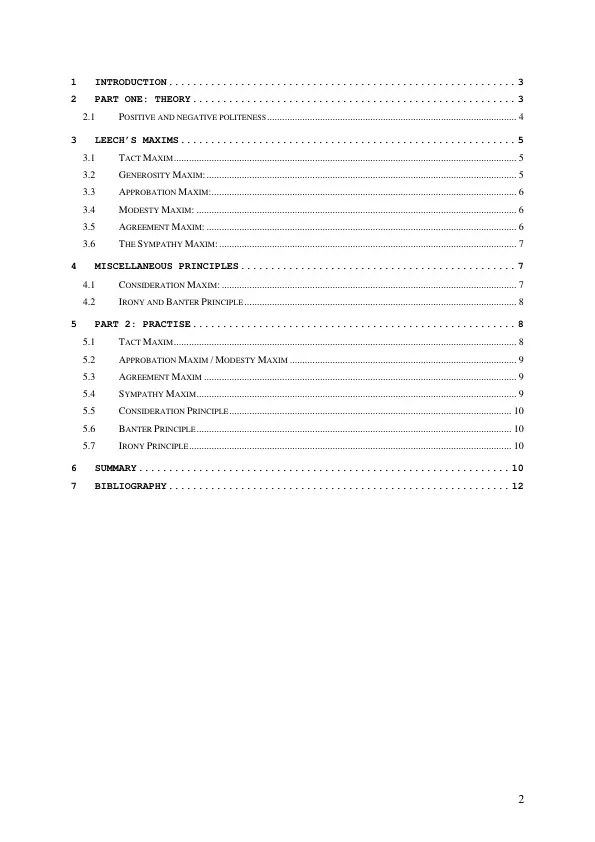
Table of Contents
1 INTRODUCTION
2 PART ONE: THEORY
2.1 POSITIVE AND NEGATIVE POLITENESS
3 LEECH’S MAXIMS
3.1 TACT MAXIM
3.2 GENEROSITY MAXIM:
3.3 APPROBATION MAXIM:
3.4 MODESTY MAXIM:
3.5 AGREEMENT MAXIM:
3.6 THE SYMPATHY MAXIM:
4 MISCELLANEOUS PRINCIPLES
4.1 CONSIDERATION MAXIM:
4.2 IRONY AND BANTER PRINCIPLE
5 PART 2: PRACTISE
5.1 TACT MAXIM
5.2 APPROBATION MAXIM / MODESTY MAXIM
5.3 AGREEMENT MAXIM
5.4 SYMPATHY MAXIM
5.5 CONSIDERATION PRINCIPLE
5.6 BANTER PRINCIPLE
5.7 IRONY PRINCIPLE
6 SUMMARY
7 BIBLIOGRAPHY
Research Objectives and Themes
This paper examines Leech's Politeness Principle and its constituent maxims, focusing on their application and violation within the literary context of children's literature, specifically Lewis Carroll's "Alice's Adventures in Wonderland."
- Theoretical exploration of Grice's Cooperative Principle versus Leech's Politeness Principle.
- Detailed categorization of the six main maxims and miscellaneous principles of politeness.
- Practical analysis of conversational exchanges in "Alice's Adventures in Wonderland."
- Critical evaluation of the universality of politeness maxims in cross-cultural communication.
Excerpt from the Book
3.1 Tact Maxim
The Tact Maxim is oriented towards the hearer. There are positive and negative sub-maxims. The main statement is: Minimize cost to the hearer and Maximize benefit to the hearer (Leech 1983: 108). An example for the maxim would be the following:
(c) Lend me your wife
(d) Have another sandwich
In this examples the linguistic form of the impositive is not going to effect the real cost or benefit to the hearer. Example (c) fouls the Tact Maxim, and is extremely impolite. Example (d) seems to break the Tact Maxim too, but it is not meant like this.
Chapter Summaries
1 INTRODUCTION: Outlines the scope of the paper, focusing on the application of Leech's Politeness Principle to children's literature.
2 PART ONE: THEORY: Discusses the relationship between Grice's Cooperative Principle and the need for a separate Politeness Principle.
3 LEECH’S MAXIMS: Provides a formal definition and breakdown of the six core maxims of politeness proposed by Leech.
4 MISCELLANEOUS PRINCIPLES: Introduces additional rhetorical principles, specifically Consideration, Irony, and Banter.
5 PART 2: PRACTISE: Applies the theoretical maxims to dialogues found in Lewis Carroll’s "Alice’s Adventures in Wonderland."
6 SUMMARY: Concludes that while the maxims provide a useful framework, they are not universally fixed rules for all conversations.
7 BIBLIOGRAPHY: Lists the academic resources utilized for the linguistic analysis.
Keywords
Politeness Principle, Leech's Maxims, Tact Maxim, Generosity Maxim, Approbation Maxim, Modesty Maxim, Agreement Maxim, Sympathy Maxim, Alice's Adventures in Wonderland, Pragmatics, Cooperative Principle, Linguistic Politeness, Irony, Banter, Communication.
Frequently Asked Questions
What is the fundamental focus of this paper?
The paper examines the application and violation of Leech's Politeness Principle within the narrative dialogues of children's literature.
What are the primary theoretical themes covered?
The paper focuses on the definition of politeness, the distinction between "rule-governed" semantics and "principle-controlled" pragmatics, and the specific maxims Leech proposes.
What is the main objective of the author?
The goal is to demonstrate how Leech's maxims function in practice by identifying where characters in "Alice's Adventures in Wonderland" break these rules.
Which scientific methodology is utilized?
The paper uses qualitative linguistic analysis, comparing theoretical pragmatic models against specific textual evidence from a literary source.
What topics are explored in the main body?
The main body covers the theoretical foundation of maxims like Tact, Generosity, and Approbation, followed by a practical analysis of character interactions in Carroll's work.
How would you describe the key characteristics of this research?
It is an introductory pragmatic study that bridges abstract politeness theory with practical literary application.
How does the author view the relationship between the Tact and Generosity maxims?
The author notes that they function in parallel with reversed effects, making it often unnecessary to strictly distinguish between the "other-centred" Tact maxim and the "self-centred" Generosity maxim in practice.
Why is the "Banter Principle" considered a unique case in the study?
The Banter Principle is described as an "offensive way of being friendly," which relies on a pre-existing strong relationship between speakers where traditional politeness is suspended.
What conclusion does the author reach regarding the universality of these maxims?
The author concludes that politeness is not a fixed, universal rule but varies across cultures, meaning the maxims are useful guides rather than absolute guarantees of polite behavior.
- Quote paper
- Annika Schario (Author), 2008, Politeness Principle, Munich, GRIN Verlag, https://www.grin.com/document/150093