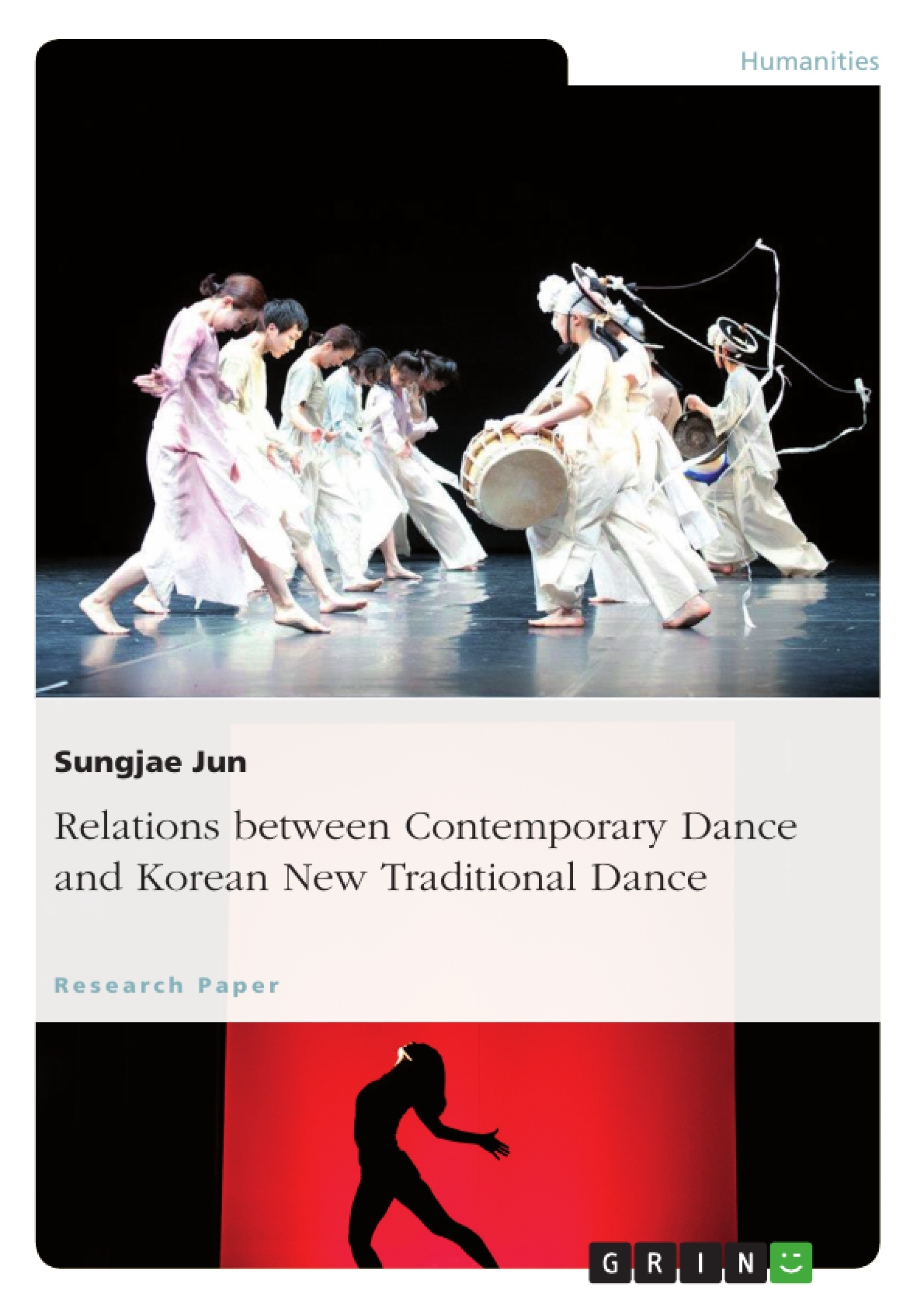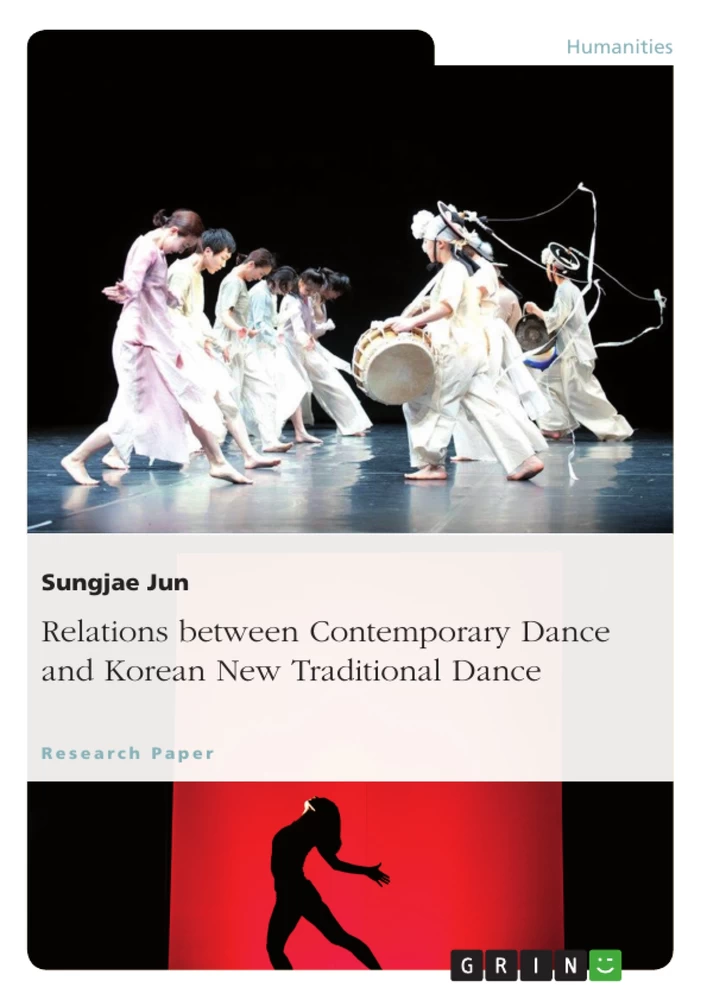
Have you ever asked yourself, which relations there are between Korean New Traditional Dance and Contemporary Dance?
Traveling all around the world, people are watching me with big eyes as soon as I speak about my dance career. Many of them, even artists, ask me, which are the relations between Contemporary Dance and Korean New Traditional Dance.
There is always a question mark on the face of people, when I try to explain that the Korean Dance, for example Korean Ballet or Korean Modern Dance, are related to Contemporary Dance. It is difficult for them to understand the subject at first. For many people, regard to the content of the Contemporary Dance is either an abstract subject or only an American art of Dance.
With this small contribution I want to show the importance of Korean Dance generally and its relations to worldwide Dance. This book should even show the similarities between Korean New Traditional Dance and Contemporary Dance today. It is supposed to give answers to all my friends and colleges, who ask themselves: what are the differences and similarities of these dances?
[The author is no native speaker.]
Table of Contents
INTRODUCTION
CHAPTER 1: KOREAN TRADITIONAL DANCE
I. PERFORMING ART
II. DANCE STORY IN KOREA
III. TYPES OF KOREAN DANCE
1. COURT DANCE 정재
2. FOLK DANCE 민속무용
3. RITUAL DANCE 의식무용
4. NEW TRADITIONAL DANCE 신무용
CHAPTER 2: CONTEMPORARY DANCE
I. DEFINITION OF DANCE
II. THE PHILOSOPHY OF DANCE
III. THINKING OF DANCE
IV. DANCE STORY IN ANCIENT
V. PERFORMANCE AND PARTICIPATION
VI. CONTEMPORARY DANCE
VII. MODERN DANCE
CHAPTER 3: THE RELATION BETWEEN CONTEMPORARY DANCE AND KOREAN NEW TRADITIONAL DANCE
Objectives and Themes
The primary objective of this work is to explore the historical and artistic intersections between Korean New Traditional Dance and Contemporary Dance, addressing the question of how these two distinct forms are related and influenced by global cultural exchange.
- Evolution of Korean Traditional Dance from shamanistic roots to modern expressions.
- The role of key figures like Choi Seoung Hee in the development of New Traditional Dance.
- Comparative analysis of Contemporary Dance philosophy and movement patterns.
- The impact of globalization and cross-cultural influences on dance development.
- The interconnectedness of various dance genres in the 20th and 21st centuries.
Excerpt from the Book
1. Court Dance 정재
Every one knows Korean Dance, will know even Court Dance of Korea. This traditional Old Korean Dance is today practicing in many different countries from Korean community all around the world. In Switzerland, in one of the small countries the world, are the smallest Korean community interested in a court dance. Even here in the church and Korean Festivals is Court Dance an important part of transferred and shown Korean culture. The court dances is called "Jeongjae" (hangul:정재, hanja:呈才) which originally referred to "display of all talent" including not only dance but also other performing arts such as Jultagi 줄타기, Gong deonjigi 공던지기, and Mokmatagi 목마타기 but gradually only denoted "court dance". The term has been used since the early period of Joseon 조선 dynasty.
Jeongjae 정재 were used to perform for the royal family, court officials, and foreign envoys or for festive occasions sponsored by the state. Jeongjae is divided into the two categories, "Dangak Jeongjae" 당악정재 and "Hyangak Jeongjae" 향악정재. Dangak Jeongjae are dances derived from court dances of Tang China during the Goryeo 고려 dynasty, whereas the other consists of newer court dances originated in Korea.
Summary of Chapters
CHAPTER 1: KOREAN TRADITIONAL DANCE: This chapter provides an overview of the origins and historical development of Korean dance, distinguishing between court, folk, ritual, and the emergence of New Traditional Dance.
CHAPTER 2: CONTEMPORARY DANCE: This chapter examines the definition and philosophy of Contemporary Dance, its connection to Modern Dance history, and its evolution as a global performance art.
CHAPTER 3: THE RELATION BETWEEN CONTEMPORARY DANCE AND KOREAN NEW TRADITIONAL DANCE: This chapter synthesizes the previous discussions to argue that both dance forms share a common path of evolution influenced by global cultural globalization and specific historical figures like Choi Seoung Hee.
Keywords
Korean Traditional Dance, New Traditional Dance, Contemporary Dance, Modern Dance, Choi Seoung Hee, Jeongjae, Shamanism, Butoh, Globalization, Choreography, Performance, Cultural Influence, Performing Arts, Dance History, Movement.
Frequently Asked Questions
What is the core subject of this book?
The book investigates the relationship between Korean New Traditional Dance and Contemporary Dance, exploring how they are interconnected through history and cross-cultural exchange.
What are the primary thematic fields covered?
The text focuses on the history of Korean traditional performing arts, the evolution of contemporary dance philosophy, and the influence of globalization on artistic movement.
What is the main research hypothesis?
The author hypothesizes that there are significant, traceable relations between Contemporary Dance and Korean New Traditional Dance, both of which developed or modernized significantly during the 20th century.
Which scientific methodology is utilized?
The work employs a comparative and descriptive approach, analyzing dance definitions, historical development, and the impact of key cultural figures on the evolution of dance forms.
What topics are discussed in the main body?
The main body covers the categorization of Korean traditional dance (court, folk, ritual), the philosophy of contemporary dance, and an analysis of how these forms overlap and influence one another.
How would you characterize this work through keywords?
The work is defined by terms such as Korean Traditional Dance, Contemporary Dance, Cultural Exchange, Choi Seoung Hee, and Dance Evolution.
Who was Choi Seoung Hee?
Choi Seoung Hee was a legendary Korean dancer who studied in Japan and is credited with creating the New Traditional Dance, acting as a crucial bridge between traditional Korean roots and modern dance influences.
Why is the "direction of fit" mentioned in the context of dance?
The author uses this metaphor to illuminate the difference between belief and desire, reflecting on how dance can serve as a form of philosophical reflection and cognitive ambition.
- Arbeit zitieren
- Sungjae Jun (Autor:in), 2015, Relations between Contemporary Dance and Korean New Traditional Dance, München, GRIN Verlag, https://www.grin.com/document/302294