The principal aim of this assignment is to work out an overview of the application of English in non-English firms.
For this purpose, the motives of those parties who are involved in the process and the companies´ main objectives, challenges and benefits of using English as a corporate language, are taken into account.
The intentions for using English as a corporate language are manifold. However, the three following purposes are the most obvious ones. Thus they are to be examined closely: firstly, the prospect of better business conducts, secondly, the need of enhancing collaboration performance and thirdly, the requirement of staying competitive in an increasingly global market.
The assessment, of whether these objectives can be generally achieved by conducting English as a corporate language, will be given in the concluding section.
Since the beginning of the 21st century, English has become increasingly popular with the business world.
This originates from the widespread use of English in the British colonies and the influence of the economic superpower, the USA. Since the Information Technology (IT) has been launching ever more sophisticated e-commerce applications and communication tools for web conferences, the way was paved for conducting international business online. Henceforth, even small and medium sized enterprises seek to enter the international market.
This development made it necessary to communicate on an equal language basis with the stakeholders of a company. Communicating effectively without major obstacles can be achieved by the assistance of communication experts like translators and interpreters. Nevertheless, it might be more economical to deal with this correspondence in English by an own English savvy workforce. To solve this issue, many companies mandate English as a corporate language.
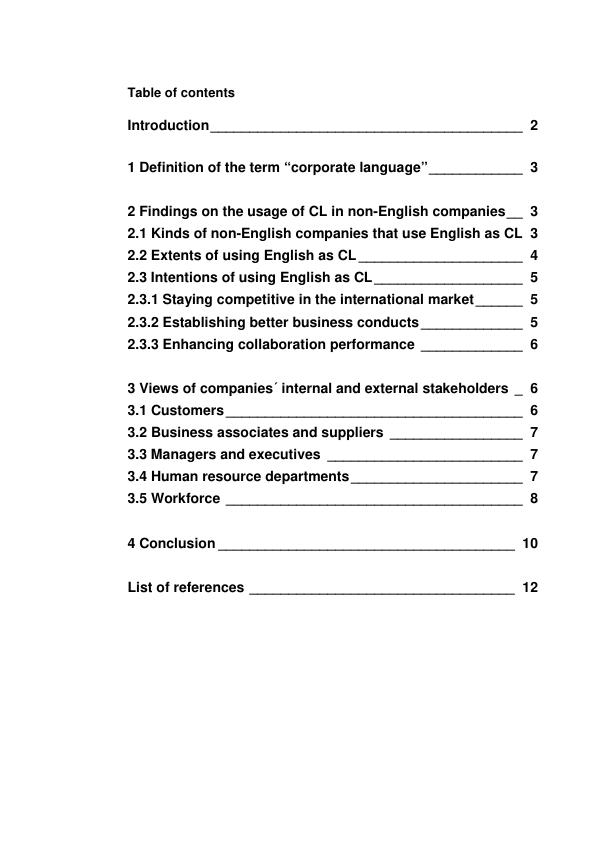
Table of Contents
Introduction
1 Definition of the term “corporate language”
2 Findings on the usage of CL in non-English companies
2.1 Kinds of non-English companies that use English as CL
2.2 Extents of using English as CL
2.3 Intentions of using English as CL
2.3.1 Staying competitive in the international market
2.3.2 Establishing better business conducts
2.3.3 Enhancing collaboration performance
3 Views of companies´ internal and external stakeholders
3.1 Customers
3.2 Business associates and suppliers
3.3 Managers and executives
3.4 Human resource departments
3.5 Workforce
4 Conclusion
Research Objectives and Focus Areas
This paper examines the application of English as a corporate language (CL) in non-English speaking firms, analyzing the motives, challenges, and benefits associated with this strategic decision to better understand its impact on international business operations.
- Strategic role of corporate language within corporate identity.
- Intentions behind adopting English, including competitiveness and business conduct.
- Perspectives of internal and external stakeholders on language policies.
- Challenges for the workforce and human resource management.
- Evaluation of the long-term effectiveness of English as a corporate language.
Excerpt from the Book
3.5 Workforce
If a corporate identity includes English as single or second CL, the policy is to be adhered to by the concerned workforce. However, not every employee cooperates willingly. The inclination of the members of staff towards motivation or frustration “[…] depends on two key factors: employee buy-in and belief in capacity. Buy-in is the degree to which employees believe that a single language will produce benefits for them or the organisation. Belief in their own capacity is the extent to which they are confident that they can gain enough fluency to pass muster.” (6) Often, elder workers lack these key factors. Instead, they feel bothered by this policy and are unwilling or unable to cooperate. If meetings, team discussions and even personal talks are restricted to the English language, valuable information gets lost. “Especially older employees would sometimes have to bother to participate actively in such situations. Eventually, this would also lead to the result that many detailed information could be exchanged in the German language, not until the coffee break” (7) Stefanie Zeng, chief editor of the Swiss personnel professional journal HR Today explains.
Summary of Chapters
Introduction: Provides the context for the increasing popularity of English in the business world and outlines the assignment's aim to evaluate the application of English in non-English firms.
1 Definition of the term “corporate language”: Explains corporate language as a strategic aspect of corporate identity, linked to a company's business conduct and reputation.
2 Findings on the usage of CL in non-English companies: Discusses the types of companies adopting English, the extent of its implementation, and the core intentions behind this shift.
3 Views of companies´ internal and external stakeholders: Analyzes the impacts of English language policies on various groups, including customers, suppliers, management, and employees.
4 Conclusion: Critically evaluates the findings, suggesting that while English is beneficial for competitiveness, its implementation requires careful management of employee motivation and skill gaps.
Keywords
Corporate language, Corporate identity, International business, Stakeholder perspective, English as a second language, Global market, Human resource management, Business communication, Employee motivation, Collaboration performance, Language policy, Cross-cultural communication.
Frequently Asked Questions
What is the primary focus of this work?
The work focuses on the strategic implementation of English as a corporate language (CL) within companies based in non-English speaking countries.
What are the central themes of the research?
The central themes include the definition of corporate language, the motives for its adoption, the impact on internal and external stakeholders, and the challenges regarding workforce integration and collaboration.
What is the main research objective?
The primary objective is to provide an overview of the application of English in non-English firms, specifically considering the motives, benefits, and challenges involved.
Which scientific method is utilized?
The study utilizes a descriptive and analytical approach, synthesizing findings from management literature, business journals, and expert opinions to evaluate corporate language strategies.
What topics are covered in the main body?
The main body covers the definition of corporate language, the extent of English usage in different industries, the intentions behind language policies, and detailed stakeholder feedback from employees to management.
Which keywords characterize this paper?
Key terms include corporate language, international business, language strategy, workforce management, and corporate identity.
How does the author view the role of the workforce in language policies?
The author emphasizes that successful implementation depends heavily on employee 'buy-in' and the belief in their own capacity, noting that a lack of support can lead to frustration and decreased productivity.
Why might a 'Bad Simple English' (BSE) develop within a company?
BSE often develops as a simplified, faulty version of English used by non-native speakers, which can lead to critical misunderstandings in professional relationships.
How should managers support employees struggling with English?
The paper suggests providing on-the-job training and using positive reinforcement to encourage employees, rather than relying solely on mandates.
- Quote paper
- Sabine Lavid (Author), 2014, English used as a corporate language in non-English companies, Munich, GRIN Verlag, https://www.grin.com/document/322823