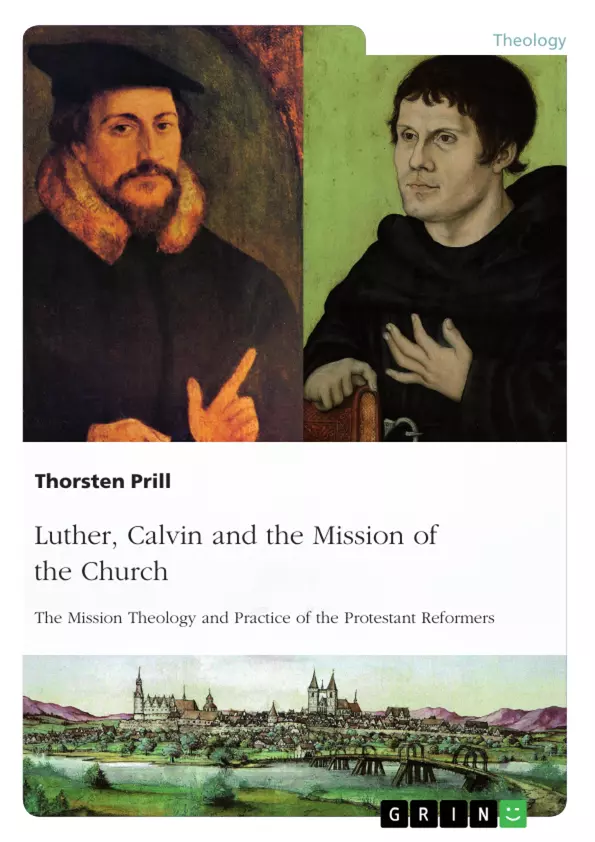
On the 31st October 1517 Martin Luther published his Ninety-Five Theses in which he criticised the sale of indulgences by the Roman Catholic Church. This date is considered the beginning of the Reformation. While the Protestant Reformers are widely praised for the rediscovery of the biblical gospel, they have come under fire regarding their views on mission. There are church historians and missiologists who argue that the Protestant Reformers were not interested in mission and, in fact, ignored the mission mandate which Christ had given to his Church. However, a closer study of Luther, Calvin, Bucer, and Melanchthon, shows that the critics miss both the Reformers’ commitment to practical mission work and their missiological contributions.
The critics seem to overlook the fact that cities, such as Geneva and Wittenberg, in which the Reformers lived, studied and taught, served as hubs of a huge missionary enterprise. Thousands of preachers went out from these centres of the Reformation to spread the gospel all over Europe. Leading Scandinavian theologians, such as Mikael Agricola, Olaus Petri, or Hans Tausen, had all studied under Luther and Melanchthon in Wittenberg before they began their reform work in their home countries.
Furthermore, with their re-discovery of the gospel of justification by faith alone, their emphasis on the personal character of faith in Christ, their radical re-interpretation of the priesthood, their recognition of God’s authorship of mission, their reminder that the witness to the gospel takes place in the midst of a spiritual battle, and their insistence that the Bible has to be available in common languages, the Protestant Reformers laid down important principles for the mission work of the church which are still valid today.
Table of Contents
Foreword
The Charges against the Reformers
The Critics and their Flaws
The Reformation Cities: Regional Mission Hubs
Wittenberg and the Reformation in Scandinavia
The Reformers and their Mission Theology
Biographical Notes
Research Objectives and Core Themes
The primary objective of this work is to challenge the widely accepted, yet historically flawed, academic narrative that the Protestant Reformers were indifferent to mission. By examining the theological foundations and practical missionary activities of figures such as Luther, Calvin, Bucer, and Melanchthon, the author demonstrates that the Reformation was not a hindrance but a significant catalyst for the missionary spread of the gospel.
- The historical re-evaluation of the "Great Omission" narrative regarding the Reformation and mission.
- The analysis of 16th-century cities as vital hubs for international missionary enterprise.
- The recovery of a robust, biblically-based mission theology inherent in the teachings of the Reformers.
- The exploration of the role of the priesthood of all believers as a mandate for active gospel witness in daily life.
Excerpt from the Book
Historical Circumstances
First, the critics seem to ignore the fact that there are several valid reasons why the Protestant Reformers were not more focussed on world mission. The Reformers, as the word indicates, considered it their first task to reform the church, which was a time-consuming endeavour. They were fully committed ‘to establish and secure the principles of the Reformation in their own domain.’ Their regional churches were, as Bosch points out, ‘involved in a battle of sheer survival; only after the Peace of Westphalia (1648) were they able to organize themselves properly.’ The Thirty Years War (1618-1648), in particular, had devastated many Protestant countries in central and northern Europe and had made it very difficult for Protestants to have a normal church life. As a result, it was almost impossible to develop an overseas mission strategy. Furthermore, in contrast to the Roman Catholic Church, located in countries like Italy, Portugal, and Spain which were maritime powers with colonies and trading connections outside Europe, most Protestant churches in Germany or Switzerland did not have any direct links with overseas countries. Unlike the Catholic rulers ‘none of the monarchs won over to the Reformation had’, as Zorn points out, ‘responsibilities in distant countries.’ Therefore, it would have been difficult for the Reformers to pursue overseas mission work compared to Spanish and Portuguese Roman Catholic monks who could rely on the support from their monarchs and willing navigators.
Summary of Chapters
Foreword: Introduces the 500th anniversary of the Reformation and identifies the common critical argument that Reformers lacked interest in mission.
The Charges against the Reformers: Documents the scholarly criticisms claiming that the Reformers ignored the mission mandate or abandoned it due to their theology.
The Critics and their Flaws: Examines the misconceptions of critics who define mission strictly in terms of 19th-century colonial-era models.
The Reformation Cities: Regional Mission Hubs: Explains how centers like Wittenberg and Geneva functioned as sending hubs for preachers and missionaries.
Wittenberg and the Reformation in Scandinavia: Highlights the practical export of Reformation theology to Nordic countries via students educated at Wittenberg.
The Reformers and their Mission Theology: Details the theological core of the Reformers' mission, focusing on the gospel, the authority of Scripture, and the priesthood of all believers.
Biographical Notes: Provides professional background on the author, Dr. Thorsten Prill.
Keywords
Protestant Reformation, Martin Luther, John Calvin, Mission Theology, Great Commission, Missio Dei, Wittenberg, Priesthood of All Believers, Sola Scriptura, Evangelism, Church History, Missiology, Scandinavian Reformation, Justification, Spiritual Warfare.
Frequently Asked Questions
What is the core argument of this book?
The book argues that the Protestant Reformers were not indifferent to mission; instead, they developed a strong, church-centered mission theology that fundamentally shaped the Protestant missionary movement.
What are the primary thematic fields covered?
The work covers Reformation history, the theological debate regarding the Great Commission, the practical missionary networking in 16th-century cities, and the application of Reformation doctrines to global outreach.
What is the author's primary research goal?
The primary goal is to refute the "Great Omission" theory by demonstrating that the Reformers' commitment to the gospel, the Bible, and the church effectively laid the foundation for modern missionary activity.
What scientific methodology is utilized?
The author uses a historical-theological approach, relying on primary sources from the Reformers and a critical synthesis of contemporary missiological historiography.
What specific topics are explored in the main body?
The text explores historical constraints on the Reformers, the role of 16th-century cities, the influence of Wittenberg in Scandinavia, and the biblical doctrine of the priesthood of all believers as an engine for mission.
Which keywords best characterize this work?
Protestant Reformation, Mission Theology, Sola Scriptura, Great Commission, Church-centered mission, and Priesthood of All Believers.
How does the author address the critique of Reformers regarding the Great Commission?
The author argues that while some Reformers did not use the passage in Matthew 28 as a modern mission text, they treated other biblical passages, such as Luke 24, as clear mandates for the proclamation of the gospel to all nations.
How is the concept of the "priesthood of all believers" linked to mission?
The author posits that the Reformers viewed every Christian as a witness for Christ, transforming the mission task from the preserve of a few professionals to a responsibility of the entire church.
- Arbeit zitieren
- Dr. Thorsten Prill (Autor:in), 2017, Luther, Calvin and the Mission of the Church, München, GRIN Verlag, https://www.grin.com/document/351853