This work will reflect on the mutability of meaning in the female mulatto body as well as on the mutability of perception by acknowledging the erroneous nature of race and its concrete results, by examining the valorization and undermining of racial essentialism and heterogeneity, and by revealing passing as bound by the social and legal restraints related to the physical body even as it interrogates racial classifications. Specifically, this study will explore how some nineteenth century, modern, and postmodern American narratives containing mulattoes and passing personas produce a resolution reiterating the structure of race or new subjectivities within or possibly without the color line. Through this exploration, the war between the homogenous Self and the different Other will play out. In an effort to unite a divided personality, the Other will counter attempts by the Self to maintain essentialism. The success lies not in the final outcome but in recognizing the subversive acts of the Other and the irrational tactics of the Self as continuously revealing the subjects as always already married and as surpassing mere essentialism into the multitudinous, heterogeneous One. Still, this work realizes that essentialism has a place in heterogeneity, even if essentialism is a logical error. Duality and conflict are inherent in heterogeneity, or the multitudinous One. The key is not to eradicate, in an essentialist manner, one and not the other, but to live in a state of awareness, respecting and accepting those who knowingly choose to construct identities within or without the color line.
Table of Contents
Introduction
Reading Meaning in the Mixed Body
Chapter One
Assimilating into What?: Stereotypes, Appearances, and Behavior
Chapter Two
Eliminating the Tragic: Intersections of Christianity, Racial Uplift, and True Womanhood
Chapter Three
Passing as Subversion and Reification
Chapter Four
The Journey Home: Replacing Tragedy with Authority
Chapter Five
Looking Within and Beyond Race with Irene, Clare, and Angela
Chapter Six
From the Passing Mulatto to the Biracial Character: Race, Class, Gender, and Family
Conclusion
The Community of Multiplicity
Research Objectives & Themes
This dissertation examines the mutability of meaning associated with the female mulatto body and explores how various nineteenth-century, modern, and postmodern American narratives interrogate racial essentialism and construct heterogeneous subjectivities. The study aims to demonstrate how passing, while historically bound by social and legal restraints, functions as a subversive act that challenges traditional racial categories and exposes the artificial nature of the color line.
- The role of the "tragic mulatto" archetype in early American literature.
- Assimilation and racial uplift as strategies for navigating societal hierarchies.
- The intersection of race, class, and gender in the construction of identity.
- Passing as a mechanism for both reinforcing and destabilizing essentialist frameworks.
- The transition from modernist essentialism to postmodern multiplicity in contemporary narratives.
Excerpt from the Book
Assimilating into What?: Stereotypes, Appearances, and Behavior
The ideological cobweb of race appears so substantial that it has been made to serve as the very basis of individual and group identity. The ideology of race is based upon tacit theoretical assumptions, enabling the equivalency of race to a “biological” unit. Racial character as inherent in the biological unit serves as a basis for the separation of individuals and groups into allegedly homogeneous and labeled categories informed only by heterogeneity when each is contrasted with the other. The difference highlighted by contrast is, however, merely superficial. After all, race is fundamentally a concept and racial character is merely a related idea rather than biological fact. Since the establishment of race involves “thought-fully” creating oversimplified and illogical divisions, then the idea of racial character also must be imbued with the same as well as other errors that often occur in the cognitive process.
One error constituting a primary means of racial characterization, the stereotype, serves to separate and/or exclude individuals and groups from racial privilege. In Difference and Pathology, Sanders L. Gilman notes that when the sense of order and control in relation to the Self undergoes stress, anxiety appears. We then “project that anxiety onto the Other, externalizing our loss of control. The Other is thus stereotyped [and] . . . is invested with all of the qualities of the ‘bad’ or the ‘good.’” In other words, since racialized qualities of difference threatening order and control allegedly are in the body of the Other, then these differences and the very body of the Other are now within control of the Self.
Summary of Chapters
Introduction: Reading Meaning in the Mixed Body: Sets the theoretical framework for the study, focusing on the mulatto as a "racial war site" and a metaphor for a personality at war with itself.
Chapter One: Assimilating into What?: Stereotypes, Appearances, and Behavior: Analyzes how stereotypes and the "one-drop rule" were utilized to maintain racial boundaries and explores early literature of the tragic mulatto.
Chapter Two: Eliminating the Tragic: Intersections of Christianity, Racial Uplift, and True Womanhood: Examines how black authors utilized Christianity and domestic ideals to counter stereotypes and uplift the mulatto figure.
Chapter Three: Passing as Subversion and Reification: Investigates the complex dynamics of passing, focusing on how characters manipulate racial signs to challenge or uphold the status quo.
Chapter Four: The Journey Home: Replacing Tragedy with Authority: Explores the Harlem Renaissance's approach to the tragic mulatto theme and the shift toward racial pride and self-determination.
Chapter Five: Looking Within and Beyond Race with Irene, Clare, and Angela: Delves into newer narrative techniques, such as the gaze and fantasy, to achieve a state of non-essentialist identity.
Chapter Six: From the Passing Mulatto to the Biracial Character: Race, Class, Gender, and Family: Examines postmodern texts that redefine the mulatto as a biracial character, moving beyond stock archetypes toward self-aware, plural identities.
Conclusion: The Community of Multiplicity: Summarizes the findings, arguing for a "community of multiplicity" where conflicting identities can coexist without the need for essentialist categorization.
Keywords
Mulatto, Passing, Racial Essentialism, Identity Construction, Harlem Renaissance, Tragic Mulatto, Racial Uplift, True Womanhood, Heterogeneity, Self and Other, Multiplicity, Biracial Identity, American Literature, Subversion, Subjectivity.
Frequently Asked Questions
What is the core focus of this dissertation?
The work examines the mutability of meaning within the female mulatto body in American literature, focusing on how identity is constructed, manipulated, and subverted across different historical periods.
What are the primary themes discussed?
The central themes include racial essentialism, the performative nature of passing, the intersectionality of class and gender, and the push toward a non-essentialist, heterogeneous identity.
What is the main objective of the research?
The primary goal is to analyze how various American narratives—ranging from the nineteenth century to the postmodern era—reiterate or subvert racial structures and to explore the emergence of "multiplicity" as a way of being.
What scientific or literary methodology is employed?
The dissertation uses a literary and cultural studies approach, engaging with theories of identity, racial discourse, and critical analyses of major texts and authors to provide dual readings of mulatto characters.
What is covered in the main body of the work?
The main body traverses the historical trajectory of the mulatto figure, moving from the tragic archetypes of early abolitionist fiction through the Harlem Renaissance and ending with contemporary, postmodern explorations of identity.
Which keywords best characterize this work?
Keywords include Mulatto, Passing, Racial Essentialism, Identity Construction, Harlem Renaissance, Tragic Mulatto, Racial Uplift, and Multiplicity.
How does the author define the "Self" and the "Other"?
The author defines the "Self" as homogenous whiteness seeking separation, while the "Other" represents the difference of blackness, often used as a reservoir for devalued qualities.
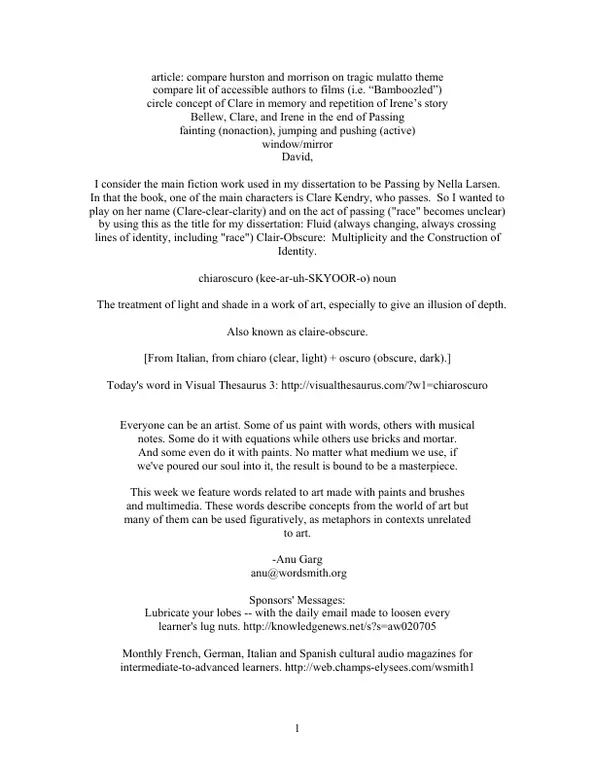
What is the significance of the title "Fluid Clair-Obscure"?
The title refers to "chiaroscuro," the artistic technique of light and shade, playing on the name "Clare" and the shifting, always-crossing lines of racial identity.
- Quote paper
- Dr. Tamara Hollins (Author), 2003, Turning Dreams to Chaos: Multiplicity and the Construction of Identity, Munich, GRIN Verlag, https://www.grin.com/document/74993