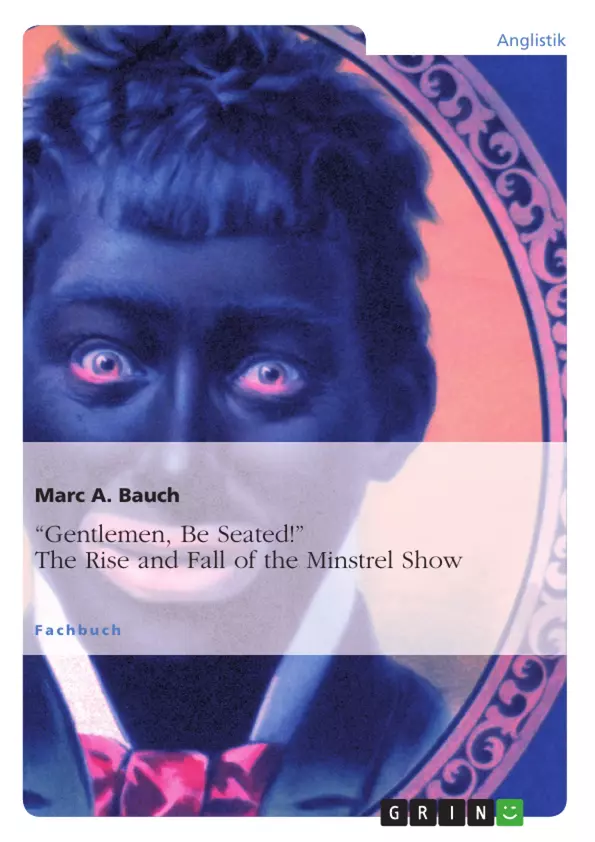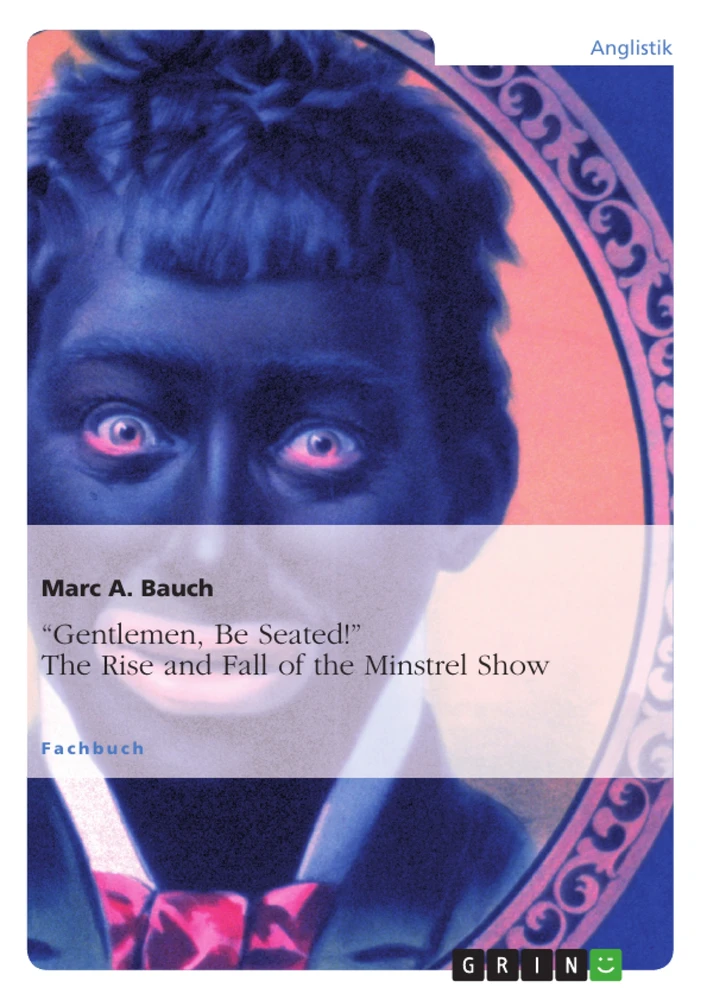
A native form of entertainment that came up in around 1843 was the minstrel show. The minstrel show was a show that consisted of melodies by slaves and jokes by white actors in blackface in order to imitate the blacks. Led by Mr. Interlocutor, the master of ceremonies, three more actors in blackface sat in a semicircle. The endmen or cornermen were known as Mr. Bones and Mr. Tambo, who joked together or made fun of slaves.
Thus, the minstrel show was double-edged: on the one hand, racism in the United States was reinforced; on the other hand, so many white Americans have become aware of black popular culture. No wonder therefore, the rise of the minstrel show coincided with the growth of the abolitionist movement in the 19th century.
But without doubt, racial discrimination was played down in the minstrel show. The minstrel show was meant as a form of entertainment, which was not intended to be taken seriously. Although the minstrel aimed to create a native and distinctly American form of entertainment, the songs they adopted were of English, Irish or Scottish origin. Furthermore, they presented parodies of European-style entertainment or parodied works by William Shakespeare.
The book gives an overview of the history of the minstrel show. Marc A. Bauch is a scholar of American Literature and has specialized in American Theater, including the American Musical.
Table of Contents
1. The Origins of the Minstrel Show and Its European Antecedents
2. Jim Crow and Zip Coon
3. Banjo Music and Dance
4. Daniel D. Emmet and the Virginia Minstrels
5. The Hey-Day of the Minstrel Show
6. The Decline of the Minstrel Show
7. The Cultural Importance of the Minstrel Show and Its Legacy
8. Bibliography
Objectives and Topics
This book explores the historical development, cultural significance, and decline of the minstrel show, the first uniquely American theatrical genre that profoundly influenced the evolution of American musicals in the 20th century.
- The formation of the minstrel show from European antecedents and American slave culture.
- The creation and popularization of iconic archetypes like Jim Crow and Zip Coon.
- The transition of the genre through key figures like Daniel D. Emmet and the Virginia Minstrels.
- The social, political, and economic factors contributing to the rise, commercialization, and eventual decline of blackface minstrelsy.
Excerpt from the Book
1. The Origins of the Minstrel Show and Its European Antecedents
One milestone in the history of 19th century American theater is the minstrel show. As the only uniquely American genre within American theater, the minstrel show is the most important antecedent of 20th century American musicals and influenced musicals like Porgy and Bess (1935).
“The minstrel show was a unique development, a purely native form of entertainment, and a distinctively American contribution to theatrical history.” This is how Carl Wittke evaluates popular stage entertainment in the US where whites imitated black slaves in song and dance. In the minstrel show, African-Americans were portrayed and mocked. White actors blacked their faces with burnt cork and wore wigs with curly hair. In sketches, songs and dances, slaves were shown as decayed, superstitious, happy and musical characters. The minstrel show is a turning point in American theater, because after the second War of Independence against England from 1812 to 1814 the Americans wanted to become independent, not only politically, but also with respect to culture: “The minstrel show was the most important new form.”
Already in European theater, there were dark figures: In ancient drama, the Greeks had their “phallophoroi”. Demons, goblins, Indians, Turks, moors and blacks can be found in Renaissance drama. Also William Shakespeare’s Othello is such a representation of a black character. Pulcinella and Arlecchino are two swarthy characters of the Commedia dell’Arte. On European stages, blacks were already shown as imitations of Africans. At the end of the 17th century, also on American stages black-faced actors appeared who played minor roles as servants and who were provided for comic relief.
Summary of Chapters
1. The Origins of the Minstrel Show and Its European Antecedents: Examines the roots of the minstrel show as a uniquely American theatrical form and its historical connections to European stage characterizations.
2. Jim Crow and Zip Coon: Analyzes the emergence of the two primary, iconic minstrel character types and the role of performers like Thomas D. Rice in establishing these archetypes.
3. Banjo Music and Dance: Discusses the evolution of musical accompaniment, specifically the banjo, and the development of performance styles within the minstrel tradition.
4. Daniel D. Emmet and the Virginia Minstrels: Focuses on the founding of the Virginia Minstrels and the structural formalization of the minstrel show into a feature-length program.
5. The Hey-Day of the Minstrel Show: Explores the peak popularity of minstrelsy during the 1850s, highlighting its role as a dominant form of commercial entertainment.
6. The Decline of the Minstrel Show: Details the factors leading to the collapse of the traditional minstrel show, including changing audience tastes and the rise of new genres.
7. The Cultural Importance of the Minstrel Show and Its Legacy: Evaluates the lasting impact of minstrelsy on American musical theater, jazz, and the broader cultural landscape.
8. Bibliography: Lists the academic sources and references utilized in the research.
Keywords
Minstrel Show, Blackface, American Theater, Jim Crow, Zip Coon, Daniel D. Emmet, Virginia Minstrels, Cultural History, Plantation Melodies, Theater History, Musical Comedy, Racial Stereotypes, Vaudeville, Ragtime, Slavery
Frequently Asked Questions
What is the central subject of this work?
The book provides a comprehensive history of the minstrel show, documenting its rise, peak, and decline as a significant but controversial American theatrical tradition.
What are the primary themes explored in this book?
Key themes include the development of American popular culture, the impact of racial stereotyping in entertainment, the evolution of musical theater, and the influence of early blackface performances on 20th-century American music.
What is the main objective of the author?
The author's objective is to trace the genesis of this uniquely American genre and explain its profound role in shaping subsequent theatrical genres like the American musical.
Which methodology does the author use?
The work employs a historical and literary analysis approach, drawing upon archival research, performance records, and academic critiques to chart the evolution of the genre.
What does the main body of the work cover?
The chapters cover the European influences on the genre, the emergence of specific performance archetypes, the formalization of the minstrel program, and the socio-economic factors that led to the genre's eventual obsolescence.
Which keywords characterize this study?
Central keywords include Minstrel Show, Blackface, American Theater, Musical Comedy, and cultural legacy.
How did Thomas D. Rice influence the development of minstrelsy?
Thomas D. Rice is credited with popularizing the Jim Crow character, creating one of the first and most enduring fixed stage characters in minstrel history.
What role did the banjo play in the minstrel show?
The banjo replaced the violin as the predominant instrument in minstrel performances, with its complex syncopated rhythms serving as an early building block for American jazz.
Why did the classic minstrel show decline after 1870?
The decline was caused by increased production costs, the rise of more modern and competitive genres like vaudeville and burlesque, and shifting audience preferences in the changing American economic and social landscape.
- Citar trabajo
- Marc A. Bauch (Autor), 2011, “Gentlemen, Be Seated!” The Rise and Fall of the Minstrel Show, Múnich, GRIN Verlag, https://www.grin.com/document/183957