If you have a child with autism or are working with children with autism spectrum disorders (ASD), this book may be for you.
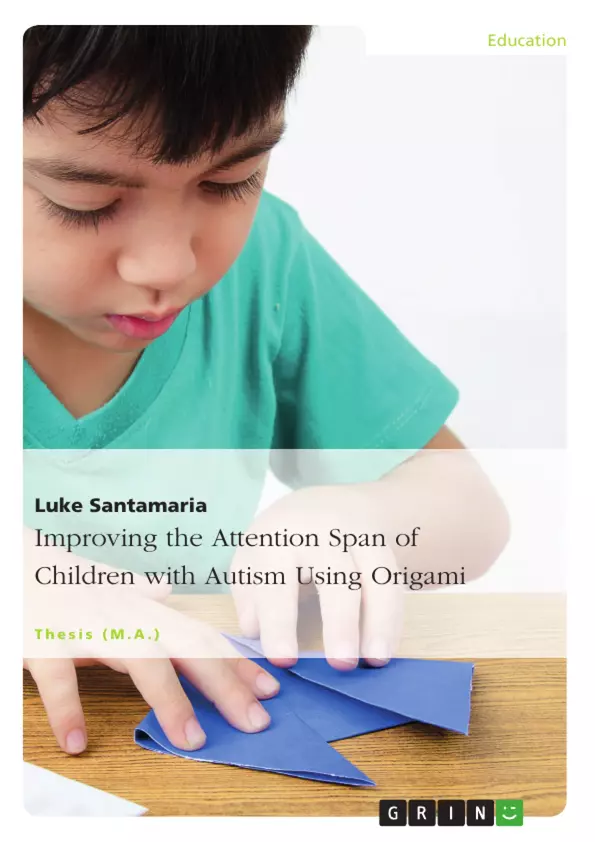
When I was teaching children with autism, I was trying to find a way to get them to focus their attention to the task at hand. I realized that children with ASD prefer to deal with things and can be very creative in their own way. I figured out that maybe they can learn to fold and write, which are important tasks reinforced through occupational therapy. It was during my thesis writing when I came up with the idea of trying out origami or paper-folding as a form of intervention.
My goal was to see if origami could significantly improve the attending skills and impulse-control behaviors of children with ASD at the preschool where I worked. To make the terminology shorter, the improvement of attending skills also means the reduction of inattention and the lengthening of attention span. The improvement of impulse control also meant the reduction of impulsivity. I developed an origami instructional manual to make sure that the intervention given to each child is consistent. The manual involves very simple origami instructions and involves some drawing and uses paper in varying sizes, colors and textures to keep the child interested.
The results showed that the use of origami as an intervention significantly improved the attending skills of the participating children with ASD. As for the improvement of impulse control, impulsivity is affected by many variables and the results showed no significant change. Although my participants showed some improvement, it was not significant enough. I hope you can try to replicate this instructional manual to your child or students and see if this can help you.
I made it my goal to have this research published as an eBook with the hopes that it will be affordable for you. Once again, please try out this book and see if it can help you.
Table of Contents
Chapter 1: Introduction
Statement of the Problem
Significance of the Study
Scope and Delimitation
Research Hypotheses
Chapter 2: Theoretical Framework
Review of Related Literature and Studies
Autism
Inattention
Impulsivity
Origami
Behavior Management
Conceptual Framework
Definition of Terms
Chapter 3: Research Methodology
Research Design
Research Locale and Respondents
Instrumentation
Research Procedure
Statistical Treatment
Chapter 4: Presentation and Analysis of Results
Chapter 5: Summary, Conclusions, and Recommendations
Summary of Findings
Conclusions
Recommendations
Research Objectives and Themes
This study investigates whether integrating an origami intervention program into standard special education improves attention spans and impulse control in preschool-aged children with autism. The research seeks to validate the appropriateness of a specifically designed origami instructional manual and measure the quantitative behavioral changes in experimental versus control groups.
- Impact of origami-based activities on behavioral regulation in children with autism.
- Comparative analysis of attention and impulse control performance.
- Validation of instructional materials for special education settings.
- Assessment of developmental outcomes through standardized observation and statistical analysis.
Excerpt from the Book
Autism
Autism Spectrum Disorder (ASD) is a developmental disorder which is more commonly known as autism. This disorder affects the way the brain uses information. The disorder affects functionality on cognitive processing resulting in stereotypic behaviors. Autism usually affects the individual from birth. Autism brings with it delay or deficit in the development of children leading to cognitive and behavioral deficits. It is characterized by its three early indicators: the lack of eye contact, lack of attention to the same item or topic the other interacting person is focusing on, and the lack of reciprocal conversation or turn-taking. The mentioned behavioral deficits affect the functionality of CWA. As a result, the disorder affects a person’s functionality resulting to the child’s inability to function normally (Heward, 2006).
The Diagnostic and Statistics Manual of Mental Disorders, commonly known as DSM-IV, states that people with autism may exhibit a range of behavioral symptoms. The general behavioral symptoms include short attention span, impulsivity, aggressiveness, self-injurious behaviors and temper tantrums (American Psychiatric Association, 2000).
Summary of Chapters
Chapter 1: Introduction: Outlines the behavioral challenges faced by children with autism and proposes origami as an intervention tool to enhance attention and impulse control.
Chapter 2: Theoretical Framework: Provides a comprehensive literature review regarding autism, attention, impulsivity, and the educational history of origami.
Chapter 3: Research Methodology: Details the quasi-experimental design, participant selection, and the structure of the origami intervention program.
Chapter 4: Presentation and Analysis of Results: Analyzes data from expert validations and pre/post-test observations to evaluate the efficacy of the intervention.
Chapter 5: Summary, Conclusions, and Recommendations: Synthesizes the research findings, concludes on the validity of the manual, and provides recommendations for future educational applications.
Keywords
Autism, Origami, Attention Span, Impulse Control, Special Education, Behavior Management, Cognitive Development, Quasi-experimental Design, Instructional Manual, Behavioral Indicators, Pre-learning Skills, Mann-Whitney U test, Direct Instruction, Occupational Therapy, Intervention Program.
Frequently Asked Questions
What is the fundamental goal of this research?
The study aims to determine if an origami intervention program can effectively increase the levels of attention and impulse control in preschool children with autism when added to their typical special education curriculum.
Which core topics are addressed in the study?
The research focuses on the developmental needs of children with autism, specifically targeting inattention and impulsivity, and explores origami as a structured visual art intervention.
What is the primary research question?
The primary research question examines whether the additional 20-session origami program leads to a significant statistical difference in attention and impulse control compared to a standard special education program.
What scientific methods were employed?
The study utilized a quasi-experimental design, involving purposive sampling and pre/post-test observations, with results analyzed using the Mann-Whitney U test.
What content is covered in the main body?
The main body reviews literature on autism and behavioral management, describes the creation of the origami instructional manual, and details the statistical analysis of the experimental intervention results.
Which keywords best characterize this work?
Key terms include Autism, Origami, Attention Span, Impulse Control, and Special Education.
Why was origami chosen as an intervention?
Origami was selected due to its hands-on, sequential nature, which requires focused attention and step-by-step instruction, making it an engaging and concrete tool for special education.
Did the origami program significantly improve all observed behaviors?
While the study found a significant increase in attention for the experimental group, it did not find a significant difference in impulse control when compared to the control group, suggesting that impulse control may be influenced by a wider variety of factors.
- Citation du texte
- Luke Santamaria (Auteur), 2008, Improving the Attention Span of Children with Autism Using Origami, Munich, GRIN Verlag, https://www.grin.com/document/303700