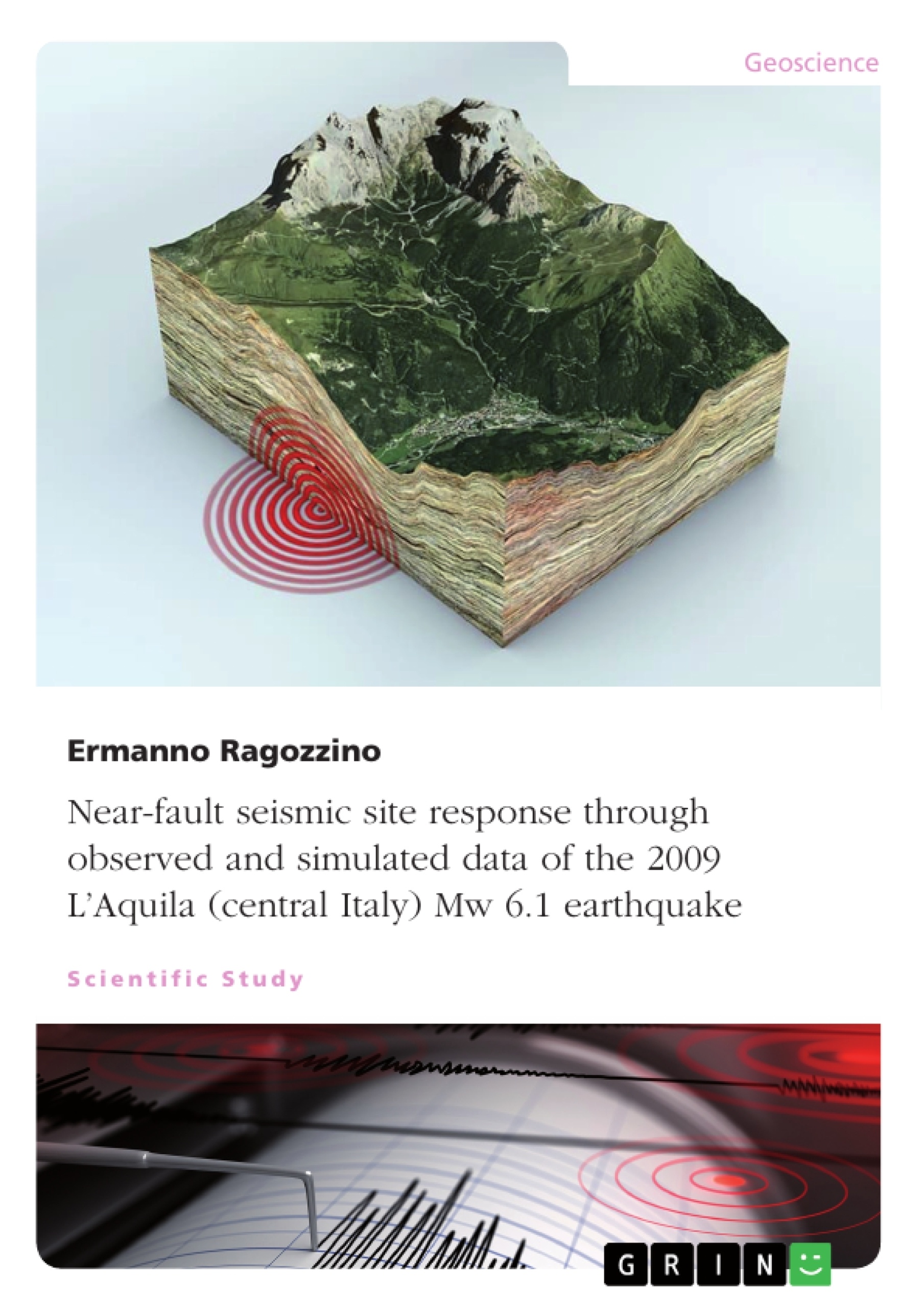
In L’Aquila Basin (central Italy), several seismic stations of the Italian Strong Motion Network recorded a huge amount of weak- and strong-motion data near an active fault during the 2009 L’Aquila seismic sequence. This study analyzes the ground motion records of events with magnitude ranging between 1.6 and 6.1 and compares the observed peak accelerations and the H/V and V/H response spectral ratios with those revealed from numerical simulations.
The finite element method is considered herein to perform dynamic simulations on models of the upper Aterno River Valley and L’Aquila City center, which are based on the reviewed geologic, geotechnical and geophysical investigations that were performed in previous studies. The Martin-Finn-Seed’s pore-water pressure model is used in the simulations.
The comparison between the computed and the experimental results shows a seismic site response that is sensitive to the level of earthquake magnitude and mainly depends on the rock and soil elastic and dynamic properties, the intensity and the depth of the seismic impedance contrast, the water table depth, the two-dimensional irregular configuration, the dip angle of strata, the shape and the frequency content of the input motion record. Moreover, the near-fault seismic site response may be influenced by near-source effects and peculiar wave-field incidence angles.
Table of Contents
Introduction
Case Study #1: Western L’Aquila Basin
The Aterno River Valley Strong-Motion Array
Geological, Geotechnical and Geophysical Data
Ground Motion Record Analysis
Dynamic Modeling
Peak Ground Acceleration Amplification Factor
Observed vs. Numerical Peak Ground Acceleration
Excess Pore-Water Pressure and Liquefaction
Observed vs. Numerical H/V and V/H Response Spectral Ratios
Conclusions
Case Study #2: Historical L'Aquila City center
Geological, Geotechnical and Geophysical Data
Ground Motion Record Analysis
Dynamic Modeling
Peak Ground Acceleration
Observed vs. Numerical H/V Response Spectral Ratio
Excess Pore-Water Pressure and Nonlinear Behavior
Conclusions
Objectives and Topics
This book aims to analyze the seismic response of sediments filling the L’Aquila Basin by comparing recorded ground motions from the April 2009 earthquake with non-linear dynamic finite element models to understand site effects in both the Western L’Aquila Basin and the historical city center.
- Analysis of seismic site effects using strong-motion array data.
- Evaluation of non-linear soil behavior and pore-water pressure generation.
- Comparison of observed vs. numerical peak ground acceleration.
- Investigation of horizontal-to-vertical (H/V) and vertical-to-horizontal (V/H) spectral ratios.
- Application of finite element modeling for subsurface site response simulation.
Excerpt from the Book
Introduction
During the night of 6 April 2009, at 01:32 GMT, an earthquake hit the L’Aquila Basin, in central Italy. The earthquake caused damage to between 3000 and 11000 buildings in the medieval center. Several buildings also collapsed. Three hundred and nine people died and more than 1500 were injured. About 65000 people (out of a population of 72000) had to abandon their homes. The Mw 6.1 main shock occurred with an epicenter at 42.3400° N, 13.3800 °E, approximately 90 km NE of Rome, near the city of L'Aquila. The earthquake was caused by movement on a NW-SE trending normal fault that was defined to strike 140° and dip 50° to the SW. Most co-seismic slip occurred in a small rupture area of approximately 16 km along strike and nearly 8 km in the dip direction, in a depth range of 4-10 km [41]. The main shock and many aftershocks of the 2009 L’Aquila seismic sequence were recorded by the near-fault stations Colle Grilli (AQG), Fiume Aterno (AQA), Centro Valle (AQV), Il Moro (AQM), Aquil Park Int. (AQK) that belong to the Italian Strong Motion Network (RAN) [20,51] and Aquila Castello (AQU) that belong to the National Institute of Geophysics and Volcanology (INGV). The stations are situated in the Upper Aterno River Valley and in the medieval City of L’Aquila. Later, several groups and institutions made a great quantity of data available as a result of geological, geotechnical and geophysical investigations [2,17,46], whereas various authors performed different types of research studies.
Summary of Chapters
Introduction: This chapter provides an overview of the 2009 L’Aquila earthquake and summarizes previous research on seismic site amplification in the region.
Case Study #1: Western L’Aquila Basin: This chapter investigates the seismic response in the Upper Aterno River Valley by analyzing station recordings and applying non-linear 2D dynamic modeling to assess peak acceleration and pore-water pressure effects.
Case Study #2: Historical L'Aquila City center: This chapter focuses on the historical city center, utilizing geological data and numerical simulations to evaluate site response and liquefaction potential in the Quaternary sediments.
Keywords
L’Aquila earthquake, seismic site response, finite element modeling, ground motion, pore-water pressure, liquefaction, peak ground acceleration, H/V spectral ratio, V/H spectral ratio, geotechnical analysis, Quaternary sediments, non-linear behavior, seismic sequence, Aterno River Valley, subsurface modeling.
Frequently Asked Questions
What is the primary focus of this research?
The research focuses on the seismic site response of sediments within the L’Aquila Basin using the April 2009 earthquake as a primary case study.
What are the central thematic areas covered?
The work covers geological and geotechnical data analysis, non-linear dynamic modeling of soil behavior, and the interpretation of seismic ground motion records.
What is the main objective of the study?
The objective is to compare observed ground motion data from 2009 with non-linear finite element dynamic models to better understand how local soil conditions affect seismic amplification.
Which scientific methods are utilized?
The study employs ground motion record analysis, horizontal-to-vertical (H/V) and vertical-to-horizontal (V/H) spectral ratio techniques, and 2D non-linear dynamic numerical modeling based on the Martin-Finn-Seed pore-water pressure model.
What does the main body of the work address?
It addresses site-specific analysis for the Western L’Aquila Basin and the Historical City center, including borehole logs, dynamic modeling setups, and comparisons between empirical and numerical results.
What key terms characterize this research?
Keywords include seismic site response, liquefaction, non-linear soil behavior, finite element simulation, and spectral ratios.
How does pore-water pressure affect the findings?
The study finds that the generation of excess pore-water pressure during seismic shaking leads to soil softening and reduces effective stress, which is critical for explaining the observed frequency shifts.
Why are the L’Aquila Basin sediments significant?
These Quaternary sediments exhibit strong impedance contrasts and non-linear behaviors that significantly amplify seismic motions, making them essential for assessing structural damage and hazard mitigation.
- Quote paper
- Ermanno Ragozzino (Author), 2016, Near-fault seismic site response through observed and simulated data of the 2009 L’Aquila (central Italy) Mw 6.1 earthquake, Munich, GRIN Verlag, https://www.grin.com/document/350021