In Europe a lot of historians have worked on African history for the period after the continent came under colonial rule. But little has been written about African states contemporary to the European medieval period, i.e. before the Europeans arrived in Africa. Especially the history of south-eastern Africa has been mostly the domain of white southern African researchers, archaeologists, historians and „discoverers“ in the 19th and for the major part of the 20th century. Only since the independence of Zimbabwe has a new generation of African researchers come to the fore. But their work has been largely neglected in European literature.
The author tries to bridge this gap. The work is particularly interesting as it tries to correlate the findings of three disciplines: History, Archaeology and Ethnology. With the latter’s particular subject of oral traditions Ethno-History can make a strong contribution, where written sources end. Archaeology is important as early African societies did not produce written records. But there is one element of sources which can help to go back in time from there: the writings of Islamic travelers and reporters, which give rich evidence of the connections of their world to the south-eastern African region from the 8th century onwards.
Putting all these elements together the author gives a clearer picture of the formation of states in that region of Africa and the role they played, after they contacted global trade which centered around the Indian Ocean rim, before the Portuguese and later other European powers destroyed that network of independent partners and replaced it by their own protectionist colonial rule. More work has to be done.
Heinrich Bruellau, a historian at heart, had to earn his living as a manager and consultant. His many travels led him to Zimbabwe and other countries of the region, whose liberation struggle he had supported from the beginning. He followed on the lead of his historian gene to engage with researchers of the region. He even had the honour of meeting Peter Garlake, the great old man of Zimbabwean archaeology, in his home, but also got encouragement from Dawson Munjeri, who is now the representative of Zimbabwe at Unesco.
With this book, he is inviting researchers to invest more work into the global trade network of the medieval period in order to get a better understanding of the importance of the African contribution to world trade long before it was subjected to subjugation by colonialism.
Contents
0. Some Personal Remarks
1. Introduction
1.1. The Role of Archaeology, History and Ethno-History in the context of the Southern African Region
1.2. The Geographical Introduction - Boundaries of the Area and the Geography behind the History
1.3. The Periods under Consideration in the Context of the Region
2. Archaeology of the Region: Sources, Methods and Results
2.1. The Development of Archaeological Research with particular Reference to Great Zimbabwe
2.2. Archaeological Findings at Mapungubwe and Bambandyanalo
2.3. The Leopard's Kopje Tradition
2.4. Ingombe Ilede
2.5. Manekweni
2.6. Khami Ruins and Dhlo Dhlo
2.7. Further Related Sites
2.8. The Early Portuguese Period
2.9. The Current State of Research. New Questions and Approaches
2.10. Some Hypotheses put forward by Archaeologists on the Society and State Formation of the Great Zimbabwe Culture
2.10.1. Predominance of Politico-Religious Symbolism
2.10.2. Pastoralism
2.10.3. The Trade Hypothesis
2.10.4. The Initiation Interpretation
2.10.5. Reasons for the Fall of Great Zimbabwe
2.11. Some Remarks on the Current Scientific Debate and some Conclusions from Archaeological Results
3. Documentary History of South Eastern Africa with Special Reference to Arab and Early Portuguese Sources
3.1. Available Arab Documentary Sources
3.2. Some Conclusive Remarks on the Evidence from Arab Sources
3.3. Portuguese Reports on the Interior and their Impact on Historiography
3.3.1. The very early Portuguese Contact
3.3.2. Portuguese Writings of the second half of the Sixteenth and in most of the Seventeenth Century
3.3.3. Later Portuguese Writings with Special Reference to the Changamire
3.4. Some Conclusive Remarks on the Documentary History
4. Ethno-History of Zimbabwe and Mozambique - Oral Tradition as History
4.1. Special Problems of Methodology of Ethno-History in the Region
4.2. The Discovery of Maramuca through the Combination of Oral Tradition and Portuguese Documents
4.3. The Contribution of Oral Tradition to the Rozvi- Question and the Problem of the Abandonment of Great Zimbabwe
4.4. The Development of the Term "Shona" , the Linguistic Affinities of Modern Shona and their Importance to the Exploration of Historical Developments
5. Preliminary Conclusions from a Synthesis of the Findings of Archaeology, Documentary and Ethno-History in Zimbabwe and Adjacent Areas - Summary and Outlook
Objectives and Topics
This work aims to provide a comprehensive historical and archaeological analysis of pre-colonial state formation in South-East Africa, specifically examining the interaction between African societies and the Indian Ocean trade network. By synthesizing archaeological findings, documentary records from Arab and Portuguese sources, and oral traditions, the author seeks to reconstruct the complex economic and social developments of the region, challenging eurocentric narratives and exploring how indigenous states managed external influences and trade.
- Analysis of Iron Age state formations (Great Zimbabwe, Monomotapa).
- Evaluation of the influence of the Indian Ocean rim trade on African interior economies.
- Critical re-examination of Arab and Portuguese historical accounts.
- Exploration of indigenous economic structures, specifically iron and gold production.
- Synthesis of archaeological evidence with traditional oral history.
Excerpt from the Book
The Development of Archaeological Research with particular Reference to Great Zimbabwe
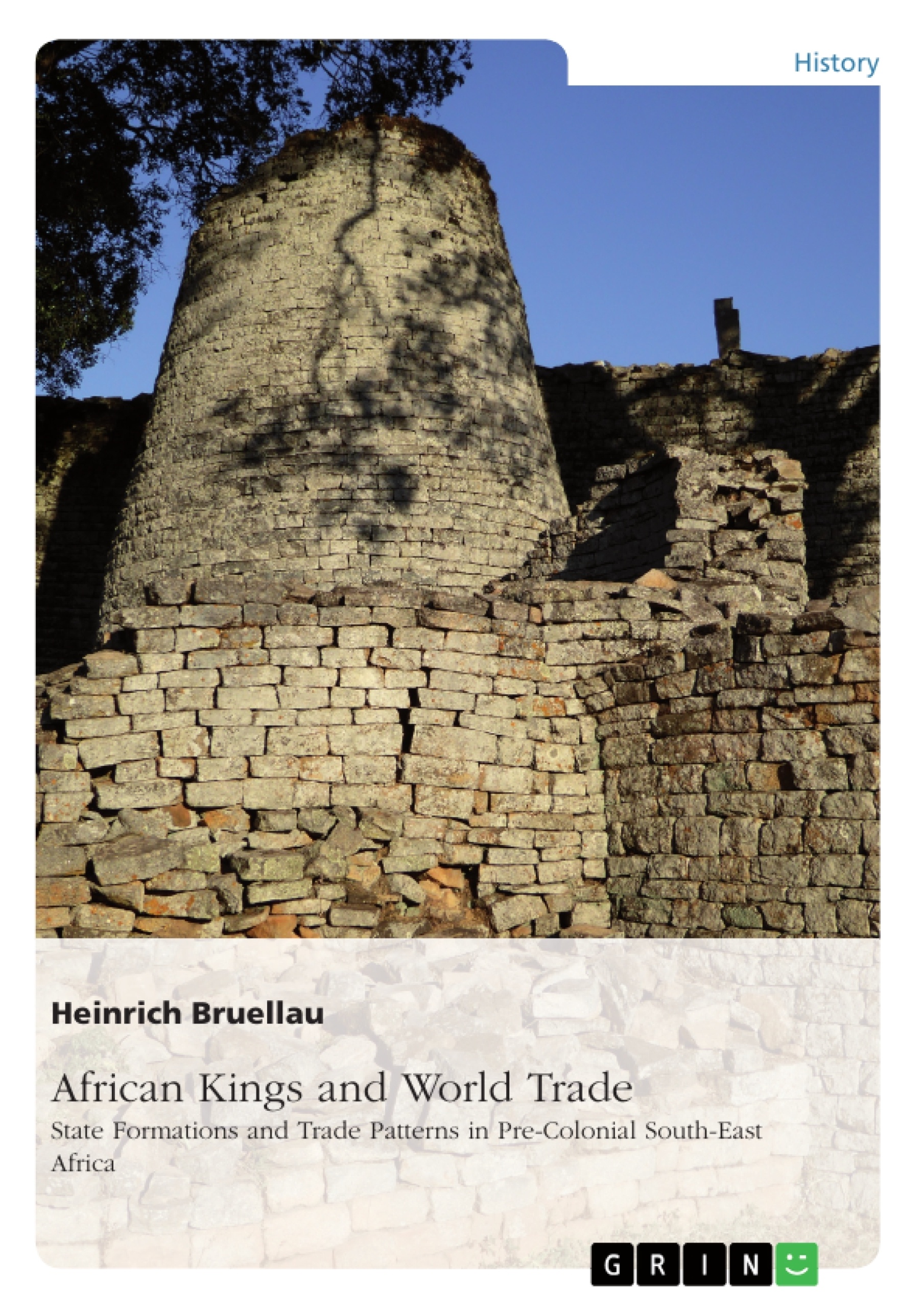
The discussion of the early perception of European researchers on 'mysterious' origins of the Great Zimbabwe and related cultures shall only be mentioned briefly. It is true that in colonial times there was many a pseudo-historian who tried to prove that Great Zimbabwe was not of African origin or that it had at least no link to the present African population of the country. The purpose of these racialist theories is simply an attempt to deny the rights of the original inhabitants of the land. They have been dealt with enough. Any further discussion would mean nothing else than shadow-boxing. It is much more interesting to concentrate on the progress of scientific archaeology and to see what conclusions have been drawn out of the material findings of the excavations. The impressive nature of the stone buildings of Great Zimbabwe makes it necessary to focus the first attention in the discussion on the results of research into that particular site.
"The site Great Zimbabwe covers over 720 ha and comprises mainly stone wall enclosures and areas of hut remains. ... The stone walls, up to 6 m thick and 11 m high, are built of granite blocks without the use of mortar. Natural granite boulders are often incorporated into a wall which usually follows a curved line. The purpose of the walls was primarily to enclose areas within which 'dhaka' (clay) structures and smaller partition walls were constructed." The builders made use of the natural source of granite split in slabs and easily available locally. "The earliest 'undressed' masonry, dated to the 13th century, is built from these slabs; the 14th century masonry is composed of 'dressed' blocks deliberately chipped to the required shape and size.
Summary of Chapters
0. Some Personal Remarks: The author details his experiences visiting archaeological sites in the region and his perspective on the political and historical context of his research.
1. Introduction: This chapter contextualizes the history of Zimbabwe, addressing controversies and the impact of ideological perspectives on historical research.
2. Archaeology of the Region: Sources, Methods and Results: An extensive analysis of the development of archaeological research, examining key sites, methodologies, and the societal structures revealed by material findings.
3. Documentary History of South Eastern Africa with Special Reference to Arab and Early Portuguese Sources: This section reviews historical documentation, critiquing reliance on external sources and proposing a more nuanced analysis of trade interactions.
4. Ethno-History of Zimbabwe and Mozambique - Oral Tradition as History: An investigation into the methodology and challenges of using oral traditions as a reliable source for historical reconstruction in the region.
5. Preliminary Conclusions from a Synthesis of the Findings of Archaeology, Documentary and Ethno-History in Zimbabwe and Adjacent Areas - Summary and Outlook: A synthesis of the three disciplinary perspectives, offering a concluding assessment of state formation and historical development.
Keywords
Great Zimbabwe, Archaeology, Mwenemutapa, South-East Africa, Indian Ocean Trade, Oral Tradition, Iron Age, State Formation, Portuguese Sources, Arab Sources, African History, Monomotapa, Zimbabwe Culture, Socio-economic History
Frequently Asked Questions
What is the central focus of this book?
The book focuses on the history of pre-colonial state formation in South-East Africa, with a particular emphasis on how these societies were structured and how they interacted with the broader Indian Ocean economic world.
What are the primary subjects treated in this work?
The work covers archaeological findings, the critique of Arab and Portuguese historical documents, the usage of oral traditions as a source, and theoretical models of state formation in African societies.
What is the author's primary research goal?
The goal is to move beyond eurocentric interpretations of African history and provide a sober, fact-based understanding of the complex development of indigenous state societies in the Zimbabwe region.
Which scientific methods are employed?
The author uses a "three-pronged approach" combining archaeological research, critical analysis of documentary history, and the evaluation of oral traditions.
What is discussed in the main body of the work?
The main body examines the history and archaeology of Great Zimbabwe, Mapungubwe, and the Mwenemutapa state, alongside an analysis of economic foundations like mining, agriculture, and regional versus international trade.
What are the characterizing keywords for this research?
Key terms include Great Zimbabwe, African state formation, Indian Ocean trade, archaeological history, and the critical analysis of historical documents.
How does the book address the role of gold in the region?
The author argues that while gold was a significant prestige item and a driver of external trade, it was not the sole foundation for state formation, which was primarily rooted in complex socio-economic systems like cattle-keeping and agriculture.
What is the significance of the "Zanj" and "Sofala" in this study?
The author uses these terms to track the evolving knowledge of East African geography and economic importance in Arab and related medieval accounts, serving as identifiers for the regional economic center and its links to international markets.
- Citation du texte
- Heinrich Bruellau (Auteur), 1999, African Kings and World Trade. State Formations and Trade Patterns in pre-colonial South-East Africa, Munich, GRIN Verlag, https://www.grin.com/document/379570