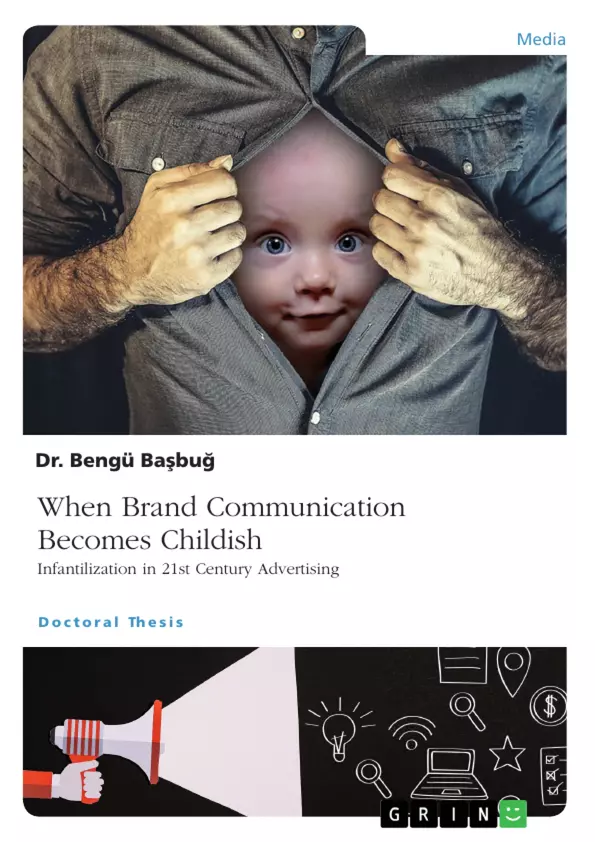
Living in a media-dominated age in which countless images circulate around the world, we are constantly faced with an environment that has become increasingly saturated by advertising. An emerging phenomenon that can be increasingly noticed in a global sense, but especially in Turkish advertising of 21st century which will be explored in this doctoral thesis, is infantilization.
Infantilization is the practice of treating adults like children and, thus, viewing them as if they have never grown up – an old concept which appears in a great number of fields, from natural sciences to social and cultural studies. However, infantilization received rarely attention until late 20th century, even processes of infantilization had been occurring for centuries in various areas of life from religion to politics. Although infantilization is not new, its contemporary range of development and its influence on consumers today is. Meanwhile it has reached its ultimate breakthrough in the realms of marketing and mass media culture in general.
Consumer infantilization increasingly becomes a technique to attract adults by approaching them like children with advertisements based on the imagination and level of a child. In this sense, the Turkish advertising landscape is rich in elements from children’s worlds which originally address children but actually are instrumentalized in particular for adult consumer purposes. Thus, the purpose of the thesis is to examine and improve a deeper understanding of infantilization as an emerging phenomenon in 21st century with regard to its implementation in Turkish advertising. The thesis will demonstrate how and why brands implement the concept of infantilization within the framework of their marketing strategy in advertisements.
Using the qualitative multiple-case study research design, the thesis adopts a psycho-semiotic method within the postmodern worldview by analyzing selected advertising campaigns (226 commercials and 52 Facebook posts) of 60 well-known brands in Turkey between 2004-2018. The overriding aim of the thesis is to reveal how the ideal postmodern consumer – the child-like adult – is attempted to create through infantilization within unconscious processes by activating psychic dynamics via childhood signs embedded in Turkish advertisements.
Table of Contents
1. INTRODUCTION
1.1. BACKGROUND AND MOTIVATION
1.2. FOCUS
1.3. STRATEGY
1.4. PURPOSE
1.5. SIGNIFICANCE
1.6. DISPOSITION
2. 21ST CENTURY ADVERTISING
2.1. THE ERA WE LIVE IN: KEY FEATURES OF 21ST CENTURY
2.1.1. Postmodern Times
2.1.2. Media Explosion
2.1.3. Massive Consumerism
2.1.4. Age of Uncertainty
2.2. ADVERTISING
2.2.1. Definition and Key Characteristics
2.2.2. Postmodern Marketing Strategy in 21st Century Advertising
2.2.2.1. Why Postmodern Advertising Appeals
2.2.2.2. Features of Postmodern Advertising
2.3. BETWEEN WESTERN ORIENTATION AND EASTERN TRADITION: TURKEY
3. INFANTILIZATION
3.1. DEFINITIONS, TERMINOLOGY, AND METAPHORICAL DIMENSIONS
3.2. INTERDISCIPLINARY SPECTRUM
3.3. HISTORICAL BACKGROUND AND USAGE
3.4. BETWEEN TWO POLES: CHILDHOOD VERSUS ADULTHOOD
3.4.1. Childhood
3.4.2. Adulthood
3.5. OLD CONCEPT, NEW TWIST
3.5.1. From Protestant Ethic to Infantilist Ethos: The New Spirit of 21st Century Capitalism
3.5.1.1. Ideological Shift
3.5.1.2. Core Traits
3.5.1.3. Economic Imperative
3.5.1.4. Formula of the Ideal Consumer: Kid + Adult = Kid-ult
3.5.2. Infantilization Becomes Mainstream: The Contemporary Media and Marketing Landscape
3.6. RESPONSE TO A CHANGING ZEITGEIST: SERIOUS CONCERNS AND IRRESISTABLE CHARM OF INFANTILIZATION
3.6.1. Serious Concerns: Infantilization in the Critical View
3.6.2. Irresistible Charm: Generational Motivations for Infantilization
4. INFANTILIZATION IN ADVERTISING CONTEXT: A PSYCHO-SEMIOTIC FRAMEWORK AND CASE STUDY METHODOLOGY
4.1. A MASS CULTURAL DESIRE FOR THE CHILDLIKE: PSYCHOLOGICAL DYNAMICS DRIVING INFANTILIZATION
4.1.1. On the Freudian Couch: Psychoanalyzing Infantilization
4.1.2. Trip Back to Childhood: Consumer Regression, Infantilism, and Postmodern Nostalgia
4.1.3. Archetypal Traces: Jung’s Eternal Child and Mother
4.1.4. Parent-Child Ego States: Berne's Transactional Analysis
4.1.5. Cute at First Sight, Young at Heart: An Evolutionary Psychological Perspective on Infantilization
4.1.5.1. Cuteness Sells! Why Consumers Are Attracted to the Infantile
4.1.5.2. Childlike Consumer Behavior and Psychological Neoteny
4.2. SEMIOTICS OF INFANTILIZATION: READING SIGNS OF CHILDHOOD IN ADVERTISING
4.2.1. Semiotics: What it Means and Why it Matters
4.2.2. Science of Signs: Origins and Features of Semiotics
4.2.2.1. Saussure’s Dyadic Sign: Signifier and Signified
4.2.2.2. Peirce’s Triadic Sign and Typologies
4.2.2.3. Barthes’ Mythical Sign and Orders of Signification
4.2.3. Advertising as a Sign-Creating System: Insights and Instruments
4.2.4. Infantilization via Signs of Childhood: A Theory Development
4.2.4.1. Instrumentalizing Childhood for Adult Consumer Purposes
4.2.4.2. The Kinder Surprise Effect: How Can We Reveal Infantilization?
4.3. PSYCHO-SEMIOTIC APPROACH AND CASE STUDY METHODOLOGY
4.3.1. Research Design: Qualitative Case Study Methodology
4.3.2. Psycho-Semiotic as Research Method
4.3.3. Research Process of the Study
4.3.3.1. Cross-Sectoral Data Analysis and Selection of Brands
4.3.3.2. Identification of Infantilizing Design Elements and Techniques in Advertisements
4.3.3.3. Development of Multiple Cases Studies
5. MULTIPLE CASE STUDIES: INFANTILIZATION IN TURKISH ADVERTISING
5.1. REINVENTING CHILDREN’S TRADITIONAL STORIES: ADULTS’ ADVENTURES IN THE FANTASY WORLDS OF BRANDS
5.1.1. “I Have a Dream…”: Like Alice in Consumerland
5.1.1.1. Get Whatever You Want, Whenever You Want: Welcome to Odealand!
5.1.1.2. Diving into Brand New Worlds: A Child’s Play with Yumoş
5.1.1.3. Toyota Joyride through Wonderland
5.1.2. Back to Idyllic Nature and Purity: A Heidi-fication with Rinso
5.1.3. Enchanted Brands Environments
5.1.3.1. From Ikea to Cif: How Brands Satisfy the Inner Princess
5.1.3.2. Enchanted Kitchen Ensemble: Sunlight Cif’s Beauty and the Beast
5.1.4. When Talking Animals Advise Adults in Financial Issues: Garanti Bank’s Fabulous Bremen Town Musicians
5.1.5. Following in the Footsteps of Nils Holgersson: Around the World with Turkish Airlines’ Wingo
5.1.6. Monstrous Insights into Brands’ Microworlds
5.1.6.1. Infantile Germ Wars with Domestos
5.1.6.2. Antibacterial, Tough, and Durable: Royal Halı and Düfa Boya
5.1.6.3. Organic Food Style with L’Era Fresca
5.1.6.4. Anadolu Sigorta’s Infantile Cyclopes: Nazar and Kısmet
5.1.7. Consumer-Driven Neverland and Peter Pan in Türk Telekom: Are Consumers the Lost Boys?
5.2. REVIVAL, REMAKE, RECONNECTION: INFANTILE BRAND PROMOTION WITH CHILDREN’S ENTERTAINMENT MEDIA FOR ADULTS
5.2.1. Retro Cartoons
5.2.1.1. “Money Must Be Funny in the Rich Man’s World”: Duck Tales in Enpara.com
5.2.1.2. Peanut’s Snoopy in MetLife
5.2.1.3. Betty Boop in Papia and Bernardo
5.2.1.4. Wannabe Garfields: The Cats of Türk Telekom and Alarko
5.2.1.5. Casper-ly Ghost: Türk Telekom’s Bulut
5.2.2. Vadaa, Moneygiller, Emocanlar: Infantile Heroic Brand Creatures
5.2.3. Classic TV Shows: Fragments of Sesame Street and The Muppets
5.2.3.1. If “Your Better Half” Infantilizes You: Spectres of Simulacra with Maximum Card
5.2.3.2. Seeing the World through Children’s Eyes: Secret Sides of the ING Bank’s Lion Puppet
5.2.4. Cartoonized and Animated: Infantile Inner Lifes of Products
5.2.4.1. Dyo’s Molecules, Margarine Girl & Co.: The Many Infantile Figures of Brand Spheres
5.2.4.2. Banvit’s Lezzetçibaşı: The Imaginary Friend of Housewives
5.2.4.3. Algida’s Ice Creams Making Propaganda: Political Election Spectacle as Infantile Infotainment
5.2.4.4. From Brush Man to Manga Girl Ajda Pekkan: Polisan Boya
5.2.4.5. Infantile Robotic Brand Character: Garanti’s Ugi
5.2.4.6. From Pepee-Oriented Characters to Stick Figures: Brand’s Preschool Approaches to Serious and Sensitive Issues
5.2.5. Childlike Video Games and Virtual Reality
5.2.5.1. Retro Video Games in Axe and Duracell
5.2.5.2. When Life Becomes a Video Game: Street Fighter Legend in Anadolu Sigorta
5.2.5.3. Avea’s Teletubbied Virtual Reality
5.2.5.4. Opedo as the Turkish Mega Man
5.3. RENAISSANCE OF TOY STORIES, TASTES, PLACES & CO.: BRANDED ADULT VERSIONS OF CHILDHOOD SYMBOLS AND MOTIFS
5.3.1. Brand New Toy Stories
5.3.1.1. Consuming Barbie Worlds with Maximum Card and Axe
5.3.1.2. Toyota Auris’ Car Story
5.3.1.3. Commercial Teddy Bears
5.3.1.4. The Lego Life of Aras Kargo
5.3.2. From Children’s Day to Dirt: Childhood Habits as Reminders
5.3.2.1. Promoting Children’s Day as Adult’s Inner Child Day
5.3.2.2. Products as Symbolic Mothers: How Vitra and Selpak Cares
5.3.2.3. Dirt is Good: Omo for Inner Child Development
5.3.3. Kindergartened and Schoolish Symbols
5.3.3.1. Like a Kindergarten Celebration: The Hopi App
5.3.3.2. Brand’s School Time for Adults
5.3.3.3. Adultified Babies and Babified Men in Bruno’s Kindergarden
5.3.3.4. From Nursery Rhymes to Bubble Play: Traditional Children’s Games for Adults
5.3.4. Milk, Ice-Cream & Candy: Childhood Tastes as a Ticket Back to Childhood
5.3.4.1. Pınar, Torku, and İçim: Milk as Reconnector to Childhood
5.3.4.2. Returning Back to Childhood with Panda Ice-Cream
5.3.4.3. Candies Make Children Happy – But Adults Even More!: Haribo and The Gummy Bear Cult in 118 80
5.3.5. Baby Alarm: Striving for Infanthood
5.3.5.1. The Baby Within the Adult: “Live Young” with Evian
5.3.5.2. Striving for Infantile Appearances with L’Oréal
6. CONCLUSIONS AND DISCUSSION
6.1. GENERAL EVALUATION OF MULTIPLE CASE STUDY ANALYSIS
6.2. KEY FINDINGS AND DISCUSSION: INFANTILIZATION IN 21ST CENTURY ADVERTISING
Research Objectives and Themes
The primary aim of this doctoral thesis is to explore and analyze the emerging phenomenon of infantilization within 21st-century Turkish advertising. The study addresses the core research question of how and why brands implement infantilization—a strategy that treats adult consumers as children—within their marketing strategies. By adopting a psycho-semiotic approach, the dissertation investigates the unconscious processes and symbolic manipulations that brands use to activate childhood dynamics, ultimately revealing how companies attempt to shape the "ideal postmodern consumer" (the child-like adult) to reinforce consumerist behavior.
- The implementation of infantilization as a strategic marketing tool in Turkey.
- Psychological dynamics, such as regression and the "inner child," that drive consumer responses.
- Semiotic analysis of childhood signs, motifs, and traditional stories used in advertising.
- The transformation of consumer identity and the emergence of the "kidult."
- Cultural and socio-economic contexts that facilitate infantilizing strategies in the Turkish market.
Auszug aus dem Buch
1.1. BACKGROUND AND MOTIVATION
Living in a media-dominated age in which countless images circulate around the world, we are constantly faced with an environment that has become increasingly saturated by advertising. Being an important tool of marketing for promoting consumerism to inspire brand systems, advertising is an incredible means of persuasion with its textual, visual, and auditory components (Moriarty et al., 2009). An emerging phenomenon that can be increasingly noticed in a global sense, but especially in Turkish advertising of 21st century which will be explored in this thesis, is infantilization.
Infantilization (in Turkish: “enfantilizasyon”, meaning çocuklaştırma) – the practice of treating adults like children and, thus, viewing them as if they have never grown up – is an old concept which appears in a great number of fields, from natural sciences to social and cultural studies. However, infantilization received rarely attention until late 20th century, even processes of infantilization had been occurring for centuries in various areas of life from religion to politics. But although infantilization is not new, its contemporary range of development and its influence on consumers today is. Infantilization has now achieved a new twist reaching its ultimative breakthrough in the realms of marketing and is meanwhile an essential centerpiece of mass media culture (Dorfman, 1987: 177; Danesi, 2003; Barber, 2007). However, infantilization has not developed randomly out of nowhere; it is an omnipresent large-scale, strategically planned and industrially promoted postmodern phenomenon emerging in 21st century, which operates and establishes itself, slowly but surely, at the very centre of contemporary Western societies.
Summary of Chapters
1. INTRODUCTION: This chapter introduces the core phenomenon of infantilization, discusses the research motivation, outlines the methodology, and defines the scope and significance of the study within the context of postmodern advertising.
2. 21ST CENTURY ADVERTISING: This section explores the media-saturated and uncertain landscape of the current era, examining how postmodern marketing strategies increasingly influence advertising practices in Turkey.
3. INFANTILIZATION: This chapter provides a theoretical exploration of infantilization, covering its historical roots, interdisciplinary spectrum, and its role as a new ethos in consumer capitalism.
4. INFANTILIZATION IN ADVERTISING CONTEXT: A PSYCHO-SEMIOTIC FRAMEWORK AND CASE STUDY METHODOLOGY: This section details the analytical approach by combining psychological theories with semiotic methods to interpret how childhood signs are strategically utilized in advertising.
5. MULTIPLE CASE STUDIES: INFANTILIZATION IN TURKISH ADVERTISING: This central chapter presents empirical analysis through various case studies, demonstrating how traditional stories, retro cartoons, and childhood symbols are reconstructed in brand campaigns to appeal to adult consumers.
6. CONCLUSIONS AND DISCUSSION: The final chapter summarizes the findings of the study, evaluates the effectiveness of infantilizing strategies, and offers concluding thoughts on the future of consumer behavior in an infantilized marketplace.
Keywords
Infantilization, Advertising, Postmodernism, Psychology, Semiotics, Consumerism, Kidult, Inner Child, Branding, Media Culture, Psycho-Semiotic, Turkish Advertising, Nostalgia, Symbols, Neoteny
Frequently Asked Questions
What is the core subject of this thesis?
The thesis explores the phenomenon of "infantilization" in 21st-century advertising, specifically how brands target adult consumers by using childlike imagery, themes, and psychological triggers.
What are the primary themes analyzed in the research?
The research focuses on the transition of capitalism into an "infantilist ethos," the use of childhood signs as semiotic codes, psychological regression to childhood, and the influence of postmodern culture on adult consumer identities.
What is the primary research goal?
The overriding objective is to reveal how and why brands implement infantilization within their marketing strategies in Turkish advertising, thereby filling a significant gap in academic literature.
Which scientific methods are employed?
The thesis uses a qualitative multiple-case study design, applying a "psycho-semiotic" method to analyze 226 commercials and 52 Facebook posts from 60 well-known brands.
What does the main body of the work cover?
The main part of the thesis categorizes and analyzes various case studies, ranging from the reinvention of fairy tales to the use of retro cartoons and childhood symbols in contemporary brand promotions.
Which keywords characterize this work?
The most important keywords include Infantilization, Advertising, Postmodernism, Psychology, Semiotics, Consumerism, Kidult, Inner Child, and Brand Identity.
How does Turkey compare to Western countries regarding this trend?
The study highlights that while infantilization is a global phenomenon, it manifests with unique power in Turkey due to its specific socio-cultural structure, characterized by a young population and a strong collectivist "We-orientation" within family systems.
What is the "kidult" phenomenon in the context of this study?
A "kidult" refers to an adult who cultivates tastes, hobbies, and mindsets traditionally associated with children. The study illustrates how advertisers actively create and cater to this hybrid identity to maintain consumption cycles.
- Citar trabajo
- PhD Bengü Basbug (Autor), 2018, When Brand Communication Becomes Childish. Infantilization in 21st Century Advertising, Múnich, GRIN Verlag, https://www.grin.com/document/465677