Junior Management Science (JUMS) ist das erste wissenschaftliche Journal, das die besten Abschlussarbeiten der Betriebswirtschaftslehre aus Deutschland, Österreich und der Schweiz (DACH-Region) veröffentlicht.
Für die Publikationen von JUMS legen wir höchste wissenschaftliche Qualitätskriterien an. Um diese sicherzustellen, unterliegen die Abschlussarbeiten – wie in der Wissenschaft üblich – einem double-blind Review-Prozess. Dies bedeutet, dass zwei Wissenschaftler*innen die Abschlussarbeiten unabhängig voneinander begutachten, ohne zu wissen, von wem und an welcher Hochschule die Arbeit verfasst worden ist. Nur die Arbeiten, welche einstimmig als herausragend beurteilt werden, werden von uns publiziert. Die Qualität der Begutachtung wird nicht zuletzt durch unser Advisory Editorial Board gewährleistet, welches über 50 Professor*innen von mehr als 30 Universitäten und Hochschulen aus der DACH-Region umfasst.
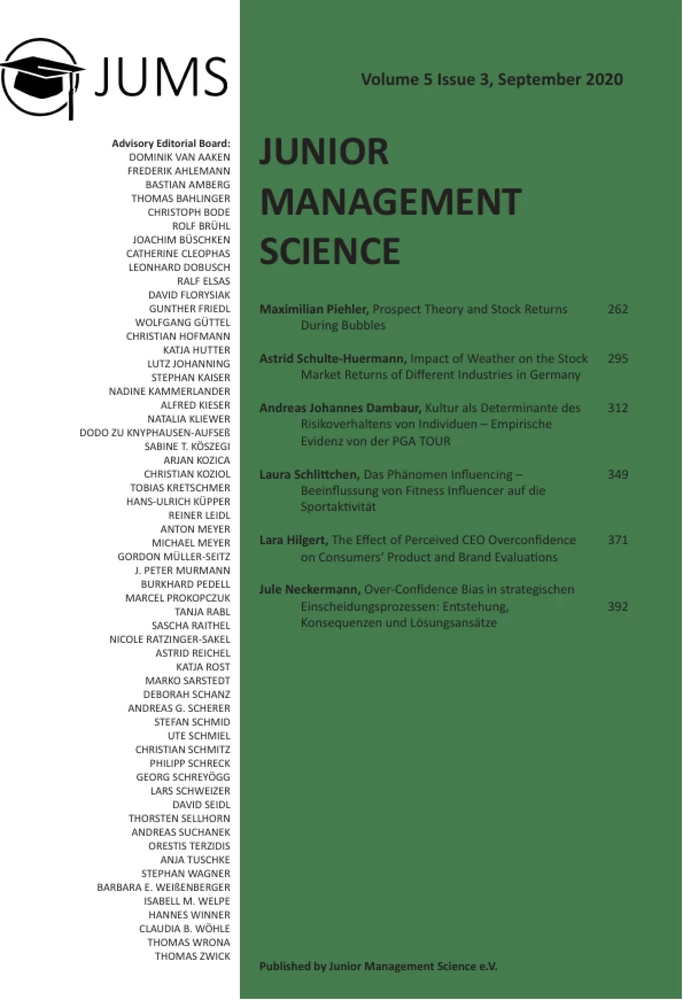
In diesem Sammelband befinden sich die besten Beiträge im Jahr 2020, welche in Junior Management Science Volume 5 Issue 3 publiziert wurden.
"Prospect Theory and Stock Returns During Bubbles" von Maximilian Piehler
Keywords: Prospect Theory; bubbles; limits to arbitrage; individual investors.
"Impact of Weather on the Stock Market Returns of Different Industries in Germany" von Astrid Schulte-Huermann
Keywords: Stock markets; investor behaviour; weather effect; market returns; decision-making.
"Kultur als Determinante des Risikoverhaltens von Individuen – Empirische Evidenz von der PGA TOUR" von Andreas Johannes Dambaur
Keywords: risk-taking; cultural background; sports economics; behavioral economics.
"Das Phänomen Influencing – Beeinflussung von Fitness Influencern auf die Sportaktivität" von Laura Schlittchen
Keywords: Fitness Influencer; Sport; Soziale Medien; Instagram und Training.
"The Effect of Perceived CEO Overconfidence on Consumers’ Product and Brand Evaluations" von Lara Katharina Hilgert
Keywords: Overconfidence; leadership; consumer; perception; brand.
"Over-Confidence Bias in strategischen Entscheidungsprozessen: Entstehung, Konsequenzen und Lösungsansätze" von Jule Neckermann
Keywords: Overconfidence; strategische Entscheidung; kognitive Verzerrungen; Debiasing.
Inhaltsverzeichnis
1. Introduction
1.1. Motivation
1.2. Approach
2. Prospect theory
2.1. Representation and valuation
2.2. Valuation
2.2.1. Valuation methodology
2.2.2. Components of prospect theory and related concepts
2.3. Representation
2.3.1. Gains and losses in the stock market
2.3.2. Information sources
2.3.3. Prospect theory value of return distributions
3. Model of asset prices
3.1. The model by Barberis et al. (2016)
3.2. Model extension and hypothesis
4. Review of the evidence
4.1. Limits to arbitrage
4.1.1. Arbitrage
4.1.2. Risks associated with arbitrage
4.1.3. Measures for the limits to arbitrage
4.1.4. Limits to arbitrage and implementation costs during bubbles
4.2. Individual investor’s participation during bubbles
5. Bubbles
5.1. A short history of bubbles
5.2. Detecting bubbles in asset prices
5.3. The Phillips et al. (2015a) approach for bubble detection
5.3.1. Rational bubble model
5.3.2. SADF and GSADF test
5.3.3. Time stamping bubbles
5.3.4. Other applications
5.4. Bubbles in the S&P 500
5.4.1. Data
5.4.2. SADF test of the S&P 500
5.4.3. Time stamping of bubbles in the S&P 500
6. Prospect theory and stock returns during bubbles
6.1. Empirical approach
6.2. Data
6.2.1. Databases
6.2.2. Data Summary
6.3. Portfolio sorts on prospect theory value
6.4. Prospect theory and stock returns in the cross section
6.5. Prospect theory value, limits to arbitrage and individual investors
6.6. On the relevance of prospect theory components
6.7. Prospect theory versus expected utility
6.8. Decile sorts on prospect theory value
7. Conclusion and summary of results
Zielsetzung & Themen
Die Forschungsarbeit untersucht die Anwendung der Prospect Theory auf Aktienrenditen, insbesondere während Marktphasen mit spekulativen Blasen. Das primäre Ziel ist es, zu prüfen, ob Aktien mit einem hohen Prospect-Theory-Wert, die als überbewertet gelten, in Zeiten von Blasenbildungen niedrigere Renditen erzielen als in normalen Marktphasen, unter Berücksichtigung von Arbitrage-Grenzen und individuellen Anlegerentscheidungen.
- Empirische Untersuchung der Prospect Theory auf US-Aktienmärkten.
- Methodische Identifikation und Zeitstempelung von spekulativen Blasen im S&P 500.
- Analyse des Einflusses von Arbitrage-Grenzen auf die Renditeerwartungen.
- Untersuchung des Verhaltens privater versus rationaler Investoren.
- Vergleich der Vorhersagekraft von Prospect Theory gegenüber der klassischen Erwartungsnutzentheorie.
Auszug aus dem Buch
1. Introduction
The decision whether to buy or sell a stock is risky. In order to understand the buying and selling behaviour in the stock market it is therefore important to investigate how investors make risky choices. In other words, how do investors evaluate a given stock and how can this be integrated into pricing models? In the past century, many researchers modelled investor’s choices via expected utility. They assumed that investors maximize their expected utility, which is the sum of the utility of each outcome weighted by its probability. It relies on certain assumptions formalized by Neumann (1944). Expected utility has been a useful tool for research in investor behaviour and asset pricing. Nonetheless, the pricing models based on its assumptions do not explain stock prices with complete precision. Several anomalies seem to persist in the stock market, despite multi-factor pricing models. For example, Jegadeesh and Titman (1993) find that stocks that performed well during the past year subsequently outperform stock that did poorly during the past year. This effect is generally called momentum. De Bondt and Thaler (1985) report on long-term reversal: a stock’s returns over the last two to five years on average negatively predict the subsequent return. Similarly, there is a short-term reversal in stock returns i.e. the return of the last month negatively predicts the following return, discovered by Lehmann (1990). More recently, Ang et al. (2006) find that the volatility of idiosyncratic returns has a negative effect on returns, while Novy-Marx (2013) shows how measures of firm profitability have a positive effect on returns, with a predictive power comparable to that of the book-to-market ratio. In light of these return patterns which are hard to make sense of using classical measures of risk and return, some researchers have focused on behavioural explanations. Maybe it is wrong to assume that investors make rational investment choices in the stock market. Kahneman and Tversky (1979) and Tversky and Kahnemann (1992) offer an alternative model of preferences and choice under risk: prospect theory.
Zusammenfassung der Kapitel
1. Introduction: Diese Einleitung führt in die Problematik ein, wie Investoren risikoreiche Aktienentscheidungen treffen, und stellt die Prospect Theory als Alternative zur klassischen Erwartungsnutzentheorie vor.
2. Prospect theory: In diesem Kapitel wird die theoretische Grundlage der Prospect Theory sowie die Konstruktion von Renditeverteilungen und die Bedeutung von Referenzpunkten bei Investitionsentscheidungen erläutert.
3. Model of asset prices: Hier wird das von Barberis et al. (2016) stammende Modell des Aktienmarktes präsentiert und um eine Hypothese zu Blasenphasen erweitert.
4. Review of the evidence: Dieser Abschnitt bietet einen Literaturüberblick zu Arbitrage-Grenzen sowie zum Verhalten individueller Anleger während Blasen.
5. Bubbles: Kapitel 5 widmet sich der Definition und Detektion spekulativer Blasen sowie der Anwendung dieser Methoden auf den S&P 500 Index.
6. Prospect theory and stock returns during bubbles: Der empirische Hauptteil analysiert die Auswirkungen der Prospect Theory auf die Aktienrenditen, unterteilt in Blasen- und Nicht-Blasenphasen.
7. Conclusion and summary of results: Das Fazit fasst die Ergebnisse zusammen und diskutiert die Implikationen für die Verhaltensökonomie.
Schlüsselwörter
Prospect Theory, Spekulative Blasen, Limits to Arbitrage, Privatanleger, Behavioral Finance, Asset Pricing, S&P 500, Risikopräferenzen, Erwartungsnutzentheorie, Verlust-Aversion, Wahrscheinlichkeitsgewichtung, Renditeanomalien, Volatilität, Aktienmärkte, Verhaltensökonomie.
Häufig gestellte Fragen
Worum geht es in dieser Arbeit grundsätzlich?
Die Arbeit untersucht, ob die Prospect Theory dazu beitragen kann, Aktienrenditen besser zu erklären, insbesondere unter Berücksichtigung von Verhaltensanomalien in Phasen spekulativer Blasen.
Was sind die zentralen Themenfelder?
Die Schwerpunkte liegen auf Behavioral Finance, der Modellierung von Investorenentscheidungen, der Identifikation von Marktblasen und der Analyse von Arbitrage-Grenzen an den Finanzmärkten.
Was ist das primäre Ziel der Forschungsarbeit?
Das Hauptziel ist es, zu testen, ob der von der Prospect Theory abgeleitete Effekt – dass Aktien mit hohem Prospect-Value geringere zukünftige Renditen erzielen – während Blasenphasen aufgrund veränderter Anlegerbeteiligung und höherer Arbitrage-Kosten verstärkt auftritt.
Welche wissenschaftliche Methode wird verwendet?
Es kommen ökonometrische Verfahren zur Anwendung, insbesondere Fama-MacBeth-Regressionen und die Identifikation von spekulativen Blasen mittels des BSADF-Tests nach Phillips et al.
Was wird im Hauptteil behandelt?
Der Hauptteil befasst sich mit der theoretischen Herleitung, der empirischen Datenaufbereitung, der Identifikation von Blasen im S&P 500 sowie der Durchführung statistischer Tests zur Validierung der Hypothesen.
Welche Schlüsselwörter charakterisieren die Arbeit?
Prospect Theory, spekulative Blasen, Limits to Arbitrage, Behavioral Finance und Asset Pricing sind die Kernkonzepte der Analyse.
Was ist das Besondere an der Analyse von Blasenperioden im Vergleich zu normalen Marktphasen?
Der Autor argumentiert, dass in Blasenphasen die effektive Partizipation irrationaler Anleger steigt und Arbitrage-Kosten zunehmen, was das Potenzial für eine stärkere Fehlbewertung von Aktien mit hohem Prospect-Value erhöht.
Inwiefern unterscheidet sich der Ansatz der Prospect Theory von der Erwartungsnutzentheorie in dieser Untersuchung?
Während die Erwartungsnutzentheorie auf rationalen Axiomen basiert, nutzt die Arbeit die Prospect Theory, um Verzerrungen wie Verlustaversion und Wahrscheinlichkeitsgewichtung als deskriptive Faktoren für das Anlegerverhalten direkt in die Preismodelle zu integrieren.
- Quote paper
- Junior Management Science e.V. (Editor), 2020, Junior Management Science, Volume 5, Issue 3, September 2020, Munich, GRIN Verlag, https://www.grin.com/document/961483