This paper aims to make appropriate recommendations, corroborated by academic and practical knowledge, that should contribute to the turnaround of the ailing Prague Hotel. The recommendations are based on the case study information provided in the appendix. Given the increasing importance of the internet the paper devotes considerable attention to online marketing activities. In particular, it focuses on online distribution, web design, search engine optimisation and online advertising, but it will also refer to market segmentation as well as product and pricing strategies.
The impact of information technology on the hotel industry is highlighted by a separate case study of the hotel chain Omena Hotels. In addition, an industry analysis using Michael Porter’s Five Forces model is provided in the appendix. Since employees make a significant contribution to guest satisfaction and eventually business success, the paper refers to the key factors that affect employee motivation, satisfaction and retention. Due to the complexity of the aspects covered in this paper and the need to clarify some of them more comprehensively, appendices are provided that include more detailed information and practical examples.
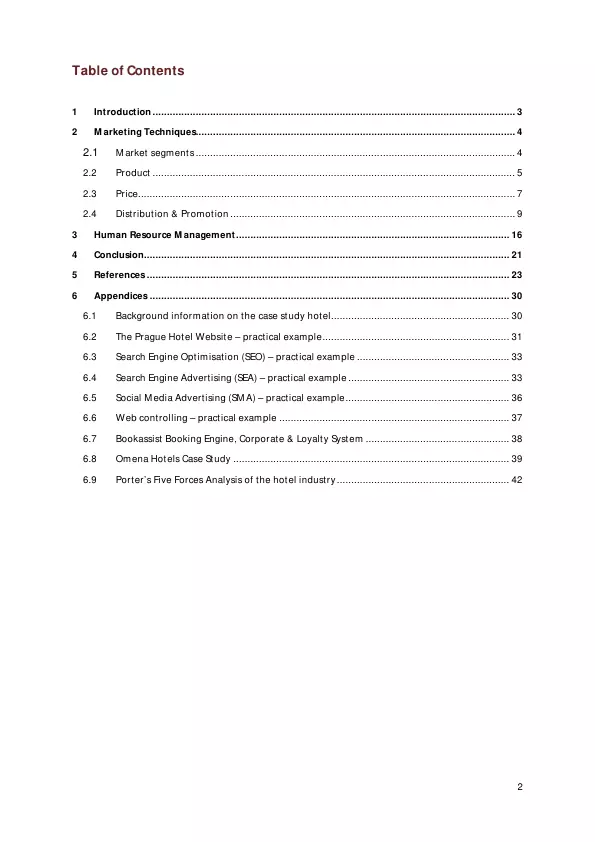
Table of Contents
1 Introduction
2 Marketing Techniques
2.1 Market segments
2.2 Product
2.3 Price
2.4 Distribution & Promotion
3 Human Resource Management
4 Conclusion
5 References
6 Appendices
6.1 Background information on the case study hotel
6.2 The Prague Hotel Website – practical example
6.3 Search Engine Optimisation (SEO) – practical example
6.4 Search Engine Advertising (SEA) – practical example
6.5 Social Media Advertising (SMA) – practical example
6.6 Web controlling – practical example
6.7 Bookassist Booking Engine, Corporate & Loyalty System
6.8 Omena Hotels Case Study
6.9 Porter’s Five Forces Analysis of the hotel industry
Objectives & Core Topics
This paper provides strategic recommendations for the turnaround of the Prague Hotel by integrating academic theory with practical applications in marketing and human resource management. The core objective is to improve occupancy, guest satisfaction, and long-term competitiveness in a challenging economic environment.
- Strategic realignment of marketing efforts and online distribution channels.
- Optimization of product offerings and pricing strategies to maximize revenue.
- Enhancement of human resource management to boost employee motivation and service quality.
- Analysis of information technology’s role in modern hospitality business models.
Excerpt from the Book
2.1 Market segments
In a highly competitive marketplace it has become essential to extend a company’s product range in order to target more than just one market segment. In the case of the Prague Hotel it is recommended to “target segments in which it can profitably generate the greatest customer value and sustain it over time” (Kotler, et al, p. 69).
In addition to the existing target customers which are airline staff, business travellers, students and backpackers, the Prague Hotel could take advantage of seasonal local events, the 18-hole golf course situated nearby, the newly constructed “Aquapalace”, which is the biggest water park in central Europe (Aquapalace Praha, 2010), and its image being one of the most romantic cities in the world. Tailor-made packages could therefore attract especially those people that would like to combine culture, sightseeing, shopping or leisure activities. This approach can be highly supportive to sell empty rooms, in particular on weekends. Moreover, the existing conference facilities are perfectly suitable for weddings, birthday parties and so forth. Hence, the Prague Hotel might even attract those people that seek the ideal venue for such events. When it comes to the hotel restaurant and coffee shop, the Prague Hotel could give them a particular name and offer certain specialities in order to make them more interesting for external guests. Many hotels, especially those of large hotel chains, have given their food and beverage outlets distinctive names which attract significant attention from internal and external guests alike.
Summary of Chapters
1 Introduction: Introduces the competitive challenges of the hotel industry and outlines the strategic focus on marketing and human resource management for the Prague Hotel.
2 Marketing Techniques: Examines strategies for market segmentation, product development, pricing, and the crucial role of digital distribution and promotion.
3 Human Resource Management: Discusses the importance of staff motivation, organizational culture, and strategic leadership in delivering high-quality guest service.
4 Conclusion: Summarizes the necessity of adopting dynamic, technology-integrated strategies to maintain competitiveness and ensure long-term viability.
5 References: A comprehensive list of academic and professional sources utilized throughout the paper.
6 Appendices: Provides supplemental practical examples, case studies, and industry analyses, including the Omena Hotels case and Porter's Five Forces model.
Keywords
Hotel Management, Marketing Strategies, Human Resource Management, Online Distribution, Customer Satisfaction, Competitive Advantage, Digital Marketing, E-Business, Prague Hotel, Service Quality, Pricing Strategy, Market Segmentation, Organizational Culture, Porter’s Five Forces, Information Technology.
Frequently Asked Questions
What is the primary focus of this paper?
The paper focuses on revitalizing the performance of the Prague Hotel by addressing weaknesses in its marketing and human resource management strategies through modern, digital-first approaches.
What are the central themes discussed in the work?
The central themes include digital marketing, online distribution, employee motivation, service culture, and the impact of technology on traditional hotel business models.
What is the main goal or research question?
The primary goal is to provide actionable recommendations to improve the Prague Hotel’s occupancy rates and financial stability, ensuring it achieves a sustainable competitive advantage.
Which scientific methods are utilized?
The work employs a case study methodology combined with a comprehensive literature review of marketing and strategic management theories to analyze current industry practices.
What topics are covered in the main body?
The main body covers market segmentation, product tailoring, pricing strategies, the transition to online distribution channels, and the implementation of a customer-oriented organizational culture.
Which keywords best characterize this work?
Key terms include Hotel Management, Digital Marketing, Strategic Management, Service Quality, and Human Resource Development.
How does the Omena Hotels case study contribute to the discussion?
It illustrates a successful, technology-driven business model that highlights how automation and digital systems can bridge market gaps and drive cost efficiency.
What role does employee management play in the proposed turnaround?
Effective human resource management is presented as essential for service delivery; the paper emphasizes that motivated, well-trained staff are the key to building an outstanding, customer-oriented service culture.
Why is the "online channel" emphasized so strongly?
The paper identifies the online channel as the primary growth driver, noting that hotels must establish a professional, direct online presence to reduce dependency on intermediaries and capture modern travelers.
What does the Porter’s Five Forces analysis suggest about the hotel industry?
It suggests that while the internet offers opportunities for direct engagement, it also increases the bargaining power of buyers and creates new competitive threats, necessitating a flexible and adaptive strategy.
- Citation du texte
- Christoph Müller (Auteur), 2010, Contemporary Marketing and Human Resource Management in the Hotel Industry, Munich, GRIN Verlag, https://www.grin.com/document/178566