
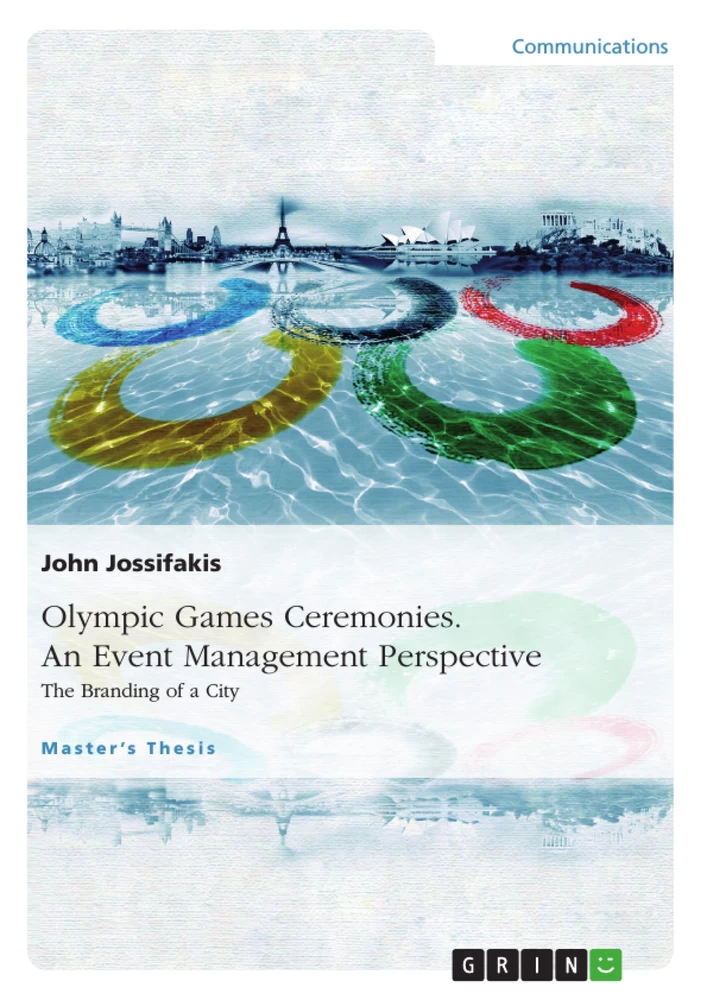
The major purpose of this study is to analyse the major impact that an Olympic Games ceremony has on the branding of a city and of a nation, looking to take the current level of research and improving on this with an enhanced analysis of the subject using a case study approach.
The study has focused on one main research question. What is the impact of an Olympic Ceremony on the image of a host city? This question was further explored with three core components which were analysed and which included the discovery of the extent to which an Olympic Games ceremony could help to create an image of a specific city / country, the importance ascribed to Olympic Games ceremonies and how they are deemed to be vital in leading to rising tourist numbers as well as a consideration of the major short and long-term socio-economic impacts of an Olympic Games ceremony on a host city.
Table of Contents
1. Introduction
1.1. Overview
1.2. Background
1.3. Purpose of Study
1.4. Research Aims and Objectives
1.5. Structure of Dissertation
2. Review of the Literature
2.1. Introduction
2.2. Overall Impact of an Olympic Games on the Host City
2.3. Tourism, Branding and Event Hosting
2.4. Impact of Hosting a Sports Event on a City
2.5. Importance of Olympic Games Ceremonies on Tourism
2.6. Summary
3. Research Design and Methodology
3.1. Overview
3.2. Mixed Methodology
3.3. Case Study Analysis
3.4. Research Design
3.5. Research Instruments
3.6. Ethical Considerations
3.7. Limitations
3.8. Research Objectives
4. Data Presentation, Analysis and Discussion
4.1. Overview
4.2. Case Study Findings
4.3. Analysis and Discussion
5. Conclusion and Recommendations
5.1. Main Conclusions
5.2. Future Recommendations
Research Objectives and Themes
The primary aim of this study is to critically analyze the impact of Olympic Games ceremonies on the branding of host cities and nations. It investigates whether these ceremonies significantly influence tourism and socio-economic outcomes, addressing the research question: "What is the impact of an Olympic Ceremony on the image of a host city?"
- Analysis of the role of ceremonies in city branding and nation branding.
- Examination of the correlation between hosting ceremonies and tourism growth.
- Assessment of short-term and long-term socio-economic impacts of Olympic ceremonies.
- Evaluation of the "growth machine" theory and urban regeneration in host cities.
- Comparison of various Olympic Games case studies, including London, Beijing, Sydney, and Barcelona.
Excerpt from the Book
1.1. Overview
The desire to host Olympic Games in recent years, with countries across the globe competing to win the right to stage the sporting event, highlights the importance that has become to be attributed with the Games (Shipway & Fyall, 2013; Gold & Gold, 2007). The literature has underlined that ‘there is only the one chance every four years for athletes, and in most cases, only once for the hosting city to profile itself’ (van Vrijaldenhoven, 2007, p.25). Moreover, it has been acknowledged that because of the importance associated with the hosting of the event, in the history of the Olympic Games, there is a high level of competition, with it felt that ‘it is up to the candidate cities to convince the committee that their city has the most appropriate and complete plan’ (van Vrijaldenhoven, 2007, p.25). The study on the subject has also stated that, overall, there ‘are many reasons for staging a major special event, such as the Olympic Games. However, two of the more important reasons are the improvement of a destinations’ image or awareness’ (Faulkner & Faulker, 2003, p.152).
This level of importance attributed to the Olympic Games has been successfully studied in recent years, but there is a lack of research on the impact of a more specific event; that of the Olympic Games ceremony. This lack of research is discussed in chapter two of this work and has led to the overall aim of this work. Within this, the study aims to discover the extent to which an Olympic Games ceremony assists to create an image of a specific city / country, the importance ascribed to Olympic Games ceremonies and how they are deemed to be vital in leading to rising tourist numbers as well as a consideration of the major short and long-term impacts of an Olympic Games ceremony on a host city. To achieve this, the study aims to complete a conclusive case study analysis of Olympic Games ceremonies and the impact that this has on both the short and long-term branding of a host city.
Summary of Chapters
Chapter 1: Introduction: Outlines the significance of hosting the Olympic Games for city branding and establishes the research gap regarding the specific impact of ceremonies.
Chapter 2: Review of the Literature: Synthesizes existing academic research on the overall impact of the Olympics, the role of mega-events in tourism, and the theoretical underpinnings of city branding.
Chapter 3: Research Design and Methodology: Justifies the use of a mixed-methods, secondary-source case study approach to examine the ceremonies of various host cities.
Chapter 4: Data Presentation, Analysis and Discussion: Presents findings from case studies of past Olympic Games and evaluates the research objectives through comparative analysis.
Chapter 5: Conclusion and Recommendations: Summarizes the study's conclusions, rejecting the initial hypothesis that ceremonies have a direct, discernible impact on long-term tourism, and provides recommendations for future host cities.
Keywords
Olympic Games, Ceremonies, City Branding, Nation Branding, Tourism, Mega-events, Event Management, Socio-economic Impact, Urban Regeneration, Case Study, London 2012, Beijing 2008, Sydney 2000, Barcelona 1992, Legacy.
Frequently Asked Questions
What is the core focus of this research project?
This research evaluates the role of Olympic Games ceremonies as a tool for city and nation branding, assessing whether these events generate tangible long-term benefits for host cities.
What are the primary thematic areas explored?
The study centers on the intersection of event management, tourism, urban development, and the symbolic impact of global ceremonies on national and city image.
What is the main research question of the study?
The core research question is: "What is the impact of an Olympic Ceremony on the image of a host city?"
Which methodology does the author utilize?
The author employs a mixed-methodological approach, specifically using secondary source analysis and case studies of past Olympic host cities to gather data.
What does the main body of the research cover?
The body of the work covers a literature review of mega-events, the justification of the case study methodology, the presentation of expenditure data, and a critical analysis of the long-term effectiveness of ceremonial branding.
Which keywords best characterize this work?
Key terms include Olympic Ceremonies, City Branding, Tourism Impact, Mega-event Legacy, and Urban Regeneration.
What conclusion did the author reach regarding the impact of ceremonies on tourism?
The author found no discernible link between the ceremonies themselves and increased long-term tourism, leading to the rejection of the hypothesis that ceremonies alone trigger sustainable visitor growth.
How does the study evaluate the economic expenditure of ceremonies?
The study tracks the rapidly rising costs of ceremonies from 1992 to 2012, highlighting the disparity between the high investment in these events and the lack of measurable economic return in tourism figures.
- Quote paper
- John Jossifakis (Author), 2014, Olympic Games Ceremonies. An Event Management Perspective, Munich, GRIN Verlag, https://www.grin.com/document/276541

