Zum Warenkorb
Zum Warenkorb
Welcome to GRINspiration, the online magazine for self-publishers and aspiring authors! From academic papers to fantasy novels: here you'll find tips, tricks, and insights to help you successfully write and publish your work.
You are here: Magazine The Best Study Techniques for University
All articles
Bild von einer jungen Frau am Schreibtisch, die nachdenklich auf einen Zettel schreibt
12. April 2022 • Reading duration: 4 Min

The Best Study Techniques for University

How to become more productive: With the Pomodoro Technique, the Loci Method, and Mind Mapping, we introduce three effective study techniques for greater success during your studies.

What to expect:

First things first:

  • With the Pomodoro Technique, you can divide large topics into smaller learning units.
  • Use the Loci Method for memorizing information.
  • Mind maps help visualize connections and relationships.

What was already a challenge for many during school does not become easier at university: learning as much material as possible quickly and efficiently. Especially during exam periods, students often have to memorize a huge amount of different information within a very short time. But what is the best way to approach this?
In this article, we introduce three well-known methods that make studying easier: the Pomodoro Technique, the Loci Method, and Mind Mapping. These study techniques help you learn more productively and successfully manage exam preparation.

Pomodoro: Working and Studying in Smaller Time Intervals

The Italian Francesco Cirillo developed the so-called Pomodoro Technique in the 1980s: You set aside 25 minutes to study with full concentration and without distractions, followed by a five-minute break before starting the next 25-minute session.
Usually, after four such work sessions, a longer break of around 30 minutes follows. However, the number of work sessions can also be adjusted individually depending on your daily requirements.
The duration of individual study and break intervals can theoretically be varied as well. However, the structure of 25 minutes of focused work followed by a five-minute break has proven particularly effective.

The Pomodoro Technique is especially useful for studying large subject areas in smaller units. Complex learning material becomes easier to manage, and the sheer amount of information no longer feels overwhelming.
This also makes it easier to motivate yourself to start studying in the first place.
Today, you naturally no longer need to use an egg timer like Cirillo did. Instead, you can simply use modern Pomodoro apps for your smartphone or computer to organize your study sessions.

The Loci Method: Success with an Ancient Memory Technique

What the ancient Greeks could do, you can do too! Even professional memory champions still frequently use this simple technique today.
The Loci Method is not particularly suitable for learning complex relationships and concepts, but it is highly effective for memorizing many different terms and pieces of information.
The idea behind it is to mentally connect new information with familiar places (locus in Latin means “place”).

To do this, imagine a route through your apartment or shared flat, for example from the kitchen to the living room. Along this route, identify distinctive landmarks (such as doors, shelves, or other noticeable objects).
Once you have memorized these landmarks, you can connect them with different pieces of information.
This allows you not only to memorize study material but also, for example, to remember your shopping list.

The great advantage of the Loci Method is that you can use different routes and landmarks or reuse the same route for different sequences of information.
Of course, you do not have to limit yourself to routes within your home. You can also use, for example, the route from your home to the nearest supermarket as an information anchor.

Do you want to create order not only in your thoughts but also on your desk? Then we have some tips for you here: How to create sustainable order on your desk | GRIN

Mind Mapping: Just a Popular School Exercise?

Mind mapping is not only a popular assignment given by teachers to their students. On the contrary: it is much more than that. It is a simple but effective method for retaining learned information more successfully.
This learning technique is best used when you have already worked through the material once and want to review it or check how much information you have actually retained.

The process is simple: Write a topic or main concept in the center of a large blank sheet of paper. From there, arrange additional subcategories around it in a circular structure, continuing with further connections as needed.
This makes it particularly easy to break down complex topics and visualize their individual components.
It is especially important to work with different colors and as many images as possible. This helps make connections clearer when looking at the mind map later.
Due to its flexible and individual design options, this learning method is particularly suitable for visual learners who want to better understand abstract concepts.

Besides these three well-known learning and working methods, there are many other techniques available. However, even if you only use one of these methods, studying and retaining information will likely become much easier.
With these efficient and time-saving study techniques, the next exam period can come: You are prepared.

Do you like our magazine? Then sign up for our GRIN newsletter now!

All articles Back to beginning

Cover Plus

If you already have your own photo or design – or at least a very clear idea of what your book cover should look like – perfect! We’ll take care of the design process and send you several drafts to choose from.

Don’t have a cover idea yet, or would you like us to include your author photo on the back of the book? No problem at all. Based on your book’s description, we’ll search for suitable visual concepts and design your individual book cover – including your author photo on the cover – creative, professional, and tailored to your story.

Need some inspiration? Here are some of our finest covers:

Softcover or Hardcover

The choice is yours: decide between a classic softcover edition or a premium hardcover binding. We’ve summarized the key advantages and disadvantages for you:

Softcover

Hardcover

Production Costs

Lower than hardcover, allowing for a more attractive retail price

Higher production costs, which result in a higher retail price

Format

Lighter, fits more easily into your bag, and is more convenient on the go

Heavier and bulkier, therefore less suitable for travel or casual reading

Perceived Value

Feels less premium and is less eye-catching than a hardcover

Creates a high-quality impression, better suited as a gift or collector’s item; appears more prestigious

Durability

Corners bend more easily and the spine may break sooner

More durable cover, better shape retention, and improved protection for the pages

Layout check

We check your text for readability and printability (Are the margins sufficient for printing? Is the font size easy to read in print? Is the line spacing right? Is the resolution of the illustrations sufficient for good print quality?), embed the fonts if necessary and take care of automatic page numbers and a table of contents.

Publication as e-book and ISBN

With each publication, you will receive an ISBN number for your e-book and print book.

Worldwide distribution

With each publication, you will receive an ISBN number for your e-book and print book. We deliver your book to our worldwide distribution network: over 300 online shops.

Appealing blurb

We will write you a blurb that arouses curiosity and emotions – and convinces readers. Perfectly tailored to your genre and target audience.

Personal contact

Benefit from our many years of publishing experience: We support you with our know-how from upload to finished book. With us, you will get a personal contact person, we will guide you step by step through the entire process and are there for you.

Cover Service

Do you already have your own photo or motif or at least a very concrete idea of how you imagine your book cover? Perfect! We will take care of the creation and send you two to four drafts, from which you can choose one.

You don’t have a cover idea yet or would like us to include your author photo on the back of the book? No problem. For an extra charge of €50, our graphic designer will search for motifs and design your individual book cover including an author’s photo on the book cover – creatively, professionally and matching your story.

Need some inspiration? Check out some of our favorite covers!

Layout Deluxe

Your book, perfectly staged: With professional typography, stylish book typesetting and design templates that fit your project, we ensure an all-round coherent reading experience. Whether classic or individual – we design your book the way your story deserves it.

Fee overview

Each sale of your title will be remunerated according to the following table.

You will receive your royalties on top of the publisher's selling price.
The table has been valid since 17.04.2025, 12.30 p.m.

Fee on e-book sales

www.grin.com 50%

Amazon Kindle, iBook Store, Google Play, Ciando,

Pubbles, Libri, Genios, Other Distributors 30%

Fee on book sales

www.grin.com 50%
Book trade (BoD and Amazon Marketplace) 30%

The publisher's selling price is the sales price excluding the statutory value added tax as well as less trade discounts, production and shipping costs.

Free Word Templates

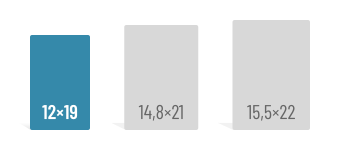
SP_illu_buchformate_01

Format: 12 x 19 cm

ideal for: fiction novels

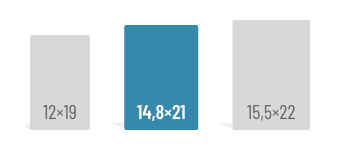
SP_illu_buchformate_02

Format: 14.8 x 21 cm

ideal for: guide books and non-fiction books

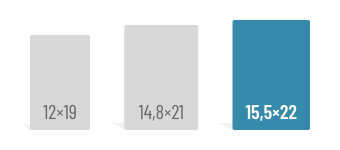
SP_illu_buchformate_03

Format: 15.5 x 22 cm

ideal for: children’s and youth books