Zum Warenkorb
Zum Warenkorb
Welcome to GRINspiration, the online magazine for self-publishers and aspiring authors! From academic papers to fantasy novels: here you'll find tips, tricks, and insights to help you successfully write and publish your work.
You are here: Magazine Got too many pages? Shorten your paper with these tips
All articles
Got too many pages? Shorten your paper with these tips, Wissen finden & publizieren, https://www.grin.com
19. March 2026 • Reading duration: 4 Min

Got too many pages? Shorten your paper with these tips

Realized you’ve written way too much? Don’t worry, we’ve got some tips to help you shorten your paper.

First things first:

  • Stick to your lecturer’s guidelines! If in doubt, ask again.
  • Be careful with changing the formatting—it can be tricky.
  • When cutting content, make sure your argument stays clear and consistent.
What to expect

Most assignments for term papers have a strict page or word count limit. However, you often have a little leeway, usually around 10% more or less than the required length. So, for a 15-page paper, you could go over or under by about one and a half pages. But it’s a good idea to check with your lecturer to see how strict they are about this.

The most important thing, though, is the quality of your paper. If you start cutting entire sections, it might weaken your argument. So be careful with what you choose to delete. That said, there are some small tweaks you can make to reduce your word count without losing substance. Here are some tips to help you shorten your paper.

Use shorter phrases

Start by looking for unnecessarily long phrases in your text. Phrases like “due to the fact that,” “at this point in time,” or “if one considers the following factor…” can often be shortened or cut entirely. Of course, these fillers can sometimes be useful or even essential for clarity, so only cut them if they’re really not needed. Once you go through your entire paper this way, you might be surprised how often you’ve used these phrases without realizing it. Plus, deleting them makes your writing more precise and easier to understand.

Cut transitions and repetitions

This tip goes hand in hand with the first one. Do you start a lot of sections with phrases like “The next point will analyze…” or “Building on this, we will now look at…”? These can often be cut without losing any meaning. Instead, just dive straight into your analysis.

Also, watch out for unnecessary repetitions. If you’ve already explained something earlier, there’s no need to repeat it. Go through your paper and weed out these redundancies.

Use abbreviations

Another way to shorten your paper is by using abbreviations. Look for phrases like “for example,” “respectively,” or “as the case may be,” and replace them with their common abbreviations. But first, check your assignment guidelines to see if abbreviations are allowed. If you create new abbreviations for terms you use frequently, consider adding an abbreviation list at the end of your paper. This list usually doesn’t count towards your total page or word count.

Font choice

Sometimes, the font is specified in the assignment guidelines. If you can choose between Arial and Times New Roman, go with Times New Roman. Arial takes up about a third more space than the same text in Times New Roman. This tip is useful if you’re trying to reduce pages rather than word count.

Be cautious with layout changes!

Adjusting the layout should be your last resort for shortening your paper. Reducing margins, decreasing line spacing, or using a smaller font size can make your paper look shorter, but these tricks are risky. Lecturers often notice these changes, which could lead to a lower grade. It’s usually better to focus on deleting content instead.

Narrowing down your topic

Finally, it’s important to carefully narrow down your topic before you start writing. Precise questioning helps you not to get out of hand and to remain precise. 

If you find yourself writing too much as you go along, it might help to revisit your outline. Consider whether you can combine two sections or cut out a subpoint.


Good luck with your next term paper!

Do you like our magazine?
Then sign up for our newsletter now!
Cover Plus

If you already have your own photo or design – or at least a very clear idea of what your book cover should look like – perfect! We’ll take care of the design process and send you several drafts to choose from.

Don’t have a cover idea yet, or would you like us to include your author photo on the back of the book? No problem at all. Based on your book’s description, we’ll search for suitable visual concepts and design your individual book cover – including your author photo on the cover – creative, professional, and tailored to your story.

Need some inspiration? Here are some of our finest covers:

Softcover or Hardcover

The choice is yours: decide between a classic softcover edition or a premium hardcover binding. We’ve summarized the key advantages and disadvantages for you:

Softcover

Hardcover

Production Costs

Lower than hardcover, allowing for a more attractive retail price

Higher production costs, which result in a higher retail price

Format

Lighter, fits more easily into your bag, and is more convenient on the go

Heavier and bulkier, therefore less suitable for travel or casual reading

Perceived Value

Feels less premium and is less eye-catching than a hardcover

Creates a high-quality impression, better suited as a gift or collector’s item; appears more prestigious

Durability

Corners bend more easily and the spine may break sooner

More durable cover, better shape retention, and improved protection for the pages

Layout check

We check your text for readability and printability (Are the margins sufficient for printing? Is the font size easy to read in print? Is the line spacing right? Is the resolution of the illustrations sufficient for good print quality?), embed the fonts if necessary and take care of automatic page numbers and a table of contents.

Publication as e-book and ISBN

With each publication, you will receive an ISBN number for your e-book and print book.

Worldwide distribution

With each publication, you will receive an ISBN number for your e-book and print book. We deliver your book to our worldwide distribution network: over 300 online shops.

Appealing blurb

We will write you a blurb that arouses curiosity and emotions – and convinces readers. Perfectly tailored to your genre and target audience.

Personal contact

Benefit from our many years of publishing experience: We support you with our know-how from upload to finished book. With us, you will get a personal contact person, we will guide you step by step through the entire process and are there for you.

Cover Service

Do you already have your own photo or motif or at least a very concrete idea of how you imagine your book cover? Perfect! We will take care of the creation and send you two to four drafts, from which you can choose one.

You don’t have a cover idea yet or would like us to include your author photo on the back of the book? No problem. For an extra charge of €50, our graphic designer will search for motifs and design your individual book cover including an author’s photo on the book cover – creatively, professionally and matching your story.

Need some inspiration? Check out some of our favorite covers!

Layout Deluxe

Your book, perfectly staged: With professional typography, stylish book typesetting and design templates that fit your project, we ensure an all-round coherent reading experience. Whether classic or individual – we design your book the way your story deserves it.

Fee overview

Each sale of your title will be remunerated according to the following table.

You will receive your royalties on top of the publisher's selling price.
The table has been valid since 17.04.2025, 12.30 p.m.

Fee on e-book sales

www.grin.com 50%

Amazon Kindle, iBook Store, Google Play, Ciando,

Pubbles, Libri, Genios, Other Distributors 30%

Fee on book sales

www.grin.com 50%
Book trade (BoD and Amazon Marketplace) 30%

The publisher's selling price is the sales price excluding the statutory value added tax as well as less trade discounts, production and shipping costs.

Free Word Templates

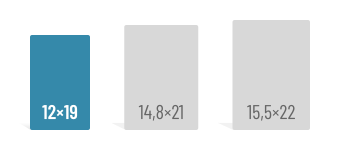
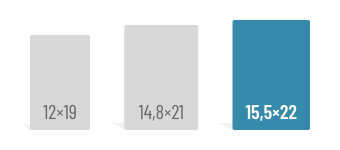
SP_illu_buchformate_01

Format: 12 x 19 cm

ideal for: fiction novels

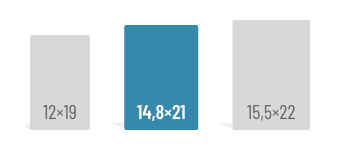
SP_illu_buchformate_02

Format: 14.8 x 21 cm

ideal for: guide books and non-fiction books

SP_illu_buchformate_03

Format: 15.5 x 22 cm

ideal for: children’s and youth books