First things first:
- Goodreads is the world’s largest social reading platform, with a strong focus on community.
- Readers use Goodreads to organize their reading, find inspiration, and exchange thoughts about books.
- For authors, Goodreads offers long-term visibility—but not quick marketing wins.
- Activity and authentic engagement matter more than advertising.
- Goodreads is especially worthwhile for international or English-speaking audiences.
Read, Review, Discover
Goodreads is one of the largest reading communities in the world. Millions of people use the platform to exchange views on books, manage virtual bookshelves, write reviews, or follow authors. For many readers, Goodreads is no longer just a database—it’s a key source of orientation and inspiration.
At the same time, many authors ask themselves: Is Goodreads really worth it as a platform? And if so, how do you use it strategically—without wasting time and energy? A clear, objective look at its features, opportunities, and limitations helps you put Goodreads into perspective.
What Is Goodreads?
Goodreads is an American social reading platform founded in 2007 by Otis Chandler and Elizabeth Khuri Chandler. Its goal was to connect readers through personal recommendations—true to the motto “Meet your next favorite book.”
Today, Goodreads is the world’s largest platform of its kind. Users can discover books, rate and review them, organize them in personal libraries, and connect with others to discuss their reading experiences. The platform is primarily English-language, but you can use your browser’s built-in translation features to read it in other languages.
Since 2013, Goodreads has been owned by Amazon. As a result, there are direct integrations with Amazon stores—for example, to purchase books or recommend them directly.
Goodreads from a Reader’s Perspective
For readers, Goodreads offers a wide range of features to organize and share their reading life.
At the core is the virtual bookshelf. Books can be marked as “currently reading,” “read,” or “to be read.” In addition, users can create custom labels to organize their books individually.
Another key feature is reading challenges. Readers set themselves an annual goal—such as a certain number of books to read—and track their progress. This adds motivation and makes reading habits visible.
Goodreads also works with personalized recommendations. However, these only become reliable once users have rated at least 20 books. Based on this data, Goodreads suggests titles that are highly likely to be read—a factor that’s also relevant for authors.
Through profiles, comments, and reviews, a social exchange emerges. Users can see what their friends are reading, how they rate books, and which titles are currently being discussed.
Goodreads for Authors: Visibility and Community Engagement
Goodreads is primarily a platform for readers—and that’s exactly where its potential for authors lies. Being present here means being visible where books are discovered, reviewed, and discussed. Goodreads doesn’t replace marketing, but it can help build a readership and establish trust over the long term.
What’s crucial here is having realistic expectations: Goodreads works slowly. It’s less about quick sales and more about long-term discoverability and meaningful exchange.
Why Goodreads Can Be Relevant for Authors
Author profiles on Goodreads are directly linked to their books: anyone searching for a specific title will automatically come across the corresponding author profile as well.
A well-maintained profile offers the opportunity to:
- introduce yourself to readers,
- offer insights into your writing process,
- and maintain long-term visibility—beyond individual publications.
Especially for authors whose books are available in English or who target an international audience, Goodreads can be a valuable part of their visibility strategy.
Registration and Participation in the Goodreads Author Program
To use Goodreads as an author, you first need to register for a standard account on Goodreads. You can then apply for the Goodreads Author Program, which is free of charge for self-published authors.
The process itself is generally straightforward:
- First, you search for your book on Goodreads.
- Below the book title, you’ll find the author’s name:
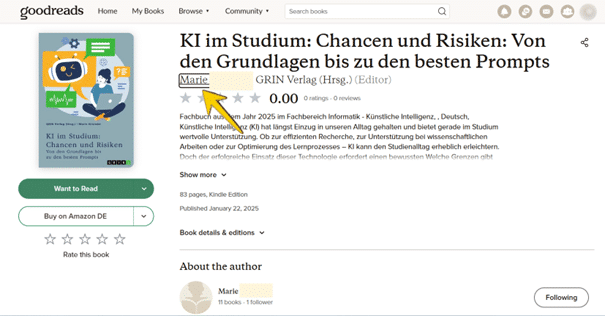
- Via the note “Is this you? Let us know you can claim the profile as the author.
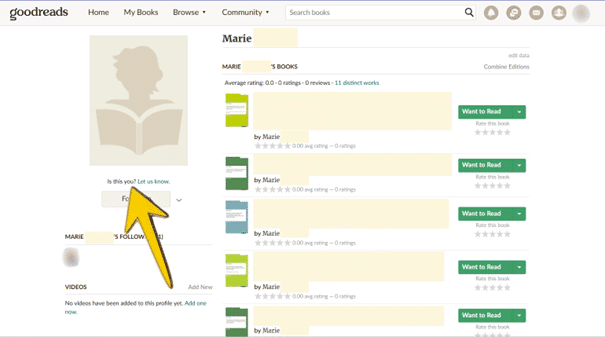
You’ll then be shown a form that you need to complete in order to be recognized as an author.


If your book isn’t listed on Goodreads yet, you can add it manually. After applying, you’ll receive confirmation that your member profile has been converted into—or expanded into—an author profile.
Setting Up and Maintaining Your Author Profile
After approval, you can start shaping your author profile. In addition to a short bio, you can add various types of content, including:
- quotes
- blog posts
- event announcements
- reading samples
- polls or personal updates
A profile feels especially trustworthy when it’s updated regularly. This doesn’t mean posting constantly—it means keeping your information current and occasionally sharing insights.
Important to note: Goodreads is not a traditional social media platform. Less is often more here.
Stephen King is a well-known author and a good example of what a strong Goodreads profile can look like:

Engaging with Readers: Using the Platform’s Features Effectively
Goodreads offers various ways to interact with readers. One of the best-known features is “Ask the Author,” which allows readers to submit questions. Authors decide for themselves whether—and when—they want to respond.
In addition, authors can:
- take part in group discussions,
- comment on posts,
- or keep readers informed about news and updates through author posts.
What matters most is your approach: Goodreads works best when authors engage as part of the community—not as purely promotional voices.
Marketing Options on Goodreads
Goodreads offers several tools to increase a book’s visibility. One of the most common options is giveaways, where copies of a book are raffled off to readers.
The platform handles the selection of winners. Experience shows that many winners go on to write a review afterward—but there’s no guarantee. . Giveaways require careful planning, as shipping costs and organizational effort need to be taken into account.
Beyond that, authors can take part in discussions, request reviews in groups, or strategically develop their profiles. Paid ads are also available, but they work on a cost-per-click basis and require a dedicated budget.
Common Pitfalls to Watch Out For
As large as Goodreads’ reach may be, the platform also has its downsides. Negative reviews are part of the ecosystem and should not be publicly commented on or challenged. Doing so can quickly appear unprofessional and may deter potential readers. It’s far more effective to evaluate criticism internally and use it constructively.
Equally problematic is pushy behavior: sending random friend requests, direct outreach, or aggressive self-promotion is often perceived as spam. Goodreads is first and foremost a community for readers—not a pure marketing channel.
There’s also ongoing criticism around issues such as review bombing, premature ratings before publication, and moderation that can feel inconsistent or unclear. It’s worth being aware of these factors so you can keep your expectations realistic.
Conclusion: Who Is Goodreads Worth It For?
Goodreads is a powerful platform—but it’s not automatically the right fit for every author or every book. It’s particularly well suited to authors whose target audience is international or English-speaking, or who are aiming to build visibility over the long term.
Anyone who chooses to use Goodreads should be prepared to invest time, get to know the platform, and engage consciously as part of a reading community. When approached this way, Goodreads can become a place where books are discovered, discussed, and recommended—not through noise, but through presence.
This decision worksheet helps you determine whether—and which—reading platform makes sense for you as an author: Goodreads, LovelyBooks, both—or neither.
Frequently Asked Questions About Goodreads (FAQ)
Goodreads is an international social reading platform where readers discover, rate, and organize books. Users maintain digital bookshelves, write reviews, and exchange views about what they’re reading. For authors, Goodreads primarily serves as a tool for visibility and long-term presence.
Goodreads can be worthwhile for authors who are looking to build reach over the long term. The platform is especially relevant for English-language or internationally published books. While Goodreads doesn’t replace traditional marketing, it can support a book’s discoverability.
Using Goodreads is generally free of charge. The Goodreads Author Program is also free for self-published authors. Costs only arise from optional activities such as giveaways or paid advertising.
Authors first register with a standard Goodreads account. They can then apply to the Goodreads Author Program to be verified as an author and link their profile to their books. Once approved, they can edit their profile information and add content.
Goodreads isn’t a direct sales channel. However, it can help books get discovered, reviewed, and recommended. Any impact on sales is usually indirect and long-term—driven by visibility and trust.



Do you like our magazine? Then sign up for our GRIN newsletter now!