What to expect:
Why typesetting is so important
Many authors invest a lot of effort in editing, proofreading, and designing a strong cover. However, the interior layout is often neglected—even though this is exactly where the professional perception of your work is shaped.
Typesetting guides the reader’s eye, structures the text, and ensures that readers can immerse themselves effortlessly in your story or subject matter. If the layout is inconsistent, the typography uneven, or the page structure clumsy, a book quickly appears amateurish—regardless of the quality of its content.
This is especially relevant in selfpublishing: reviews rarely criticize the plot or argument first, but often mention “messy formatting” or “hard-to-read layout.”. Book designers like Beate Sinn see every day the impact a well-typeset book can have. With the right layout, you create a reading experience that looks professional, feels cohesive—and truly supports your text.
What typesetting includes—and why typography is more than decoration
Typesetting begins where your manuscript becomes a book. It transforms plain text into a structured, print-ready layout: with clear paragraphs, consistent page breaks, clean typography, and a harmonious page design.
The goal is simple: readers should not stumble over formatting errors, but stay fully engaged with the content.
This involves several layers. The typographic foundation determines how your text is perceived—from font choice to line length, spacing, and emphasis. A balanced layout stabilizes the reading flow and ensures that your book is not only read, but experienced.
At the same time, typesetting also includes technical aspects such as page format, positioning of images or tables, and the structure of the table of contents.
A brief look back: how typesetting began
The term “typesetting” originates from a time when texts were assembled from individual metal letters. Until well into the 20th century, books were created by hand: each line was physically set, each page manually prepared.
The invention of movable type by Johannes Gutenberg in the 15th century revolutionized this process and made books available in larger quantities for the first time.
Even though everything is digital today, the core remains the same: typesetting is the art of arranging text so that it is readable, clear, and aesthetically pleasing. The tools have evolved—but the demand for precision and typographic sensitivity has not.
How a book is structured: an overview of the front matter
Before the main text begins, every book follows a classic structure. This section is called the front matter and follows established conventions that provide orientation for readers—and are essential for typesetting.
The main text always begins on a right-hand page. The distinction between right and left pages, as well as the correct sequence, is particularly important.
Elements of the front matter:
- Half title (right page):
Opens the book block. Usually includes the title and author’s name.
- Back of the half title (left page):
Optional—can include a short description, biography, or an illustration (frontispiece).
- Title page (right page):
The most representative page with title, subtitle, author name, publisher, and possibly genre.
- Imprint (left page):
Mandatory information such as copyright, ISBN, publication year, and possibly printing details or original edition notes.
- Dedication, quote, or table of contents (right page):
Optional—but often used to introduce the text.
In many books, pagination starts only from page 5. The main text always begins on a right-hand page so readers can immediately feel “inside” the book.
This structure is a central part of typesetting because it defines the framework for the entire book block—from reading flow to page harmony and production.
Preparing your manuscript for typesetting
Before typesetting begins, your manuscript needs a solid foundation. This is especially important in selfpublishing, where you are responsible for ensuring that the file can be processed cleanly. Editing and proofreading should be completed beforehand, so that no further content changes disrupt the layout.
A good basis is created by systematically cleaning up your document. Check the following:
- Typography and orthotypography
- Correct use of dashes (– instead of -)
- Consistent quotation marks
- Correct apostrophes
- Italics for foreign words or emphasis
- No mixed font sizes or styles
- Formatting and structure
- Remove unnecessary blank lines
- Delete manual page and line breaks
- Avoid tabs or spaces for indentation
- Start each chapter on a new page
- Ensure consistent paragraph structure
- Text organization
- No embedded links or unnecessary references
- Clean up hyphenation
- Clearly mark and correctly place images or tables
- Display formatting marks to detect errors faster
The cleaner your preparation, the more efficient the typesetting process—whether you do it yourself or hire a professional. Many selfpublishers underestimate this step and lose time in unnecessary revision loops. A well-prepared file saves time, budget, and effort—and lays the foundation for a truly professional layout.
Doing typesetting yourself or hiring a professional?
In selfpublishing, you can decide whether to handle typesetting yourself or work with a professional. Both options are viable—the key question is how confident you are with layout, typography, and the technical requirements of a print-ready PDF.
Working with our three free GRIN templates
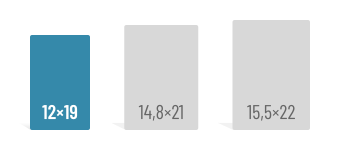
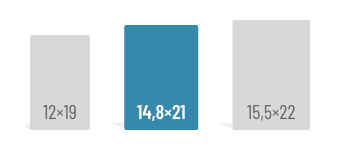
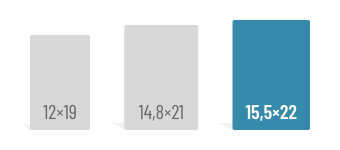
Many authors start with templates because they offer a quick and structured entry point. That’s why GRIN provides three free Word templates that you can download and fill with your text. Each format is tailored to different genres:
- 12 × 19 cm – ideal for fiction, novels, and novellas
- 14.8 × 21 cm (A5) – the classic format for non-fiction and guides
- 15.5 × 22 cm – more space for children’s, young adult, or illustrated books
These templates handle the essential basics for you: margins, line spacing, font sizes, pagination, and chapter starts. This gives you a reliable foundation without requiring deep expertise in layout software.
Professional tools like Adobe InDesign offer more design flexibility—but also require significantly more experience and time. Many selfpublishers quickly realize how detailed typesetting actually is: from baseline grids and microtypography to the harmonious design of front matter and clean chapter openings.
This is where a book designer like Beate Sinn can help. Professionals translate the atmosphere of your text into a consistent, high-quality layout and create a page design that clearly stands out from standard templates. Professional typesetting not only shapes the reading experience but also influences how your author brand is perceived—and can directly impact purchasing decisions.
Conclusion
Typesetting is one of the most underestimated aspects of selfpublishing—and at the same time one of the most impactful. A well-typeset book provides orientation, looks professional, and allows readers to stay fully immersed in the text.
. Poor typography, inconsistent pages, or chaotic formatting, on the other hand, distract readers and make a book appear less valuable than its content deserves.
With a carefully prepared manuscript, solid templates, or the right tools, you can lay the groundwork yourself. And if you want more creative freedom or prefer to avoid the detailed work, collaborating with experienced book designers can be worthwhile.
In the end, it’s about achieving a result that truly supports your story and makes the full potential of your work visible—inside and out.
Our expert statement
Those who rely on professional support for typesetting benefit not only from technical expertise but also from a trained eye for detail and design. Book designers like Beate Sinn work closely with authors to develop a layout that reflects the atmosphere of the text and gives it a distinct visual identity.
Beate Sinn describes her approach as follows:
Individual book design for strong stories
I create individual book layouts and professional typesetting for selfpublishing authors, showcasing the passion behind their manuscripts. With my many years of experience as a graphic designer, I turn every text into a high-quality book that people enjoy holding—and that stands out from the crowd. From the initial idea to the final print-ready files, I work closely and personally with my clients.
My goal: books that are not only read, but felt. Together, we turn your manuscript into a real book that deserves its place in the market.
Because your book is worth it.
Beate Sinn, book design and professional typesetting, www.sinndesign.me
Frequently asked questions
FAQ: Autor:in werden
Typesetting is the interior design of your book: fonts, paragraphs, page layout, and structure. It ensures that your text looks professional and is easy to read.
Yes. Templates or writing software make it easy to get started. For more complex layouts, you’ll need tools like Adobe InDesign—or you can work with a professional.
Complete editing, clean up formatting, use consistent typography, remove manual breaks, and structure paragraphs clearly.
Fiction: 12 × 19 cm
Non-fiction: 14.8 × 21 cm (A5)
Children’s and young adult books: 15.5 × 22 cm
GRIN provides free Word templates for all of these formats.
If you want a custom, high-quality layout or prefer to avoid the detailed work. Professionals ensure a cohesive, market-ready overall design.
For a comparison of the best self-publishing providers, feel free to check out Beate Sinn at sinndesign.me.
You might also be interested in these articles:


Do you like our magazine? Then sign up for our GRIN newsletter now!