First things first:
- Use a journal as a central place to collect your ideas and sort through them during the writing process.
- Writing can sometimes feel endless. A journal helps make your progress visible.
- Cannot decide which kind of journal to keep? Simply combine two approaches.
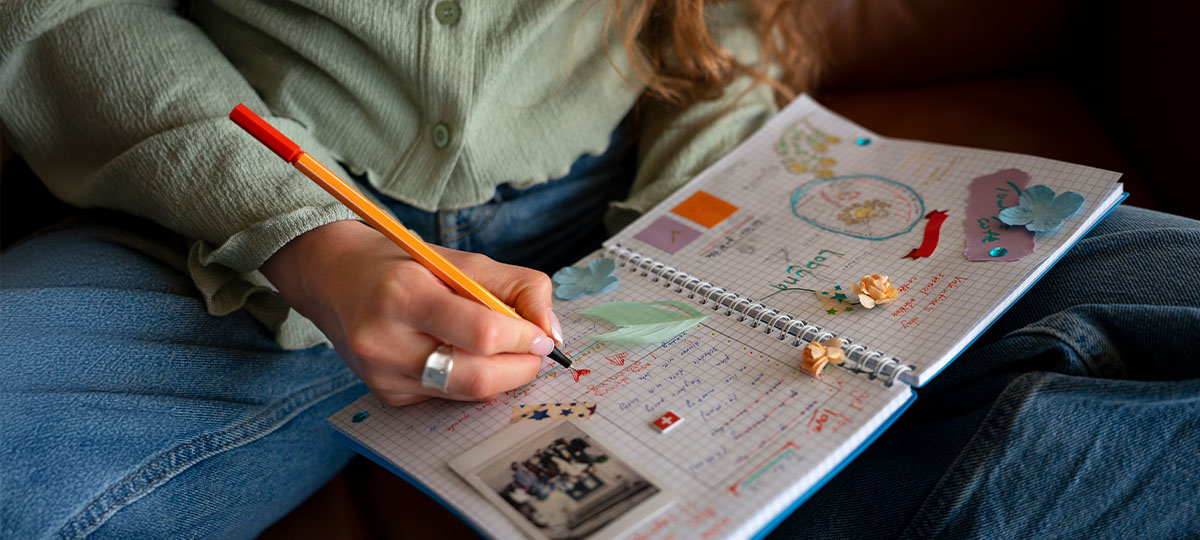
Writing your own book can be a long and demanding process. Along the way, it is easy to lose motivation or your sense of direction. Journaling can help you stay organized and keep going.
The Idea Journal
Many authors know this feeling: the best ideas rarely come while sitting at a desk. Instead, they seem to appear out of nowhere, when you are on the go or busy with something completely different. But when you return to your story later, many of those spontaneous thoughts have already slipped away.
To avoid that, an idea journal can be incredibly useful. Keep one with you wherever you go so you can write down inspiration whenever it strikes. You can also use it to collect sketches or notes on your characters. Before you sit down to continue working on your manuscript, simply look through your journal and revisit the ideas that might help you move forward.
The Writing Progress Journal
During the writing process, it can be hard to see how much you have actually achieved. At times, it may feel as though you have made no progress for days or even weeks, even though you may have spent that time refining scenes, developing character dynamics, proofreading, or building your world. That is exactly where a writing progress journal can help.
At regular intervals, write down what you have done to move your project forward. It does not matter whether you do this daily, weekly, or only once a month. Choose a rhythm that fits both you and your writing process. What matters most is that you regularly remind yourself of what you have already accomplished, even if it is something as small as creating a character profile to keep your story consistent.
Seeing that you have not actually achieved “nothing” can make a real difference and help you stay motivated throughout the rest of the writing process.
The Hybrid Approach
Would you like to collect ideas and track your progress at the same time? No problem. You can absolutely use two separate notebooks in parallel, one for ideas and one for progress. Another option is to combine both in a single journal, for example by pairing your writing updates with sketches or planning notes. This kind of journal can be structured entirely around your own needs. You might divide it into sections such as idea collection, planning, worldbuilding, character profiles, sketches, and writing progress. That way, your journal becomes a personalized tool for organizing your entire writing project.
No matter which method you choose, enjoyment should always come first. Try not to be too perfectionistic about how your journal looks. Its purpose is to support your writing process, not to add more pressure. You are also completely free when it comes to format: whether you prefer a traditional journal with pen and paper or a digital version is entirely up to you.
Find out which journaling system works best for your writing process: our reflection worksheet can help you gain clarity and develop a structure that suits you.
👉 Reflection Worksheet: Find Your Ideal Journaling System as an Author
Whichever method you choose, GRIN wishes you lots of joy with your journal and every success in your writing process.
Sources:
Do you like our magazine? Then sign up for our GRIN newsletter now!