What to expect:
First things first:
- Children’s books are categorized by thematic and age-specific target groups
- Using simpler language does not mean that children’s books are easier to write
- “Show, don’t tell” applies to children’s books as well
Children’s books can shape, comfort, empower, and inspire. However, achieving this requires far more than just a nice idea. What truly matters are a clearly defined target audience, age-appropriate language, compelling characters, relevant themes, and a coherent overall concept—especially in selfpublishing, where authors make many decisions themselves.
The first strategic step: Which age group are you writing for?
Anyone planning a children’s book should not start with the plot, but with the target audience. The age of the readers influences almost every creative and production-related decision: theme, language, text length, narrative style, proportion of illustrations, format, and marketing.
In the children’s book market, general age categories have been established to provide guidance:
In the children’s book market, general age categories have been established to provide guidance:
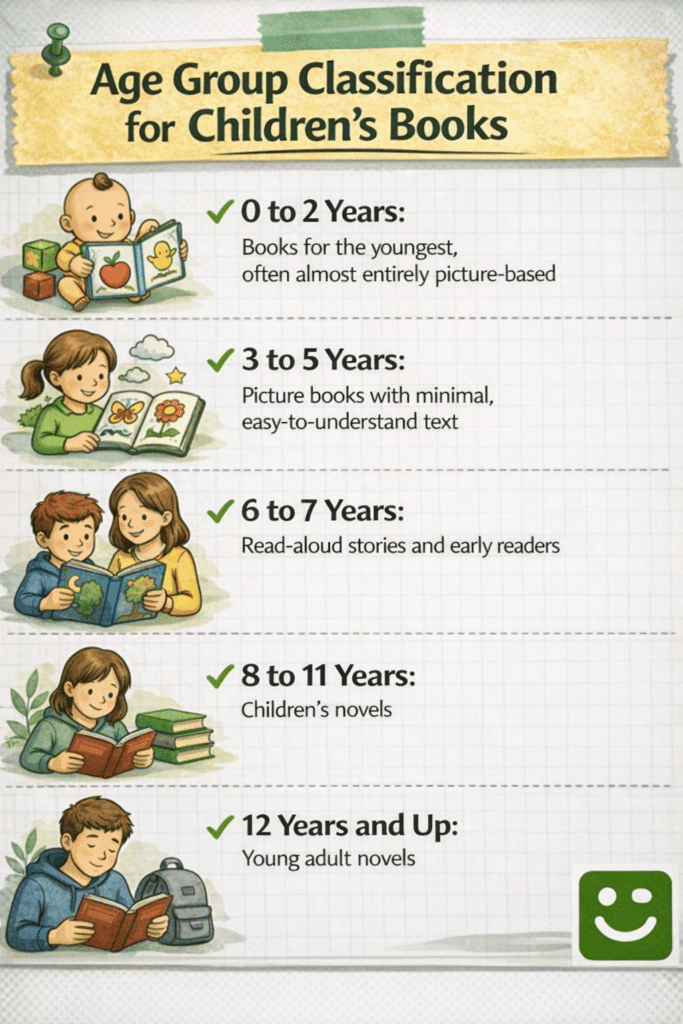
This classification is not a rigid rule, but an important industry standard. For self-publishers in particular, it is highly relevant, as it impacts discoverability, positioning, and purchasing decisions. A clearly categorized book appears more marketable than a project whose target audience is not immediately recognizable.
Children’s books require age-appropriate language
One of the most common mistakes when writing for young readers is using language that does not match the target audience. Children’s books are not successful because they are simply written, but because they are precisely tailored to the linguistic abilities and interests of their readers.
For younger children, this means short sentences, clear terms, and simple structures. Rhymes, repetition, onomatopoeia, and creative wordplay work particularly well. They create rhythm, add enjoyment, and support comprehension.
As readers grow older, the language can become more nuanced. Early reader books must still remain especially clear, as children at this stage often read slowly and with high concentration. Every line needs to carry meaning. Children’s novels from around age eight can be slightly more complex, but usually avoid convoluted sentence structures and unnecessarily difficult vocabulary.
Young adult novels, on the other hand, are much closer in style and scope to adult literature. Here, authors have significantly more linguistic freedom. Still, tone, perspective, and subject matter must remain authentic and relatable to the target audience’s lived experience.
Themes, tone, and characters: What truly resonates with children
Children’s books are aligned with the developmental stages of their readers. There is no single “right” topic, but rather different thematic focuses depending on age group.
Younger children are often interested in familiar everyday situations: going to bed, emotions, family, kindergarten, animals, or small social conflicts. Later, themes such as friendship, school, adventure, independence, and imagination become more prominent. In young adult books, topics expand to include identity, first love, belonging, future concerns, and societal conflicts.
What matters is not only what is told, but how. Even challenging topics such as fear, illness, loss, or separation can work in children’s books—provided they are presented in an age-appropriate way. Children must be taken seriously on an emotional level without being lectured. Educational messages can be present, but should never feel moralizing.
A similar principle applies to characters: children particularly enjoy reading about protagonists who are slightly ahead of them—usually one to two years older than the target audience. This creates both identification and orientation. Animals also play a major role in children’s books, whether as anthropomorphic protagonists, companions, helpers, or fantastical beings.
How long should a children’s book be?
The length of a book is closely tied to the target audience. While books for very young children often consist of just a few pages with minimal text, both text volume and complexity increase significantly with reading age.
As a rough guideline:

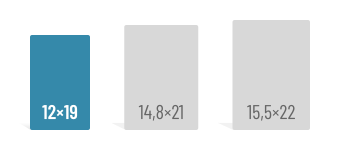
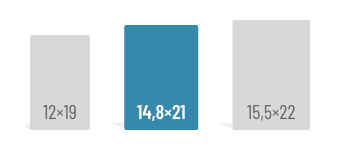
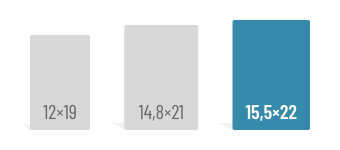
Picture books in particular are highly demanding despite their brevity. Telling a complete story across just a few double-page spreads requires focus, linguistic discipline, and a strong sense of rhythm. In selfpublishing, length and format are also economically relevant—for example in terms of printing costs, layout, and illustration effort.
Illustrations are not an add-on, but part of the concept
The younger the target audience, the more important the visual layer becomes. Illustrations convey mood, orientation, humor, and narrative. They do not merely support the text—they often actively tell the story.
For selfpublishers, this means that visual language must be planned just as strategically as the content. Style, color palette, and complexity of illustrations should match the target age group. For younger children, images must be clear and emotionally accessible. For older readers, illustrations gradually become less important or disappear entirely.
If you are not illustrating yourself, you should collaborate professionally with illustrators. In children’s books, visual quality is often a decisive factor in whether a title is perceived as high-quality.
Tension comes from structure, not coincidence
Children’s books also require a solid narrative structure. A particularly effective model is a clear, classic structure: a character has a problem, attempts to solve it several times, initially fails, and ultimately finds their own solution. This provides orientation and allows young readers to engage emotionally.
Picture books and read-aloud stories are often more episodic in structure. Chapters or sections should feel self-contained so they can be read aloud easily. Children’s novels and young adult books can be more complex, but still benefit from clear narrative arcs and well-placed turning points.
Complex time jumps, frequent flashbacks, or shifting narrative perspectives are generally less suitable for younger audiences. Children’s books tend to work best when they remain narratively focused.
Writing vividly: Why “show, don’t tell” matters in children’s books
Engaging children’s literature emerges when stories are not just explained but experienced. Scene-based writing is therefore essential. Instead of abstractly naming emotions or conflicts, they should be made visible through action, dialogue, and sensory detail.
Children respond strongly to concrete imagery. They don’t just want to be told that a character is afraid—they want to feel how cold the forest is, how dark the trees seem, or how shaky a voice sounds. Strong children’s literature therefore relies on clear, evocative details and imagery that sparks imagination without overwhelming.
This also applies to dialogue. Here, reduction is often the better strategy. Children do not need long, explanatory conversations. Short, precise sentences tend to feel more natural and impactful. What matters is not how much characters say, but the effect of what they say.
Selfpublishing: Why metadata is especially important for children’s books
In selfpublishing, the work does not end with the final sentence. Market positioning is a critical success factor—especially for children’s books. Cover, subtitle, blurb, short description, and categorization must immediately communicate who the book is for and what readers can expect.
Children’s books are usually not purchased by children themselves, but by parents, grandparents, or other caregivers. These decision-makers often determine within seconds whether a title feels relevant. A strong cover instantly signals age group, genre, and tone. The blurb should also be tailored to the target audience: clear, concise, and value-driven.
In selfpublishing, authors carry full responsibility for these aspects. It is therefore essential to think not only creatively, but strategically.
Conclusion: A good children’s book is precise, not arbitrary
Writing a children’s book does not mean writing more simply—it means writing more deliberately. Strong children’s books are clearly conceptualized, well-structured, and consistently aligned with their target audience. They take children seriously without overwhelming them. They entertain without being superficial. And they create images, characters, and stories that resonate far beyond the reading experience.
For selfpublishers, this represents a significant opportunity: those who develop their concept professionally, understand their target audience, and approach content, design, and marketing as a unified strategy can successfully position a compelling children’s book—even in a competitive market.
Not sure if you’ve planned your children’s book effectively and tailored it to the right age group? Is your project market-ready? Then take a look at our free checklist, download it, and be fully prepared:
> Publishing a Children’s Book
Have fun!
Sources:
- https://www.die-schreibtrainerin.de/kinderbuch-schreiben/
- https://www.novumverlag.com/autoren-ratgeber/detail/schreiben-fuer-kinder-und-jugendliche-ein-kinderspiel.html
FAQ:
FAQ: Autor:in werden
Always age-defined. Age determines language, length, theme, design, and marketing.
Age-appropriate, clear, and precise—not “simple,” but tailored to the audience’s understanding.
Topics rooted in children’s lived reality (e.g., emotions, friendship, identity), adapted to their developmental stage.
A central one—they are part of the storytelling and crucial for comprehension, emotional impact, and purchasing decisions.
Clear positioning: target audience, cover, metadata, and concept must be immediately understandable and market-ready.



Do you like our magazine? Then sign up for our GRIN newsletter now!