Zum Warenkorb
Zum Warenkorb
Welcome to GRINspiration, the online magazine for self-publishers and aspiring authors! From academic papers to fantasy novels: here you'll find tips, tricks, and insights to help you successfully write and publish your work.
You are here: Magazine Journaling Instead of Note Chaos: How Authors Organize Their Inspiration
All articles
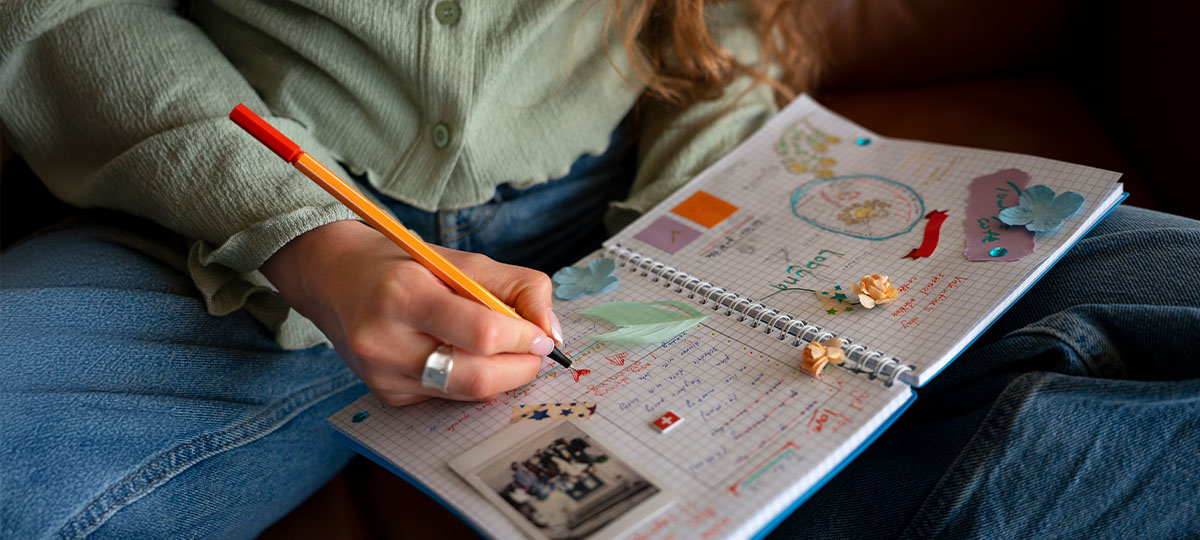
Journaling Instead of Note Chaos: How Authors Organize Their Inspiration, Wissen finden & publizieren, https://www.grin.com
18. February 2026 • Reading duration: 3 Min

Journaling Instead of Note Chaos: How Authors Organize Their Inspiration

Are you writing your own book and thinking about keeping a journal of your writing process along the way? Then you are in exactly the right place. We have gathered the key information for you here.

What to expect:

First things first:

  • Use a journal as a central place to collect your ideas and sort through them during the writing process.
  • Writing can sometimes feel endless. A journal helps make your progress visible.
  • Cannot decide which kind of journal to keep? Simply combine two approaches.

Writing your own book can be a long and demanding process. Along the way, it is easy to lose motivation or your sense of direction. Journaling can help you stay organized and keep going.

The Idea Journal

Many authors know this feeling: the best ideas rarely come while sitting at a desk. Instead, they seem to appear out of nowhere, when you are on the go or busy with something completely different. But when you return to your story later, many of those spontaneous thoughts have already slipped away.

To avoid that, an idea journal can be incredibly useful. Keep one with you wherever you go so you can write down inspiration whenever it strikes. You can also use it to collect sketches or notes on your characters. Before you sit down to continue working on your manuscript, simply look through your journal and revisit the ideas that might help you move forward.

Journaling Instead of Note Chaos: How Authors Organize Their Inspiration, Wissen finden & publizieren, https://www.grin.com

The Writing Progress Journal

During the writing process, it can be hard to see how much you have actually achieved. At times, it may feel as though you have made no progress for days or even weeks, even though you may have spent that time refining scenes, developing character dynamics, proofreading, or building your world. That is exactly where a writing progress journal can help.

At regular intervals, write down what you have done to move your project forward. It does not matter whether you do this daily, weekly, or only once a month. Choose a rhythm that fits both you and your writing process. What matters most is that you regularly remind yourself of what you have already accomplished, even if it is something as small as creating a character profile to keep your story consistent.

Seeing that you have not actually achieved “nothing” can make a real difference and help you stay motivated throughout the rest of the writing process.

Journaling Instead of Note Chaos: How Authors Organize Their Inspiration, Wissen finden & publizieren, https://www.grin.com

The Hybrid Approach

Would you like to collect ideas and track your progress at the same time? No problem. You can absolutely use two separate notebooks in parallel, one for ideas and one for progress. Another option is to combine both in a single journal, for example by pairing your writing updates with sketches or planning notes. This kind of journal can be structured entirely around your own needs. You might divide it into sections such as idea collection, planning, worldbuilding, character profiles, sketches, and writing progress. That way, your journal becomes a personalized tool for organizing your entire writing project.

Journaling Instead of Note Chaos: How Authors Organize Their Inspiration, Wissen finden & publizieren, https://www.grin.com

No matter which method you choose, enjoyment should always come first. Try not to be too perfectionistic about how your journal looks. Its purpose is to support your writing process, not to add more pressure. You are also completely free when it comes to format: whether you prefer a traditional journal with pen and paper or a digital version is entirely up to you.

Find out which journaling system works best for your writing process: our reflection worksheet can help you gain clarity and develop a structure that suits you.

👉 Reflection Worksheet: Find Your Ideal Journaling System as an Author

Whichever method you choose, GRIN wishes you lots of joy with your journal and every success in your writing process.

Do you like our magazine? Then sign up for our GRIN newsletter now!

All articles Back to beginning

Cover Plus

If you already have your own photo or design – or at least a very clear idea of what your book cover should look like – perfect! We’ll take care of the design process and send you several drafts to choose from.

Don’t have a cover idea yet, or would you like us to include your author photo on the back of the book? No problem at all. Based on your book’s description, we’ll search for suitable visual concepts and design your individual book cover – including your author photo on the cover – creative, professional, and tailored to your story.

Need some inspiration? Here are some of our finest covers:

Softcover or Hardcover

The choice is yours: decide between a classic softcover edition or a premium hardcover binding. We’ve summarized the key advantages and disadvantages for you:

Softcover

Hardcover

Production Costs

Lower than hardcover, allowing for a more attractive retail price

Higher production costs, which result in a higher retail price

Format

Lighter, fits more easily into your bag, and is more convenient on the go

Heavier and bulkier, therefore less suitable for travel or casual reading

Perceived Value

Feels less premium and is less eye-catching than a hardcover

Creates a high-quality impression, better suited as a gift or collector’s item; appears more prestigious

Durability

Corners bend more easily and the spine may break sooner

More durable cover, better shape retention, and improved protection for the pages

Layout check

We check your text for readability and printability (Are the margins sufficient for printing? Is the font size easy to read in print? Is the line spacing right? Is the resolution of the illustrations sufficient for good print quality?), embed the fonts if necessary and take care of automatic page numbers and a table of contents.

Publication as e-book and ISBN

With each publication, you will receive an ISBN number for your e-book and print book.

Worldwide distribution

With each publication, you will receive an ISBN number for your e-book and print book. We deliver your book to our worldwide distribution network: over 300 online shops.

Appealing blurb

We will write you a blurb that arouses curiosity and emotions – and convinces readers. Perfectly tailored to your genre and target audience.

Personal contact

Benefit from our many years of publishing experience: We support you with our know-how from upload to finished book. With us, you will get a personal contact person, we will guide you step by step through the entire process and are there for you.

Layout Deluxe

Your book, perfectly staged: With professional typography, stylish book typesetting and design templates that fit your project, we ensure an all-round coherent reading experience. Whether classic or individual – we design your book the way your story deserves it.

Cover Service

Do you already have your own photo or motif or at least a very concrete idea of how you imagine your book cover? Perfect! We will take care of the creation and send you two to four drafts, from which you can choose one.

You don’t have a cover idea yet or would like us to include your author photo on the back of the book? No problem. For an extra charge of €50, our graphic designer will search for motifs and design your individual book cover including an author’s photo on the book cover – creatively, professionally and matching your story.

Need some inspiration? Check out some of our favorite covers!

Fee overview

Each sale of your title will be remunerated according to the following table.

You will receive your royalties on top of the publisher's selling price.
The table has been valid since 17.04.2025, 12.30 p.m.

Fee on e-book sales

www.grin.com 50%

Amazon Kindle, iBook Store, Google Play, Ciando,

Pubbles, Libri, Genios, Other Distributors 30%

Fee on book sales

www.grin.com 50%
Book trade (BoD and Amazon Marketplace) 30%

The publisher's selling price is the sales price excluding the statutory value added tax as well as less trade discounts, production and shipping costs.

Free Word Templates

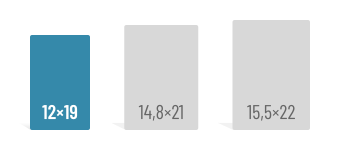
SP_illu_buchformate_01

Format: 12 x 19 cm

ideal for: fiction novels

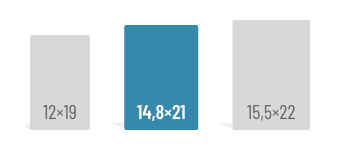
SP_illu_buchformate_02

Format: 14.8 x 21 cm

ideal for: guide books and non-fiction books

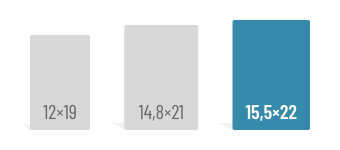
SP_illu_buchformate_03

Format: 15.5 x 22 cm

ideal for: children’s and youth books