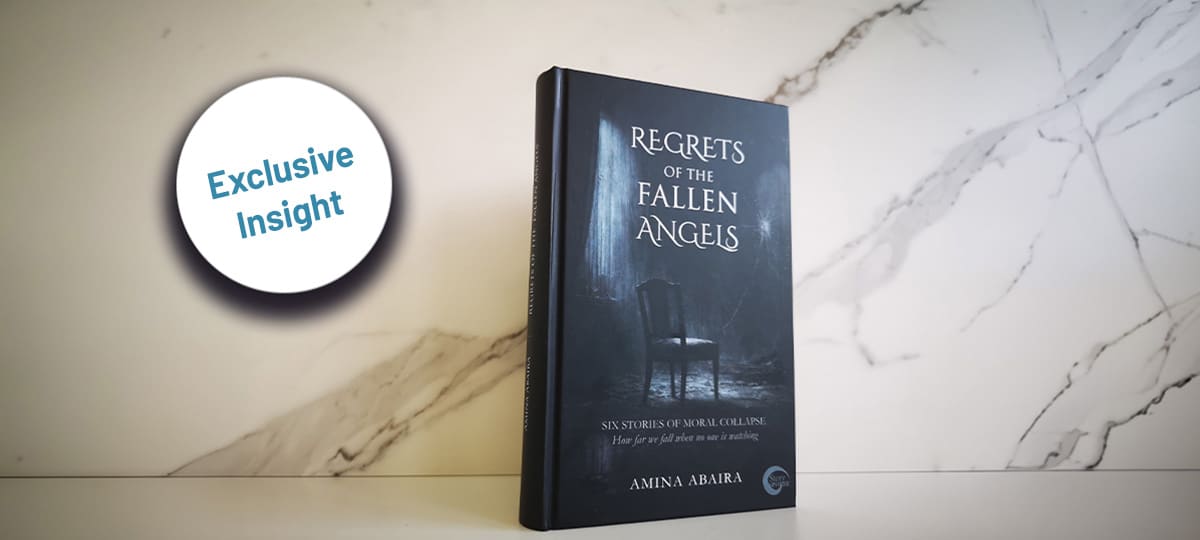
Between moral clarity and the darker depths of human nature, there is often only a very fine line — and that is exactly the line our author Amina Abaira explores consistently in her book Regrets of the Fallen Angels. In six powerful stories, she does not focus on the obvious, but on those quiet, unnoticed moments when decisions are made — far from the public eye, yet with far-reaching consequences.
Already in the foreword, she makes it clear that her book is not meant to comfort, but rather to confront readers with responsibility, inner conflict, and the consequences of wrong decisions in an unfiltered way.
In conversation with GRIN, she shares what inspired her to explore these themes, why she deliberately avoids classic heroic figures, and why her protagonists move through moral grey areas. She talks about the common thread that connects her stories, about guilt as a central motif, and about her aim to make emotions tangible through language in a direct and unembellished way.
GRIN: Your book ‘Regrets of the Fallen Angels’ deals intensely with moral decline and the darker sides of human nature. What was the initial impulse behind approaching this subject in literary form?
It feels as though all the moral values we are taught to uphold in childhood are somehow fading away. I am not saying they are completely gone, but the fact is that they are being neglected. It is a contrast between perfect, clean theory and bitter reality. I suppose that is the sad truth.
GRIN: The title refers to “fallen angels.” What inspired you to use this image, and what does it symbolize for you in the context of human decisions?
The fallen angel reflects the idea that even the purest being can become the worst version of itself. It represents the moment when the angelic side of a person begins to fade and gives way to their satanic side. This transformation starts with a small series of wrong decisions. Step by step, until the vision becomes completely blurred. At its core, it is about this inner conflict between light and darkness.
GRIN: In the foreword, you already announce that the book may feel “uncomfortable.” Was it your aim to provoke deliberately, or rather to encourage self-reflection?
It is a combination of both. It is meant to provoke the reader, spark their curiosity, and encourage them to give themselves a chance for self-reflection. I tried to put into context what to expect and what readers may be left with by the end of the book.
GRIN: You also write in your foreword that there are no heroes in this book. Why was it important to you to deliberately avoid classic figures of identification?
I deliberately wanted to distance myself from mythology. Heroes, wings, happy endings, and healing for every wound – you will not find that in Regrets of the Fallen Angels. It is rather the opposite: the characters are confronted with their own dark, hidden, and shameful side. They are not heroes — most of them, at least. They are simply people who have made wrong decisions or were forced to go through hardship because of someone else who also made the worst possible choices. The reason I emphasize the word decision so strongly is that, at the end of the day, we are the ones who make them.
They are real people acting according to their own raw human instinct. That is exactly what leads them to make mistakes and sometimes even causes catastrophes. But that is simply part of being human: to make mistakes and to learn from them.
Some victims knowingly put themselves in that position, while others were forced into it. Some villains acted consciously, while others had no choice but to become who they are. In between — precisely where everything begins to blur — vision is clouded, and judgment is often biased.
Amina Abaira
GRIN: Many of your stories take place in moments when no one is watching — in silence, in secrecy. What fascinates you about these unobserved moments?
Such decisions, and even actions, are very often made when no one is really watching. People tend to care about their public image. The main question is always: how will people judge me? It is rarely about whether something is fair or not, but rather about what others will think of me. We are more likely to take the attitude of our social environment into account than to truly decide whether what we are about to do is fair at all. But secrets, far from the public eye, give us a sense of safety. We are more likely to take the attitude of our social environment into account than to truly decide whether what we are about to do is fair at all. But secrets, far from the public eye, give us a sense of safety.
GRIN: Your characters often move through moral gray areas, where the lines between perpetrator and victim become blurred. What draws you to this kind of ambivalence?
Life makes it difficult to distinguish clearly between the two. Who is the victim, and who is the real villain? Can they always be separated so clearly in the first place? That is exactly what gave rise to this dilemma. Principles and moral values are relative. Whether we like it or not, we view things from different perspectives, and those perspectives are shaped by a wide range of factors. We look at the same situation very differently, and we judge it differently as well. What is acceptable to one person may be completely rejected by another. In the end, who decides what is what? Some victims knowingly put themselves in that position, while others were forced into it. Some villains acted consciously, while others had no choice but to become who they are. In between — precisely where everything begins to blur — vision is clouded, and judgment is often biased.
GRIN: A central motif in your book is the idea that people are responsible for their own decisions, regardless of external influences. What is your personal view on that?
I believe that our decisions are truly our own, no matter how much we try to create excuses or place the blame on a situation. At the end of the day, they still are — and always will be — our decisions. That is what it comes down to: being ready to take full responsibility for our actions instead of looking for someone else to blame.
I believe that our decisions are truly our own, no matter how much we try to create excuses or place the blame on a situation. At the end of the day, they still are — and always will be — our decisions.
Amina Abaira
GRIN: What did your creative process look like? Did the stories emerge independently from one another, or was there an overarching concept from the beginning?
The stories are separate, but there is a connecting thread. It is the regret that comes with such wrong turns in life. All the characters share at least one feeling: guilt. Even those who do not admit it or deny it — and sometimes even try to defend it — still carry it deep inside. That guilt, and the regret that comes with it, is something they all have in common.
GRIN: The language in your texts is very intense, at times almost ruthless. How do you find the balance between emotional closeness and the necessary distance while writing?
The language should fit the context and reflect the facts. That is why I tried to make it direct. No softening, no sugarcoating. Moments of regret and guilt are the most real ones. It is in those very moments that people let reality show through. exactly as it is. Their feelings are bare, and their thoughts become readable. That is what makes it direct and even harsh. I tried to speak in their place and express what they would truly have felt.
Their feelings are bare, and their thoughts become readable. That is what makes it direct and even harsh. I tried to speak in their place and express what they would truly have felt.
Amina Abaira
GRIN: Who did you write this book for? And what do you hope readers will specifically take away from it after finishing it?
It is for anyone who wants to pause for a moment and reconsider certain decisions or perhaps admit to certain mistakes. It is a chance to look at things again and to reassess certain conventions.
GRIN: How did you come to publish with GRIN as a self-publisher?
I came across the profile on Instagram and read some reviews, and that encouraged me to get in touch with GRIN.
GRIN: What advantages do you see in publishing with GRIN?
I love the fact that communication is very fast. The process is completely clear and well defined.
GRIN: And finally: are you already working on a new book project, or are the “fallen angels” still lingering?
I am already writing my next book. It will be a thriller.
GRIN: Ms. Abaira, thank you very much for taking the time. We wish you lots of joy with your book!



Do you like our magazine? Then sign up for our GRIN newsletter now!