Zum Warenkorb
Zum Warenkorb
Welcome to GRINspiration, the online magazine for self-publishers and aspiring authors! From academic papers to fantasy novels: here you'll find tips, tricks, and insights to help you successfully write and publish your work.
You are here: Magazine Writing a Nonfiction or Technical Book: Successfully Self-publish Your Expertise
All articles
13. May 2026 • Reading duration: 7 Min

Writing a Nonfiction or Technical Book: Successfully Self-publish Your Expertise

Do you have expert knowledge that truly helps others? A technical book in self-publishing could be the perfect way to go. Learn how to present your topic clearly, reach your audience, and make your expertise visible.

What to expect:

First things first:

  • Technical and nonfiction books in self-publishing allow you to publish your expertise independently.
  • Success relies on clear targeting of your audience.
  • Clarity is just as important as the technical quality of the content.
  • The general public and expert audiences require different types of content and levels of language.
  • Visibility is created through strategic positioning and professional marketing.

Why Technical Books Are Becoming More Relevant in Self-Publishing

Self-publishing is no longer just for novels or personal stories. Technical books, guides, and academic content are gaining importance. Many experts are now using self-publishing to make their knowledge visible, expand their reach, or position themselves as a brand.

Self-publishing offers great advantages, especially in specialized fields: you control the content, publication date, length, and target audience. Plus, you can publish niche topics that are often hard to place with traditional publishers.

A well-written technical text can generate sales, open doors to speaking opportunities, or even new career prospects.

Technical Book, Nonfiction, or Guidebook: What’s the Difference?

The terms “technical book,” “nonfiction,” and “guidebook” are often used interchangeably, but they differ in terms of audience, scope, and presentation.

Technical Book

A technical book usually targets people with prior knowledge. It is highly specialized, often academic or professional in nature, and uses technical terminology with little to no explanation. It typically presents new scientific findings, delves into specific topics, or provides expert analysis. Authors should possess solid expertise in the field.

Examples include textbooks and profession-specific books. You can also find some inspiration in our catalog.

The Discovery of the Cellular Sodium Pump in the 20th CenturyThe Discovery of the Cellular Sodium Pump in the 20th Century 18.99 €

EEG-Based Brain Network Biomarkers in Alzheimer's Disease ProgressionEEG-Based Brain Network Biomarkers in Alzheimer's Disease Progression 36.99 €

Trilogos Diploma Certificate 1 - Trilogos TrainerTrilogos Diploma Certificate 1 - Trilogos Trainer 39.99 €

Nonfiction

Nonfiction is aimed at a broader audience. It explains topics in a way that’s easy to understand, is often more narrative in structure, and has a lower entry barrier. Readers don’t need deep technical knowledge but want to read into a subject, understand the context, or gain new perspectives. Personal insights or opinion-driven sections may also appear in nonfiction books.

Examples of nonfiction include books like “Gut: The Inside Story of Our Body’s Most Underrated Organ” by Giulia Enders or “The Diet Compass” by Bas Kast. You can find even more examples in our catalog:

Trilogos Diploma Certificate 1 - Trilogos TrainerTrilogos Diploma Certificate 1 - Trilogos Trainer 39.99 €

The Sun - The Tool of GodThe Sun - The Tool of God 19.99 €

Guidebook

A guidebook is often targeted at readers without specific prior knowledge. It focuses on providing assistance, guidance, and actionable instructions. Topics often come from practical areas such as cooking, health, parenting, finances, or everyday life. The line between guidebooks and nonfiction is fluid.

Examples of guidebooks include parenting guides or gardening tips.

General Public or Expert Audience: Who Should Read Your Book?

Before you start writing, you should clearly define your target audience. Expert audiences and the general public have very different expectations in terms of language, depth, and structure.

Expert Audience

An expert audience already has prior knowledge and typically seeks in-depth information, new perspectives, or specific solutions. You must bring expertise to the table and can be more precise in your writing, using technical terms where appropriate.

Typical characteristics:

  • High prior knowledge
  • Industry-specific language
  • Interest in depth and detail
  • Expectation of solid sources and reasoning

Examples include:

  • Lawyers
  • Doctors
  • Scientists
  • IT professionals
  • Teachers or coaches specializing in specific fields

General Public

A general audience or laypeople is interested in the topic but doesn’t have deep technical knowledge. Here, clarity, simple examples, and an easy entry point are key.

Typical characteristics:

  • Interest in the topic
  • Limited prior knowledge
  • Desire for clear explanations
  • Emphasis on practical, real-world content

Examples include:

  • Students
  • Career starters
  • Interested non-specialists
  • Freelancers without formal training
  • People in continuing education


Effectively Communicating Complex Content

One of the biggest challenges with technical texts is making complicated subjects understandable without oversimplifying them.

Helpful approaches include:

Clear Language:

Short sentences and an understandable structure help readers grasp complex concepts more easily. Avoid unnecessary complex wording or excessive technical jargon.

Practical Examples:

Abstract theories become much more tangible when you incorporate real-world examples, case studies, or everyday situations.

Visual Aids:

Charts, graphs, checklists, and infoboxes make technical texts more engaging and easier to understand.

Chapter Structure:

A clear layout helps readers navigate the book. Useful elements include:

  • Subheadings
  • Summaries
  • Bullet points
  • Step-by-step guides
  • Highlighting key points

Why Positioning is Crucial for Technical Books

A technical book rarely sells on the strength of an exciting title alone. Readers usually search for specific solutions to problems.

You should ask yourself:

  • What problem does my book solve?

  • Who is it written for?

  • Why should people trust me?

  • What specific value does my content provide?

The clearer your positioning, the easier your marketing will be.

For example: Instead of writing broadly about “Marketing,” you could specialize in:

  • Marketing for Therapists
  • Instagram Marketing for Coaches
  • Content Marketing for Self-Publishers

Niches work especially well in the technical book space because they address clear needs.

How to Reach Your Target Audience

Even the best technical book needs visibility. In self-publishing, marketing is largely in your hands.

Leverage Existing Communities

Industry forums, LinkedIn groups, professional events, or social media communities are ideal places to directly engage your target audience.

Show Your Expertise

Articles, guest posts, podcasts, or short technical videos help build trust and demonstrate your competence.

Think SEO

Many readers search online for solutions. Therefore, your title, subtitle, and book description should include important keywords.

Build a Personal Brand

In the technical field, people often buy not just the book, but also the expertise behind it. A professional online presence helps you stay visible in the long term.

Focus on Quality Assurance

Professional editing and proofreading are essential to meet the high standards of a technical audience. A clean layout, correct source references, and a professional cover strengthen the credibility of your technical book.

Common Mistakes in Technical Books

Many technical texts fail not due to lack of knowledge, but poor execution. Avoid these mistakes:

  • Writing too complicated
  • Not defining a clear target audience
  • Lack of structure
  • Theory without practical application
  • Missing professional presentation

Technical Books profit from:

  • professional editing
  • clean layout
  • professional cover design
  • correct source citation

Conclusion: Your Knowledge Deserves Visibility

A technical book in self-publishing can be more than just a book project. It can make your expertise visible, expand your reach, and open up new career opportunities.

The key is not only your knowledge but also how you present it. If you understand your target audience, write clearly, and provide real value, you’re likely to succeed in reaching readers—even with specialized topics.

Frequently asked questions:

What’s the difference between a technical book and a nonfiction book?

A technical book is aimed at readers with prior knowledge, while a nonfiction book explains a topic more generally for a wider audience.

Who is the target audience for a technical text in self-publishing?

For authors who want to independently publish their in-depth knowledge, professional experience, or academic content.

What does “general public” mean?

A general audience is interested in a topic but does not have deep technical knowledge.
Why is clarity important for technical books?
Even complex topics need to be structured clearly so that readers can follow and apply them.
How do I reach my target audience?
Through clear positioning, relevant keywords, professional visibility, and targeted engagement in the right communities.

Why is clarity important for technical books?

Even complex topics need to be structured clearly so that readers can follow and apply them.

How do I reach my target audience?

Through clear positioning, relevant keywords, professional visibility, and targeted engagement in the right communities.

Do you like our magazine? Then sign up for our GRIN newsletter now!

Cover Plus

If you already have your own photo or design – or at least a very clear idea of what your book cover should look like – perfect! We’ll take care of the design process and send you several drafts to choose from.

Don’t have a cover idea yet, or would you like us to include your author photo on the back of the book? No problem at all. Based on your book’s description, we’ll search for suitable visual concepts and design your individual book cover – including your author photo on the cover – creative, professional, and tailored to your story.

Need some inspiration? Here are some of our finest covers:

Softcover or Hardcover

The choice is yours: decide between a classic softcover edition or a premium hardcover binding. We’ve summarized the key advantages and disadvantages for you:

Softcover

Hardcover

Production Costs

Lower than hardcover, allowing for a more attractive retail price

Higher production costs, which result in a higher retail price

Format

Lighter, fits more easily into your bag, and is more convenient on the go

Heavier and bulkier, therefore less suitable for travel or casual reading

Perceived Value

Feels less premium and is less eye-catching than a hardcover

Creates a high-quality impression, better suited as a gift or collector’s item; appears more prestigious

Durability

Corners bend more easily and the spine may break sooner

More durable cover, better shape retention, and improved protection for the pages

Layout check

We check your text for readability and printability (Are the margins sufficient for printing? Is the font size easy to read in print? Is the line spacing right? Is the resolution of the illustrations sufficient for good print quality?), embed the fonts if necessary and take care of automatic page numbers and a table of contents.

Publication as e-book and ISBN

With each publication, you will receive an ISBN number for your e-book and print book.

Worldwide distribution

With each publication, you will receive an ISBN number for your e-book and print book. We deliver your book to our worldwide distribution network: over 300 online shops.

Appealing blurb

We will write you a blurb that arouses curiosity and emotions – and convinces readers. Perfectly tailored to your genre and target audience.

Personal contact

Benefit from our many years of publishing experience: We support you with our know-how from upload to finished book. With us, you will get a personal contact person, we will guide you step by step through the entire process and are there for you.

Cover Service

Do you already have your own photo or motif or at least a very concrete idea of how you imagine your book cover? Perfect! We will take care of the creation and send you two to four drafts, from which you can choose one.

You don’t have a cover idea yet or would like us to include your author photo on the back of the book? No problem. For an extra charge of €50, our graphic designer will search for motifs and design your individual book cover including an author’s photo on the book cover – creatively, professionally and matching your story.

Need some inspiration? Check out some of our favorite covers!

Layout Deluxe

Your book, perfectly staged: With professional typography, stylish book typesetting and design templates that fit your project, we ensure an all-round coherent reading experience. Whether classic or individual – we design your book the way your story deserves it.

Fee overview

Each sale of your title will be remunerated according to the following table.

You will receive your royalties on top of the publisher's selling price.
The table has been valid since 17.04.2025, 12.30 p.m.

Fee on e-book sales

www.grin.com 50%

Amazon Kindle, iBook Store, Google Play, Ciando,

Pubbles, Libri, Genios, Other Distributors 30%

Fee on book sales

www.grin.com 50%
Book trade (BoD and Amazon Marketplace) 30%

The publisher's selling price is the sales price excluding the statutory value added tax as well as less trade discounts, production and shipping costs.

Free Word Templates

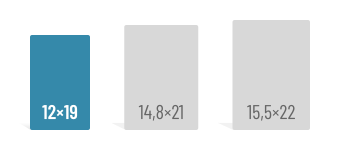
SP_illu_buchformate_01

Format: 12 x 19 cm

ideal for: fiction novels

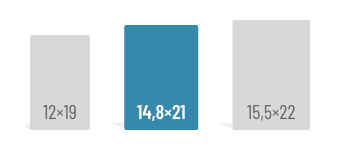
SP_illu_buchformate_02

Format: 14.8 x 21 cm

ideal for: guide books and non-fiction books

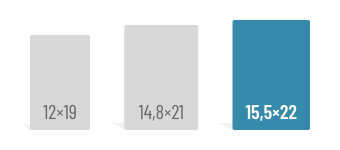
SP_illu_buchformate_03

Format: 15.5 x 22 cm

ideal for: children’s and youth books